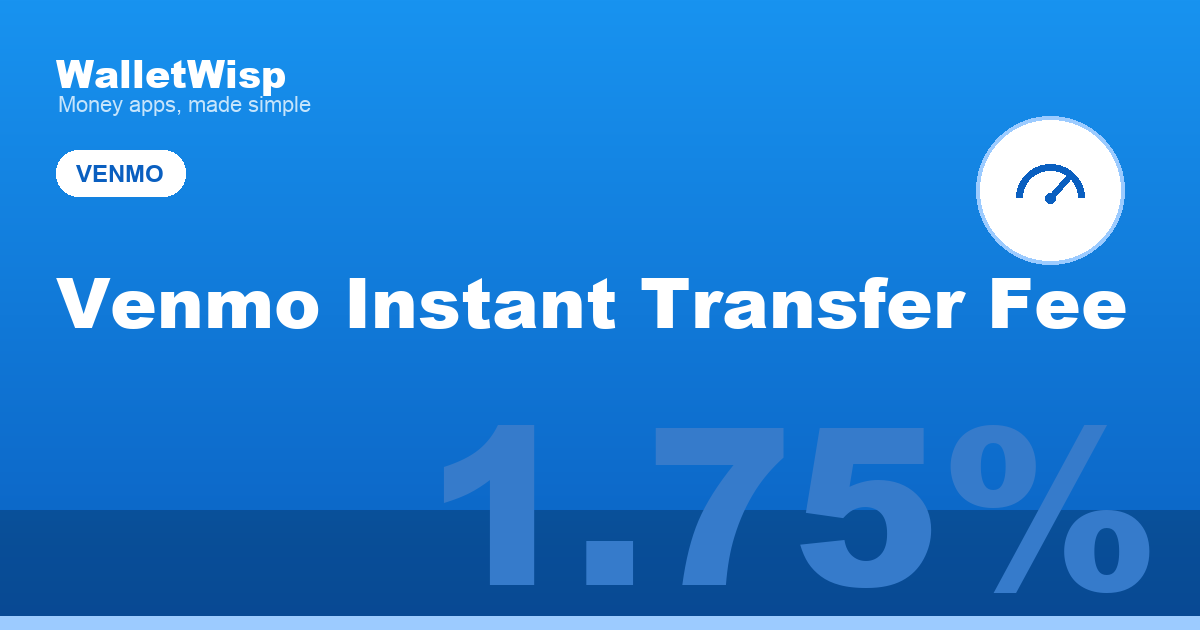
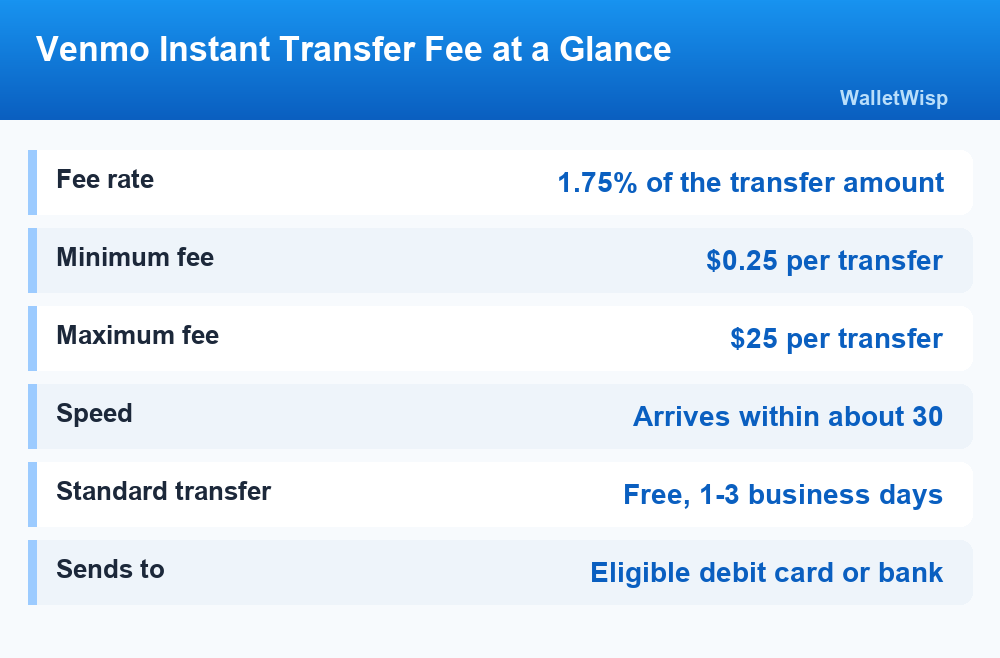
The Venmo instant transfer fee is 1.75% of the amount you cash out, with a minimum charge of $0.25 and a maximum of $25 per transfer. In exchange, your money lands in your linked debit card or bank account within about 30 minutes instead of days. If you are not in a hurry, you can skip the fee entirely: Venmo’s standard bank transfer is free and typically arrives in one to three business days.
That single choice, instant or standard, is the only thing that decides whether you pay a fee to move money out of Venmo. Below we break down exactly how the 1.75% is calculated, show the real cost at every dollar amount, explain when paying for speed actually makes sense, and cover the debit-card-versus-bank details most people miss.
What is the Venmo instant transfer fee?
When you have a balance in your Venmo account, you have two ways to move that money to your own bank. The instant transfer is the paid, fast option. Venmo charges 1.75% of the transfer amount and sends the funds to an eligible debit card or bank account, usually within minutes and almost always inside 30 minutes.
The fee is not a flat dollar amount and it is not a percentage that runs forever. It sits between two guardrails:
- Minimum fee: $0.25. On small cash-outs, 1.75% would come out to just a few cents, so Venmo charges at least a quarter.
- Maximum fee: $25. On very large cash-outs, the percentage is capped so you never pay more than $25 on a single instant transfer.
Importantly, the fee is deducted from the amount you transfer, not billed separately. If you instant-transfer $100, roughly $1.75 comes out and about $98.25 arrives in your account. There is no monthly charge and no fee just for having a balance sitting in Venmo.
How the 1.75% Venmo instant transfer fee is calculated
The math is simple once you know where the floor and ceiling kick in. To find your fee, multiply the transfer amount by 0.0175, then apply the minimum or maximum if you hit one of the limits.
The $0.25 minimum zone
Because 1.75% of a small amount is tiny, any transfer of roughly $14.29 or less triggers the flat $0.25 minimum. So cashing out $5, $10, or $14 all cost the same 25 cents. On a $10 transfer, that quarter works out to an effective rate of 2.5%, which is worth remembering if you frequently move small sums.
The straight percentage zone
Between about $14.29 and $1,428.57, you pay the true 1.75%. This is the range most everyday users fall into, so a good rule of thumb is that instant transfer costs a little under two cents on every dollar.
The $25 maximum zone
Once your transfer is large enough that 1.75% would exceed $25, the fee stops climbing. That happens at about $1,428.57. Above that, whether you cash out $2,000 or $5,000, the fee is a flat $25. On large amounts the effective rate actually drops, so instant transfer is proportionally cheaper on big cash-outs than on tiny ones.
Venmo instant transfer fee by amount (2026)
Here is what the instant transfer fee actually costs across common transfer amounts. The middle column shows the raw 1.75% math; the right column shows what you are actually charged after the $0.25 minimum and $25 maximum are applied.
| Transfer amount | 1.75% of amount | Fee you actually pay |
|---|---|---|
| $10 | $0.18 | $0.25 (minimum) |
| $25 | $0.44 | $0.44 |
| $50 | $0.88 | $0.88 |
| $100 | $1.75 | $1.75 |
| $200 | $3.50 | $3.50 |
| $500 | $8.75 | $8.75 |
| $1,000 | $17.50 | $17.50 |
| $1,500 | $26.25 | $25.00 (maximum) |
| $5,000 | $87.50 | $25.00 (maximum) |
The pattern is clear: the fee is cheapest, in effective-rate terms, on very small and very large transfers, and it costs a steady 1.75% for everything in the wide middle range. For a typical $200 cash-out you are handing Venmo $3.50 to save a day or two.
Instant vs standard transfer: the free alternative
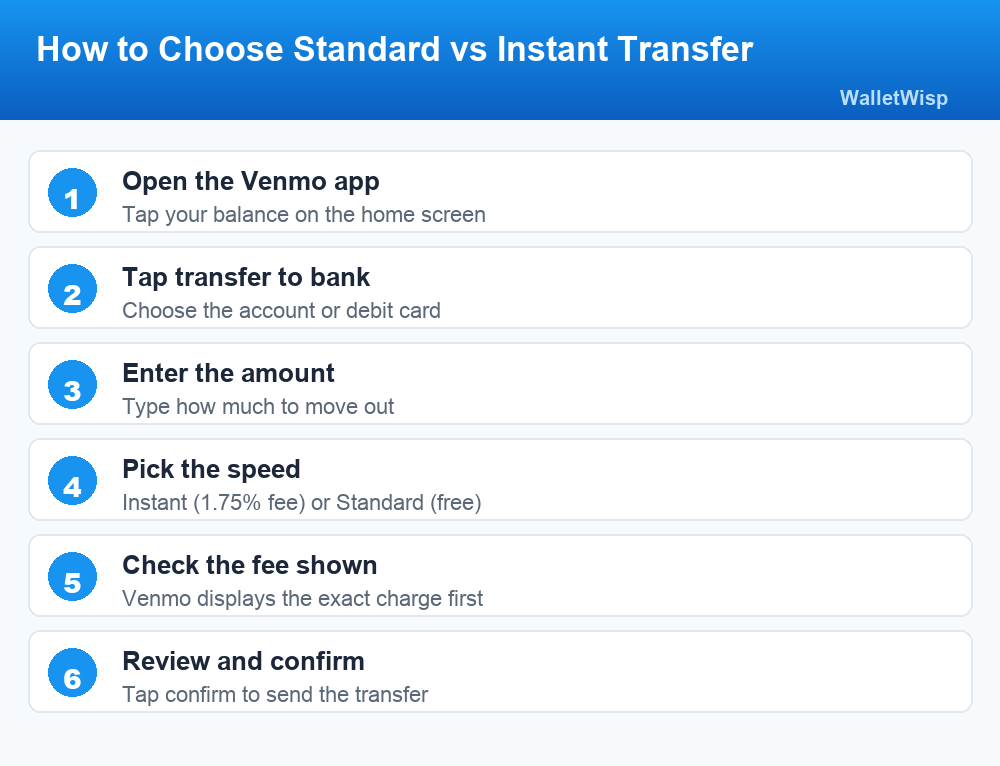
The reason the instant fee gets so much attention is that Venmo offers a completely free alternative for the same task. A standard bank transfer moves your balance to a linked bank account at no cost. The trade-off is speed: standard transfers are processed on business days and typically arrive within one to three of them. Send one on a Friday afternoon and it may not clear until the following Monday or Tuesday.
| Feature | Standard transfer | Instant transfer |
|---|---|---|
| Fee | Free | 1.75% ($0.25 min, $25 max) |
| Speed | 1-3 business days | Within 30 minutes |
| Weekends and holidays | Not processed | Processed any day |
| Sends to | Linked bank account | Eligible debit card or bank |
| Best for | Planned, non-urgent cash-outs | Urgent, time-sensitive needs |
For most people, the honest answer is that standard transfer is the default and instant is the exception. If you know you will need the money in a few days, moving it early with a free standard transfer costs you nothing but a little planning.
When paying the Venmo instant transfer fee is worth it
There are real situations where 1.75% is money well spent. The question is not whether the fee is “cheap,” but whether the speed solves a problem that costs you more than the fee.
- Avoiding an overdraft. If moving $150 instantly for about $2.63 stops a $35 overdraft fee at your bank, the instant transfer easily pays for itself.
- A bill or rent is due today. When a late payment triggers a penalty or a late fee, paying a small percentage to get funds in place now is usually the cheaper path.
- Weekends and holidays. Standard transfers do not process on non-business days. If you get paid through Venmo on a Saturday and need the cash, instant is the only way to access it before Monday.
- You are cashing out a large amount and the fee is capped. On a $2,500 transfer, the flat $25 maximum is an effective rate of just 1%, which is more palatable than the headline 1.75%.
On the other hand, paying $0.25 to instantly move $8 for a coffee you already covered, or rushing a routine cash-out you could have scheduled two days earlier, is simply money left on the table. The fee is small in absolute dollars, but it adds up quickly if instant becomes your reflex.
Debit card vs bank account: which is faster?
Venmo lets you send an instant transfer to either an eligible debit card or a linked bank account, and there is a subtle but important difference between the two.
- Eligible debit card. Instant transfers ride the card networks (Visa and Mastercard). If your debit card supports fast funds, the money typically appears within minutes. Debit cards only work for instant transfers, not standard ones.
- Linked bank account. A bank account can receive either a free standard transfer or a paid instant transfer. Instant transfers to a bank account also usually clear within 30 minutes, though the exact timing can depend on your bank.
The fee is the same 1.75% whether you choose a debit card or a bank account, so pick based on which destination you actually want the money in. One practical note: instant transfers can be capped per transaction and per week depending on your account and verification status, so a very large cash-out may need to be split or sent by standard transfer instead.
How to avoid the Venmo instant transfer fee
Avoiding the fee is entirely within your control. Every one of these approaches keeps 100% of your money.
1. Use the free standard transfer and plan ahead
This is the simplest fix. If you know a bill is coming, initiate a standard transfer a few business days early. The money arrives with zero fee, and you never feel the pinch of waiting because you moved it before you needed it.
2. Spend directly from your Venmo balance
You do not always need to move money to a bank at all. You can pay other people, split bills, and check out at many online and in-store merchants straight from your Venmo balance. If you have the Venmo debit or credit card, you can also spend the balance directly, which sidesteps any cash-out fee.
3. Leave the balance in Venmo until you truly need it
There is no fee for holding a balance. If you regularly receive and re-spend money through the app, keeping a working balance in Venmo means you rarely have to cash out at all, and never pay to do so.
4. Batch your cash-outs
Because the $0.25 minimum makes tiny instant transfers expensive in percentage terms, letting several payments accumulate and cashing out once, ideally by standard transfer, is far more efficient than moving small amounts one at a time.
How Venmo’s fee compares to Cash App and PayPal
Venmo is far from the only app that charges for speed, and the 1.75% rate is squarely in the middle of the pack. If you use more than one wallet, it helps to know how they line up before you cash out.
Cash App uses a similar instant-versus-standard model, and its fees can vary by transfer. We break the current numbers down in our guide to Cash App fees, which is worth a look if you move money between both apps. PayPal, which owns Venmo, applies its own percentage-based instant transfer fee that mirrors this structure closely; our PayPal fees explained guide covers those charges in detail.
If you find yourself paying instant fees often, it may be a sign your primary cash flow belongs in an actual bank account rather than a payment app. A fee-free spending account like Chime can eliminate the need to cash out at all for everyday money. Our comparison of Chime vs Cash App in 2026 walks through where each one fits, and the same logic applies to Venmo: the less you rely on the app as a bank, the fewer instant fees you will ever pay.
The bottom line across all of these apps is the same. Standard transfers are free and slow; instant transfers are fast and cost a small percentage. Venmo’s 1.75% with a $0.25 floor and $25 ceiling is predictable, and once you know where those limits fall, deciding whether the speed is worth it takes just a second.
Frequently Asked Questions
How much is the Venmo instant transfer fee in 2026?
The Venmo instant transfer fee is 1.75% of the amount you transfer, with a minimum of $0.25 and a maximum of $25 per transfer. The fee is deducted from the amount you cash out, so on a $100 instant transfer you pay about $1.75 and receive roughly $98.25.
Is there a free way to transfer money out of Venmo?
Yes. Venmo’s standard bank transfer is completely free. It moves your balance to a linked bank account and usually arrives within one to three business days. As long as you are not in a rush, the standard transfer costs nothing.
How long does a standard Venmo transfer take?
A standard transfer typically takes one to three business days to arrive. Because it only processes on business days, transfers started on a weekend or holiday can take a little longer to clear. Instant transfers, by contrast, process any day of the week.
What is the minimum and maximum instant transfer fee?
The minimum instant transfer fee is $0.25, which applies to any transfer of roughly $14.29 or less. The maximum is $25, which caps the fee on transfers of about $1,428.57 or more. In between, you pay the straight 1.75%.
Is an instant transfer to a debit card or bank account faster?
Both usually arrive within about 30 minutes and cost the same 1.75% fee. Instant transfers to an eligible debit card ride the Visa or Mastercard networks and often land within minutes, while instant transfers to a bank account can depend slightly on your bank’s processing. Debit cards only support instant transfers, not free standard ones.
Does Venmo charge a fee to receive money or send to friends?
No. Sending money to friends and family from your Venmo balance, linked bank account, or debit card is free, and receiving money is free. The instant transfer fee only applies when you move your balance out to a bank or card quickly. Certain business and credit card transactions can carry separate fees.
Can I get the instant transfer fee refunded if the money is delayed?
If an instant transfer cannot be completed, Venmo returns the funds to your balance and you are not charged the fee. If a transfer is merely delayed but still processing, contact Venmo support directly; refunds for delays are handled case by case rather than guaranteed.
Is the Venmo instant transfer fee worth it?
It depends on what the speed saves you. Paying about $2.63 to instantly move $150 is worth it if it prevents a $35 overdraft or a late fee, or if you need cash on a weekend when standard transfers do not process. For routine cash-outs you can plan a few days ahead, the free standard transfer is the better choice.