The Cash App CFPB settlement is the result of a January 2025 order from the Consumer Financial Protection Bureau (CFPB) requiring Block, Inc. — the company that runs Cash App — to pay up to $120 million in refunds to consumers and a $55 million penalty after regulators found it failed to properly investigate fraud and unauthorized transactions. If you are eligible, you do not need to file a claim or pay anything: an official check is mailed to you automatically by the settlement administrator, and checks began going out on June 8, 2026.
Quick answer: Eligible Cash App users — generally people whose unauthorized transfers weren’t properly investigated, who were wrongly denied refunds, or whose accounts were locked or delayed without provisional credit — are being paid automatically by mailed paper check. There is no claim form, no fee, and no action required to receive money. Checks started mailing June 8, 2026 in rolling batches, and they expire 180 days after issue, so deposit yours promptly. Verify everything only through the CFPB, the official administrator site, or the Cash App help center — anyone asking for a fee, your PIN, or a sign-in code is a scammer.
What is the Cash App CFPB settlement?
On January 16, 2025, the CFPB issued a consent order against Block, Inc., the parent company of Cash App. Regulators concluded that Block violated federal consumer-protection law — including the Electronic Fund Transfer Act (EFTA) and the Consumer Financial Protection Act — by failing to protect Cash App users from fraud and by mishandling disputes over unauthorized transactions.
In plain English, the government said Cash App made it too hard for people to get their money back when something went wrong. According to the CFPB, Block used weak security protocols, ran investigations that were “woefully incomplete,” and pushed defrauded users to chase their own banks for reversals that Cash App would then deny. For years, the customer-service phone number listed in the app reportedly didn’t even connect people to a real person who could help.
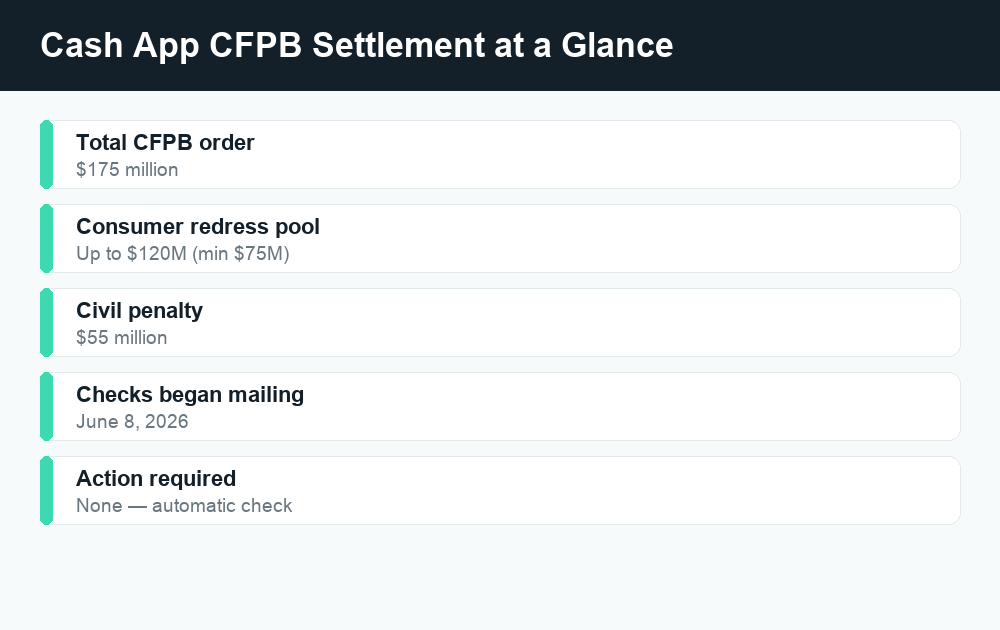
Block agreed to the order without admitting or denying the findings. The total price tag is $175 million: up to $120 million returned directly to harmed consumers as refunds and other redress, plus a $55 million penalty paid into the CFPB’s victims relief fund. Block was also required to overhaul how it handles disputes — including providing live, 24-hour customer support and actually investigating unauthorized transfers and issuing timely refunds when warranted.
Who is eligible for a payment?
You generally qualify for redress if you were a Cash App customer who was harmed by the practices the CFPB identified, mostly during the window the regulator examined (roughly mid-2019 through early 2025). Block and its administrator identified affected consumers from company records — so eligibility is determined for you, not claimed by you.
Based on the CFPB’s order, eligible consumers fall into one or more of these groups:
- Unauthorized transfers that were never properly investigated. You reported a transaction you didn’t authorize, and Cash App failed to investigate it the way the law requires.
- Refunds you were entitled to but never received. You should have gotten your money back under the rules, and you didn’t.
- Accounts locked for an extended period. Your account was frozen for a long stretch, cutting you off from your own funds.
- Missing provisional credit during a delayed investigation. When a dispute drags on, the law often requires a temporary (provisional) credit while it’s reviewed — and you didn’t get one.
Importantly, this is not a “everyone who ever used Cash App gets a check” situation. Consumer advocates and outlets like Consumer Reports have warned that social-media posts dramatically overstate who’s owed money. Only people the administrator identifies as harmed under the order will be paid through this program.
How much will eligible people get paid?
This is the part where honesty matters most: there is no single, flat check amount, and we are not going to invent one. The $120 million redress pool is divided among eligible consumers based on the specific harm each person experienced — so the amount varies from person to person. Someone who lost a large unauthorized transfer that was never investigated could receive substantially more than someone whose account was briefly locked.
The order guarantees a minimum of $75 million in consumer redress and caps it at $120 million. Your individual figure is calculated by the administrator from Block’s records. If you receive a check, the amount printed on it is your amount — and again, you should never have to pay a fee or “unlock” funds to receive it. The table below breaks down the numbers that are actually confirmed.
| Item | Confirmed detail |
|---|---|
| Total order | $175 million |
| Consumer redress pool | Up to $120 million (minimum $75 million) |
| Civil penalty | $55 million (to CFPB victims relief fund) |
| Order date | January 16, 2025 |
| Checks began mailing | June 8, 2026 |
| Distribution method | Mailed paper check (rolling batches) |
| Claim form required? | No — automatic |
| Check expiration | 180 days after issue |
| Individual amount | Varies by harm — not a flat figure |
How and when are payments distributed?
Payments are sent as mailed paper checks, issued by the court-style settlement administrator that Block retained to handle the program (reporting points to Epiq Global handling distribution under the CFPB consent order). Checks began going out on June 8, 2026, and they are sent in batches on a rolling basis — so two eligible people may receive theirs weeks apart. If you haven’t gotten yours yet, that alone doesn’t mean you’re not eligible.
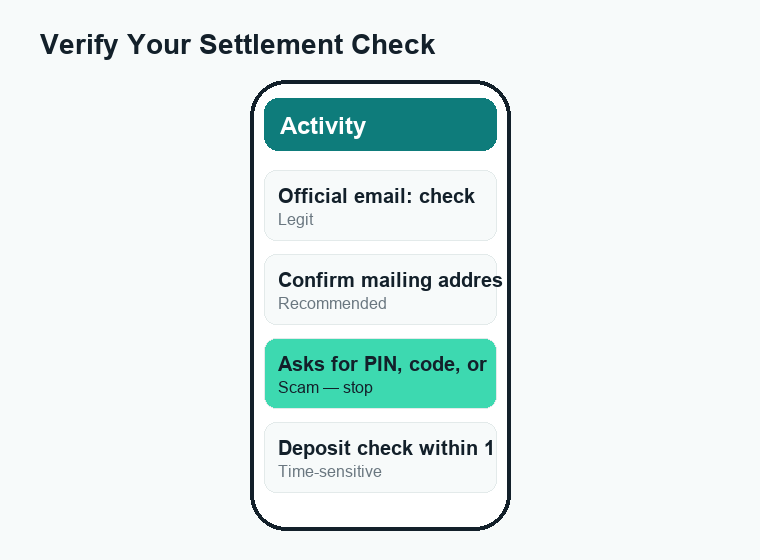
Some eligible customers also received an email in early June 2026 with a subject line along the lines of “Your Compensation Payment from Cash App is on the Way.” That notification email is legitimate, but here’s the key distinction: the official email simply tells you a check is coming. It does not ask you to click a link to “claim” your money, pay a processing fee, or hand over your PIN or sign-in code. If a message does any of those things, it’s a scam — full stop.
One time-sensitive detail: checks expire 180 days after they’re issued. Don’t set yours aside and forget about it. Deposit or cash it promptly so you don’t lose the money.
How to check your eligibility safely
Because you don’t file a claim, “checking eligibility” really means confirming whether the administrator has you on the list and whether a check is on its way to the right address. Here’s the safe way to do it:
- Start with official sources only. Use the CFPB’s newsroom page about the order, the official settlement administrator website, or the Cash App help center. Don’t trust random YouTube videos or texts.
- Confirm your mailing address is current. If you’ve moved since you used Cash App, an outdated address is the most likely reason a check wouldn’t reach you. Update it with the administrator.
- Contact the settlement administrator directly. The program lists a toll-free help line — reporting cites (888) 832-1301 — for questions about eligibility, a missing check, or a changed address. Always confirm the current number on the official site before calling.
- Cross-check anything suspicious in the Cash App app. Open the app’s official help center and search for the CFPB settlement page to confirm what real notifications look like.
- Wait out the rolling batches. If you believe you’re eligible but nothing has arrived, give it time — then follow up with the administrator rather than any third party.
How to spot a Cash App settlement scam
Whenever real money is involved, fraudsters pile on — and a high-profile name like Cash App is catnip for them. The single most important rule: the real program never asks you to pay or to share login secrets. Here are the red flags that mean “stop and don’t engage.”
- Any request for a fee. You never pay to receive settlement money. A “processing,” “release,” or “verification” fee is always a scam.
- Asking for your PIN or sign-in code. No legitimate settlement contact needs your Cash App PIN, password, or one-time sign-in code. Sharing it can drain your account.
- Pressure and urgency. “Claim in the next hour or lose it.” Real checks mail automatically and you have months to deposit them.
- Links to unofficial “claim” sites. Since the program is automatic, any site insisting you fill out a claim form to get CFPB redress is suspect. Verify the web address against official sources.
- Requests to pay you back in Cash App. If someone “accidentally overpays” you and asks you to return the difference, that’s a classic overpayment scam — unrelated to the settlement but riding its coattails.
If you’re ever unsure, walk away from the message and reach the administrator or Cash App through a channel you found yourself, not one a stranger gave you.
CFPB order vs. the separate Cash App data-security settlement
One thing trips a lot of people up: there has been more than one Cash App-related payout in the news, and they are not the same thing. The CFPB settlement covered here is a government enforcement action about fraud investigation and dispute handling, paid out automatically by check. Separately, there was a private class-action data-security settlement (tied to past data incidents) that ran through a different administrator and required eligible users to file a claim by a deadline.
Don’t assume a notice about one applies to the other. Read which program a message refers to, check the administrator name, and confirm against the official site. Mixing them up is exactly the confusion scammers count on.
What Cash App had to change
Beyond the money, the order forced operational fixes that benefit users going forward. Block was required to provide round-the-clock live customer service, genuinely investigate unauthorized-transfer claims, and issue refunds in a timely way when they’re owed. If you’ve ever felt stuck after a disputed payment, those are the exact pain points regulators targeted — and they’re worth knowing about whether or not you receive a check. While you’re reviewing your account, it can also help to understand how Cash App fees work and what to do when a Cash App payment is pending.
Frequently asked questions
Do I need to file a claim to get paid from the Cash App CFPB settlement?
No. This redress is automatic. The administrator identified eligible consumers from Block’s records and mails checks directly. If anyone tells you to file a claim or pay a fee for the CFPB redress, treat it as a scam and verify through official channels.
How much money will I get?
There’s no flat amount. The up-to-$120 million pool is split based on the specific harm each eligible person experienced, so individual checks vary. The amount printed on your official check is your amount — you should never pay anything to receive it.
When will checks arrive?
Checks began mailing on June 8, 2026, and go out in rolling batches over time. Eligible people may receive theirs at different times, so not having one yet doesn’t necessarily mean you’re excluded. Remember that checks expire 180 days after issue.
I got an email saying my payment is on the way — is it real?
The official notification email exists and simply tells eligible users a check is coming. It does not ask you to click to “claim,” pay a fee, or share your PIN or sign-in code. If your email demands any of those, it’s a phishing scam.
What if I moved and my check goes to an old address?
Contact the settlement administrator to update your mailing address. Reporting lists a help line of (888) 832-1301, but always confirm the current number and details on the official administrator website before calling.
Is this the same as the Cash App data-breach settlement?
No. The CFPB settlement is a separate government action about fraud and dispute handling, paid automatically. The earlier private data-security class action ran through a different administrator and required filing a claim. Don’t confuse the two.
What if I think I’m eligible but never get a check?
Wait out the rolling batches first, then reach the official settlement administrator directly to ask about your status. Use only the contact details listed on the official program site, the CFPB page, or the Cash App help center.
Does this mean Cash App is unsafe to use now?
The order forced Block to add live 24-hour support, investigate unauthorized transfers properly, and issue timely refunds. Like any payment app, Cash App is reasonably safe when you use good habits — protect your PIN, enable security features, and never send money to strangers promising returns. For comparison, see how peer apps stack up in our Venmo guides and whether Zelle is safe.
Last updated: June 2026. Fees, limits, and features can change — always confirm current details in the app. WalletWisp is an independent guide and is not affiliated with any app mentioned. This article is general information, not financial advice.
Related: Cash App fees explained · Why your Cash App payment is pending · More Cash App guides