
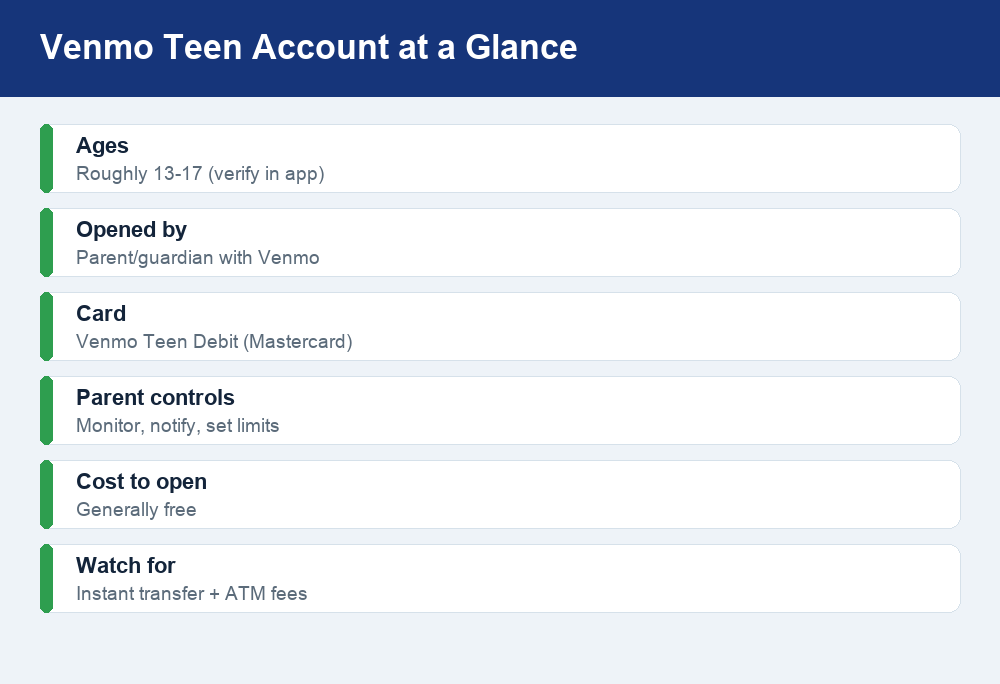
A Venmo teen account is a limited Venmo profile for kids roughly 13 to 17 that a parent or guardian opens and controls from their own Venmo account. The teen gets a Venmo Teen Debit Card (a Mastercard) they can use to spend and send money, while the parent can watch transactions, receive notifications, and set or restrict what the account can do.
Quick answer: Venmo lets an adult account holder add a teen (about 13-17) and issue them a Venmo Teen Debit Card. The teen can send, receive, and spend money with a reduced feature set, and the parent keeps oversight through notifications, transaction history, and account limits. It is generally free to open, but watch for instant-transfer fees and out-of-network ATM fees. Always confirm the current age rules, limits, and fees in the Venmo app before you set one up.
What is a Venmo teen account?
A Venmo teen account is a supervised version of Venmo built for younger users who are not old enough to open a standard adult account on their own. Instead of the teen signing up independently, a parent or guardian who already has their own Venmo account adds the teen to it. The parent stays in the driver’s seat: they own the relationship with Venmo, and the teen operates a restricted profile underneath that supervision.
The centerpiece is the Venmo Teen Debit Card, a Mastercard tied to the teen’s balance. With it, a teen can do the everyday money things they actually need to do, split a pizza with friends, buy something after school, or get paid back for a group gift, without needing a full bank account or a credit card. For a lot of families, it is a first real taste of managing money in a digital, cashless world.
Think of it as training wheels for peer-to-peer payments. The teen learns to send, receive, and track money, while the parent keeps enough visibility and control to step in if something looks off. That balance, independence for the teen plus oversight for the parent, is the whole point.
How to set up a Venmo teen account
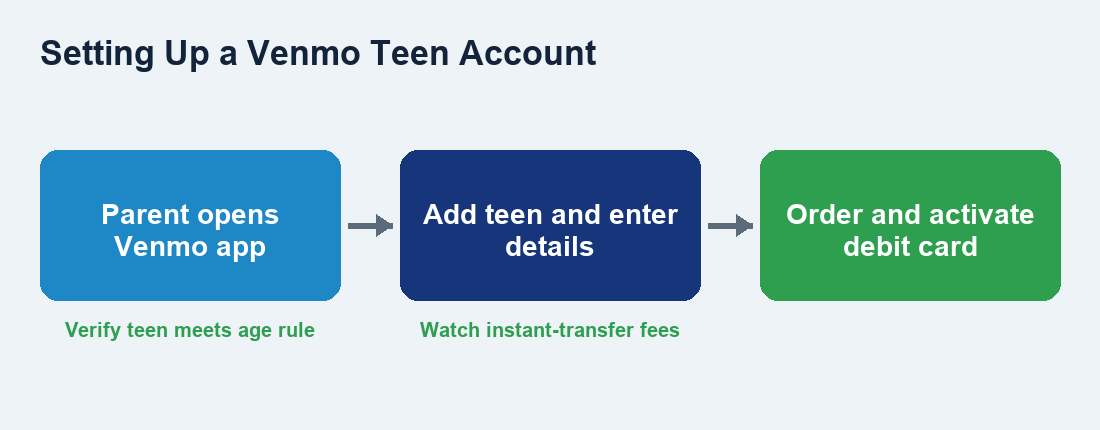
Setup starts with the parent, not the teen. You need your own active, verified Venmo account first. From there, the process generally works like this:
- Open your Venmo app and look for the option to add or invite a teen (often found in the menu or settings area of the app).
- Enter the teen’s details as prompted, including their name, date of birth, and any information Venmo requires to confirm eligibility.
- Review and accept the terms that apply to teen accounts. As the parent, you are agreeing to supervise and take responsibility for the account.
- Set up the teen’s login so they can sign in on their own device.
- Order the Venmo Teen Debit Card and activate it when it arrives in the mail.
Because Venmo can update its flow, exact steps and on-screen wording may differ from what you see here. Follow the in-app prompts, and if a screen asks for something this article does not mention, trust the app. The age window is described as roughly 13 to 17, but you should verify the current age requirement directly in Venmo before assuming your child qualifies.
The Venmo Teen Debit Card and where it works
The Venmo Teen Debit Card is a Mastercard, which means it is accepted broadly anywhere Mastercard debit is taken, in stores, online, and typically for contactless taps. The card draws from the teen’s Venmo balance rather than a traditional checking account, so a teen can only spend what has actually been loaded or received.
That “spend what you have” model is a feature, not a limitation. There is no overdraft into thin air and no credit line to rack up. If the balance is ten dollars, ten dollars is the ceiling. For parents nervous about a kid’s first card, that built-in guardrail removes a lot of worry.
Teens can also use the card at ATMs to get cash, but this is where fees quietly creep in, which we will cover next. Before your teen uses the card the first time, walk through the basics together: how to check the balance in the app, what happens when a purchase declines for insufficient funds, and why they should never share the card number or their login.
Venmo teen account fees to watch
Opening a teen account is generally free, and everyday debit-card purchases usually do not carry a fee. But “free to open” is not the same as “free to use in every situation.” Two fees deserve your attention, and they are the same ones adult Venmo users run into.
The first is the instant transfer fee. When you move money out of Venmo to a linked bank or card instantly, Venmo charges a percentage-based fee. The free alternative is the standard transfer, which takes a bit longer, usually a business day or so, to land in the bank. Teach your teen the simple rule: if you are not in a rush, choose standard and skip the fee.
The second is the out-of-network ATM fee. Withdrawing cash from an ATM outside Venmo’s fee-free network can trigger a charge, and the ATM operator may add its own surcharge on top. For a teen pulling out small amounts, those fees can eat a painful slice of the withdrawal. The fix is to use in-network ATMs when possible and to withdraw larger, less frequent amounts rather than a few dollars at a time.
Because fee amounts and structures change, do not rely on a specific number you read anywhere, including here. Check the exact, current fees in the Venmo app or on Venmo’s official site. If you want a broader picture of how Venmo charges across the board, our rundown of the fees Venmo charges and how to avoid them is a good companion read for the whole family.
| Situation | Typical cost | How to avoid it |
|---|---|---|
| Opening the teen account | Generally free | No action needed |
| Debit card purchases | Usually free | Spend from available balance |
| Standard transfer to bank | Free | Choose standard, wait ~1 business day |
| Instant transfer to bank/card | Percentage-based fee | Use standard transfer when not urgent |
| Out-of-network ATM withdrawal | Venmo fee + possible operator surcharge | Use in-network ATMs, withdraw larger amounts |
What teens can and cannot do
A teen account is deliberately more limited than a full adult account. The exact restrictions can shift over time, so treat this as the general shape rather than a locked-in list.
Teens generally can: send and receive money with approved people, use the Venmo Teen Debit Card to make purchases in stores and online, check their balance and transaction history in the app, and get cash at ATMs. In short, they can handle the everyday payment tasks that make Venmo useful.
Teens generally cannot: access the full set of adult features. Advanced or higher-risk functions, and features tied to being a verified adult account holder, are typically off the table for teens. The account is intentionally scoped down so a young user is not exposed to tools they do not need or should not have yet.
This is a good moment to talk with your teen about the difference between using Venmo among trusted friends and family versus sending money to strangers online. A restricted feature set reduces risk, but it does not replace good judgment.
Safety and parental controls
The parental controls are the reason many families choose a teen account over simply handing a kid cash or an unmonitored card. As the supervising adult, you generally get meaningful visibility and levers to pull:
- Transaction monitoring: you can see the teen’s activity and review where money is going.
- Notifications: you can be alerted about the teen’s transactions so nothing happens in a black box.
- Account management and limits: you can manage the account and restrict what the teen can do, giving you a way to tighten things up if needed.
Pair those tools with a few conversations. Teach your teen to keep their login private, to be suspicious of anyone who “accidentally” sends them money and then asks for it back, and to never send money to claim a prize, unlock a game, or help a stranger. Scam-awareness is a skill, and a teen account is a low-stakes place to build it.
Parents also reasonably ask where the money actually sits and how protected it is. Balances held through services like Venmo are typically covered by pass-through deposit insurance under specific conditions rather than being insured the way a bank account is by default, which is worth understanding, our explainer on whether Venmo is FDIC insured breaks down exactly how that protection works and what your teen’s balance is and is not covered against.
Venmo teen account vs. Cash App’s sponsored teen account
Venmo is not the only app offering a supervised option for younger users. Cash App also allows teens to use the platform through a sponsored account, where an adult sponsors and oversees the teen’s activity. The two follow a similar spirit, an adult stays responsible while the teen gets a debit card and limited features, but the details differ.
The right choice often comes down to which app your family and your teen’s friends already use. Peer-to-peer payments are only convenient if the people you pay are on the same platform, so social gravity matters. Beyond that, compare the specific parental controls, the card, the fee structure, and the feature limits inside each app before deciding.
| Feature | Venmo Teen Account | Cash App Sponsored Account |
|---|---|---|
| Who opens it | Parent/guardian with a Venmo account | Adult sponsor with a Cash App account |
| Age range | Roughly 13-17 (verify in app) | Teen users with a sponsor (verify in app) |
| Debit card | Venmo Teen Debit Card (Mastercard) | Cash App Card |
| Adult oversight | Monitoring, notifications, limits | Sponsor monitoring and controls |
| Feature set | Restricted vs. adult account | Restricted vs. adult account |
Using a teen account to teach real money skills
The best reason to open a teen account is not convenience, it is education. A supervised card is a natural classroom for lessons that stick because real money is on the line, just in small, safe amounts.
Try giving your teen a modest recurring allowance to the account and letting them manage it, including feeling the pinch of the fees when they choose an instant transfer they did not need. Review the transaction history together once a week and talk through the purchases, not to police them, but to build awareness of where money goes. Set a simple savings goal and watch the balance grow toward it.
These habits, avoiding avoidable fees, checking a balance before spending, being wary of scams, are the foundation of financial literacy. Building them at 15 is a lot cheaper than learning them at 25.
Frequently asked questions
What age can a teen have a Venmo account?
Venmo’s teen account is designed for kids roughly 13 to 17, opened and supervised by a parent or guardian with an existing Venmo account. Age rules can change, so confirm the exact current requirement in the Venmo app before you try to add your teen.
Is a Venmo teen account free?
Opening the account is generally free, and standard purchases and standard bank transfers typically do not cost anything. Watch out for the instant transfer fee and out-of-network ATM fees, which are the main charges families encounter. Verify current fee amounts in the app.
Can parents see everything on a Venmo teen account?
Parents get significant oversight, including transaction monitoring, notifications about the teen’s activity, and the ability to manage and limit the account. The exact scope of what you can see and control is defined by Venmo and can be updated, so review the current controls in your app.
Does a teen account affect taxes?
For most families, a teen using the account for allowance, gifts, and reimbursements among friends is not generating taxable business income. Rules around payment apps and tax reporting can be confusing, and our guide to whether Venmo reports to the IRS in 2026 explains when a payment app might report activity and what actually counts as taxable.
Can a teen use the Venmo debit card anywhere?
Because the Venmo Teen Debit Card is a Mastercard, it is accepted broadly wherever Mastercard debit is taken, in stores, online, and at ATMs. The teen can only spend from the loaded balance, and out-of-network ATM withdrawals may carry fees.
The bottom line
A Venmo teen account gives kids around 13 to 17 a safe, supervised way to send, receive, and spend money with a Mastercard debit card, while parents keep real oversight through monitoring, notifications, and limits. It is generally free to open, but teach your teen to sidestep the instant transfer fee and out-of-network ATM fees, and to stay alert to scams. Used well, it is less about the card and more about the money skills your teen carries into adulthood. Before you set one up, confirm the current age rules, limits, and fees directly in the Venmo app.