So is Zelle safe to use in 2026? Yes—Zelle’s technology is secure and the app itself is safe to use, but the real danger isn’t hackers. It’s scammers tricking you into sending money you can never get back. Because Zelle moves money in minutes and most payments are final, the weak point isn’t the app’s code. It’s the person holding the phone.
Quick answer: Zelle is safe for sending money to people you know and trust, like family or a friend splitting rent. It uses bank-grade encryption and never shares your full account details. The risk comes from scams: once you authorize a payment, it usually can’t be reversed. Treat every Zelle transfer like handing over cash—if you wouldn’t give a stranger cash, don’t Zelle them.
Why Zelle’s technology is actually secure
Zelle isn’t a separate app you load with money like a wallet. It’s built right into the apps of most major U.S. banks and credit unions—more than 2,000 of them. When you send money, it moves bank-to-bank, directly between accounts. There’s no Zelle “balance” sitting around for a thief to drain.
That design comes with real security upsides:
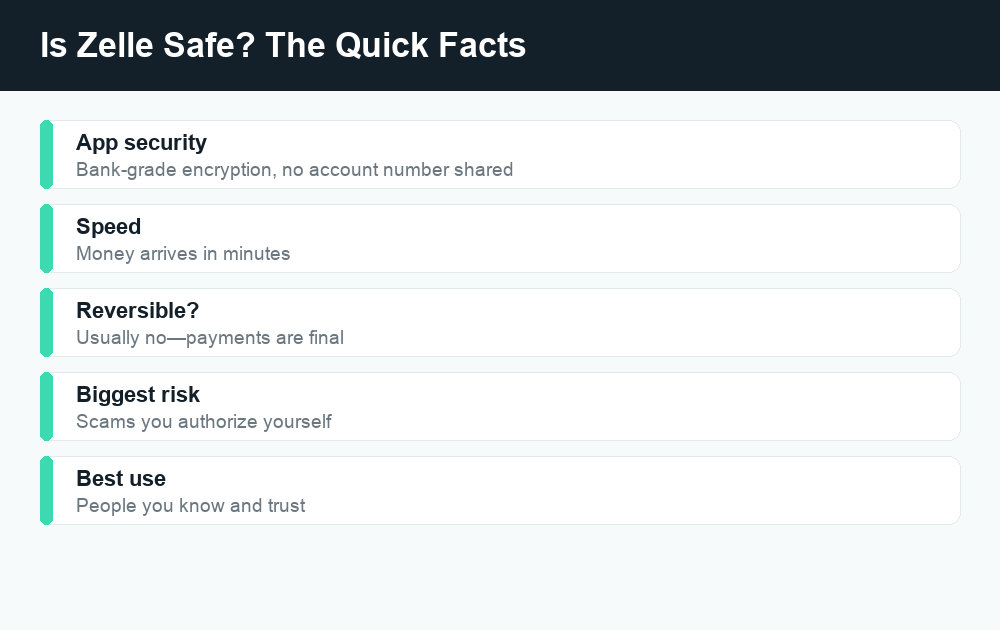
- Bank-grade encryption. Your transfers ride on the same secure systems your bank uses for everything else.
- No account numbers shared. You send money using just an email address or U.S. phone number. The other person never sees your bank account or routing number.
- Login protection. Access runs through your bank’s app, which usually means a password plus two-factor authentication, fingerprint, or face scan.
- No middleman balance. Since money doesn’t park in a Zelle account, there’s nothing for a hacker to steal from a “Zelle wallet”—because there isn’t one.
In short, the pipes are solid. Data breaches and stolen card numbers aren’t really how people lose money on Zelle. They lose it by being convinced to press “send” themselves.
The real risk: payments are instant and final
Here’s the catch that trips people up. Zelle was built for speed. Money typically lands in the other person’s account within minutes. That’s great when you’re paying back a friend. It’s terrible when you’ve just been scammed, because there’s usually no undo button.
With a credit card, you can dispute a charge. With Zelle, once you’ve authorized and sent a payment to the wrong person—or a con artist—the money is gone the moment it clears. The bank can ask the receiving bank to send it back, but the scammer has almost always pulled it out already.
This is the single most important thing to understand about Zelle safety: the technology protects your data, but it can’t protect you from a decision you were tricked into making. If you want to compare timing and reversal windows, see our guide on how long a Zelle transfer takes and whether you can cancel a Zelle payment.
| Situation | Can you get the money back? |
|---|---|
| Sent to a friend by mistake (recipient is honest) | Likely—ask them to send it back |
| Recipient not yet enrolled in Zelle | Often yes—payment can be canceled before they enroll |
| Sent to an enrolled stranger who won’t return it | Rarely—payment is usually final |
| Tricked into paying a scammer (authorized fraud) | Hard—limited protection, but report it anyway |
| Unauthorized transfer you never approved (account hacked) | Likely—federal rules protect you; report fast |
Common Zelle scams to watch for in 2026
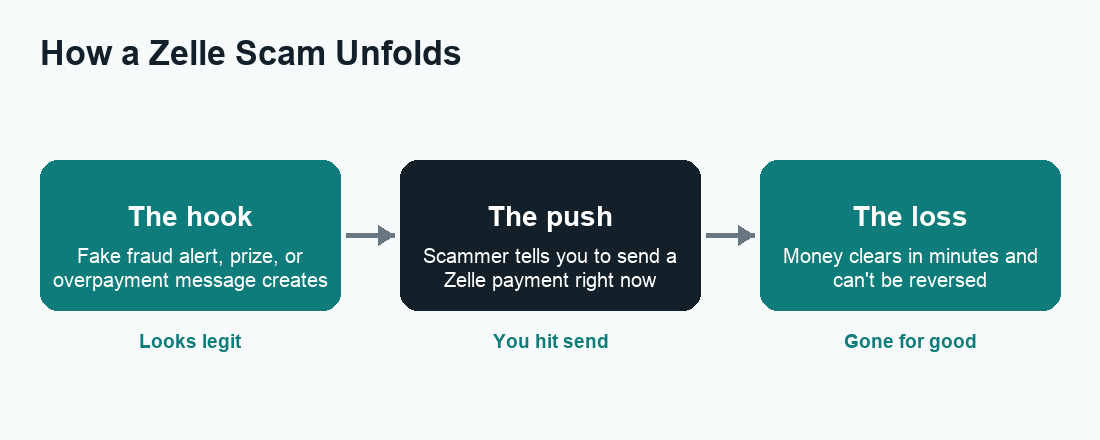
Scammers don’t break into Zelle. They talk you into using it. These are the most common tricks circulating in 2026—and the warning signs for each.
1. The fake bank fraud-department call
This is the big one. You get a call, text, or email that looks like it’s from your bank’s fraud team. They “warn” you about a suspicious charge and say you need to “reverse” it by sending yourself a Zelle payment. The number on your caller ID may even match your bank’s real number, because scammers can spoof it.
There is no such thing as “Zelle-ing yourself to cancel fraud.” When you follow their steps, you’re actually sending money straight to the scammer. Your bank will never ask you to send a Zelle payment to stop fraud. Hang up and call the number on the back of your card.
2. Marketplace and overpayment scams
You’re selling something on Facebook Marketplace, Craigslist, or OfferUp. A “buyer” sends too much by mistake and asks you to Zelle back the difference. The original payment was fake or will bounce, but the refund you send is very real. You’re out the difference and the item.
A twist: fake buyers claim they paid through “Zelle Business” and you must send a fee to “upgrade” your account before you can receive the money. Zelle has no upgrade fee. It’s all made up.
3. Rental and apartment deposit scams
You find a great apartment at a great price. The “landlord” can’t show it in person but wants a deposit by Zelle to “hold it.” Once you pay, they vanish—and often the place was never theirs to rent. Never send a deposit by Zelle for a place you haven’t seen and verified.
4. Prize, lottery, and “you won” scams
You’re told you won a prize, a grant, or a sweepstakes—but you need to pay a small “processing fee” or “tax” by Zelle to claim it. Real prizes never require you to pay money up front. If you have to pay to get paid, it’s a scam.
5. Romance and emergency scams
An online love interest, or someone pretending to be a relative in trouble, asks for a quick Zelle transfer for an emergency, a plane ticket, or medical bills. The urgency is the tell. Verify with a phone call to the real person before sending anything.
6. Payment-for-access and job scams
A “job” requires you to Zelle money for equipment or training first, with a promise of reimbursement. Or a service provider demands full payment by Zelle before doing any work, then disappears. Legitimate employers don’t make you pay to start.
How to stay safe on Zelle
Most Zelle losses are completely avoidable. Follow these rules and you’ll dodge nearly every scam out there.
- Only send to people you know and trust. Family, close friends, your roommate. Treat Zelle like cash, not like a buyer-protected checkout.
- Never use Zelle to buy from strangers. For marketplace purchases from people you don’t know, use a method with purchase protection instead.
- Slow down when someone creates urgency. “Act now or lose your account” is the scammer’s favorite line. Real banks give you time.
- Hang up and call back. If “your bank” calls about fraud, end the call and dial the number on your card. Never act on a number someone gave you.
- Ignore “send money to cancel fraud” instructions. This is always a scam. Always.
- Double-check the recipient. Confirm the email or phone number before sending. A typo can send cash to a stranger you can’t recover it from.
- Refuse overpayment refunds. If a buyer “accidentally” overpays and wants money back, stop. It’s a setup.
- Lock down your bank login. Turn on two-factor authentication, use a strong password, and never share a one-time code with anyone who calls you.
| Safe to use Zelle for | Avoid Zelle for |
|---|---|
| Paying back a friend | Buying from online strangers |
| Splitting rent with a roommate | Apartment deposits sight-unseen |
| Gifting money to family | Prize or “tax” fees to claim winnings |
| Paying a trusted local service | Upfront fees for a job or “training” |
| Chipping in for a group gift | Anyone pressuring you to hurry |
What about reimbursement if you get scammed?
This is where Zelle’s rules matter. There are two very different situations, and they’re treated differently:
Unauthorized transfers (you didn’t approve it)
If someone gains access to your account and sends money without your permission, federal rules (Regulation E) generally protect you. Report it to your bank quickly—ideally within two business days of noticing—and you’re usually entitled to get that money back. The key word is unauthorized: you never approved it.
Authorized transfers (you were tricked into sending)
If a scammer convinced you to send the payment yourself, that’s an authorized transfer in the eyes of the system, and historically these were much harder to recover. The good news: under pressure from regulators, major banks now reimburse customers for certain imposter scams—like the fake bank fraud-department trick—through Zelle’s network rules. Coverage varies by scam type and by bank, so it’s not a guarantee.
Either way, do this if you’re hit:
- Contact your bank immediately and report the transaction as fraud.
- Ask specifically about a Zelle scam claim and whether you qualify for reimbursement.
- File a report with the FTC at ReportFraud.ftc.gov and, for imposter scams, your local police.
- Save every screenshot, text, and call log as evidence.
Reporting fast gives you the best shot at recovery and helps your bank flag the scammer. Don’t assume it’s hopeless—report it.
Is Zelle safe compared to Cash App and Venmo?
All three are person-to-person payment tools, and all three share the same core warning: transfers between users generally aren’t covered by buyer protection. Zelle’s difference is that it moves money directly between bank accounts, so there’s no app balance to hold—and that also means transfers tend to be fast and final.
Cash App and Venmo keep a balance inside the app and offer some optional protections (like Venmo’s purchase protection when you tag a payment correctly). But for all three, sending to a stranger is risky. If you’re weighing the alternatives, see our breakdowns of Venmo fees and Cash App fees, or browse our full Zelle guides.
Frequently asked questions
Is Zelle safe to receive money from strangers?
Receiving money is generally low-risk for you, but be wary of any “buyer” who overpays and asks for a refund, or who claims you must pay a fee to receive funds. Those are classic scams. Zelle never charges you to receive money.
Can someone hack me through Zelle?
Not through Zelle’s system itself—it’s encrypted and tied to your bank. The real danger is social engineering: a scammer phoning or texting to trick you into sending money or sharing a one-time login code. Never share codes with anyone who contacts you.
Can I get my money back if I send Zelle to the wrong person?
If the recipient hasn’t enrolled in Zelle yet, you can often cancel the payment. If they’re already enrolled, the transfer is usually final and you’ll have to ask them to send it back. There’s no guaranteed reversal, so always double-check the recipient first.
Will my bank refund a Zelle scam?
It depends on the type. Unauthorized transfers you never approved are usually refundable under federal rules if reported fast. For scams where you were tricked into paying, many big banks now reimburse certain imposter scams, but it’s not guaranteed—report it right away to find out.
Does Zelle charge fees?
Zelle itself doesn’t charge a fee to send or receive money, though your bank could in rare cases. If anyone tells you to pay a “Zelle fee” or “upgrade” your account, it’s a scam—there’s no such thing.
Is Zelle Business safe for sellers?
Zelle is meant for paying people and businesses you trust, and it offers no purchase protection for buyers or sellers in disputes. Scammers often invoke a fake “Zelle Business upgrade fee,” so be cautious. For sales to strangers, a protected payment method is safer.
How do I report a Zelle scam?
Contact your bank immediately and report it as fraud, then file with the FTC at ReportFraud.ftc.gov. For imposter scams (like a fake bank-fraud call), also notify local police. Keep all screenshots and messages as evidence.
What’s the safest way to use Zelle?
Only send money to people you personally know and trust, never act on urgent “fraud alert” calls demanding a transfer, and treat every payment like cash. If you follow those three rules, Zelle is one of the safer ways to move money between people.
Last updated: June 2026. Fees, limits, and features can change — always confirm current details in the app. WalletWisp is an independent guide and is not affiliated with any app mentioned. This article is general information, not financial advice.
Related: Can you cancel a Zelle payment? · How long does a Zelle transfer take? · More Zelle guides