
In the I bonds vs high-yield savings decision for 2026, the short answer is this: keep your emergency fund and any money you might need within 12 months in a high-yield savings account (HYSA), and use Series I savings bonds for cash you can lock away for at least a year (ideally five) as inflation-protected, tax-advantaged savings. HYSAs win on liquidity and simplicity; I bonds win on inflation protection, tax deferral, and state-tax exemption. For most people, the smartest move is to use both, not to pick one.
Below we break down current 2026 rates, the 12-month minimum hold and 5-year penalty on I bonds, how each is taxed, how they protect against inflation, and exactly which account suits an emergency fund versus longer-term goals. Rate figures are labeled as estimates or typical ranges because both move over time — always confirm today’s numbers before you buy.
I bonds vs high-yield savings: the quick verdict
These two tools solve different problems, so comparing them head-to-head only makes sense once you match them to a goal:
- Choose a high-yield savings account when you need instant access, no lock-up, and FDIC insurance for your emergency fund or short-term savings (a car repair, a vacation, a down payment you’ll spend within a year).
- Choose I bonds when you have money you won’t touch for 12+ months, you want a guaranteed real (inflation-adjusted) return, and you like deferring federal tax while skipping state and local tax entirely.
- Use both when your emergency fund is already fully funded in a HYSA and you want to move surplus cash into something that keeps pace with inflation.
The core trade-off is liquidity versus inflation protection. A HYSA gives you your money any day of the week but its rate can fall the moment the Federal Reserve cuts rates. An I bond guarantees your purchasing power but locks your cash for a year and charges a small penalty if you cash out before five years.
Current rates in 2026: I bonds vs HYSA
Both instruments pay competitive yields in 2026, but they’re built differently. A HYSA pays a variable rate the bank can change at any time. An I bond pays a composite rate made of two parts: a fixed rate that stays with the bond for its 30-year life, plus an inflation rate that resets every six months based on the Consumer Price Index (CPI). The U.S. Treasury announces new I bond rates on the first business day of May and November.
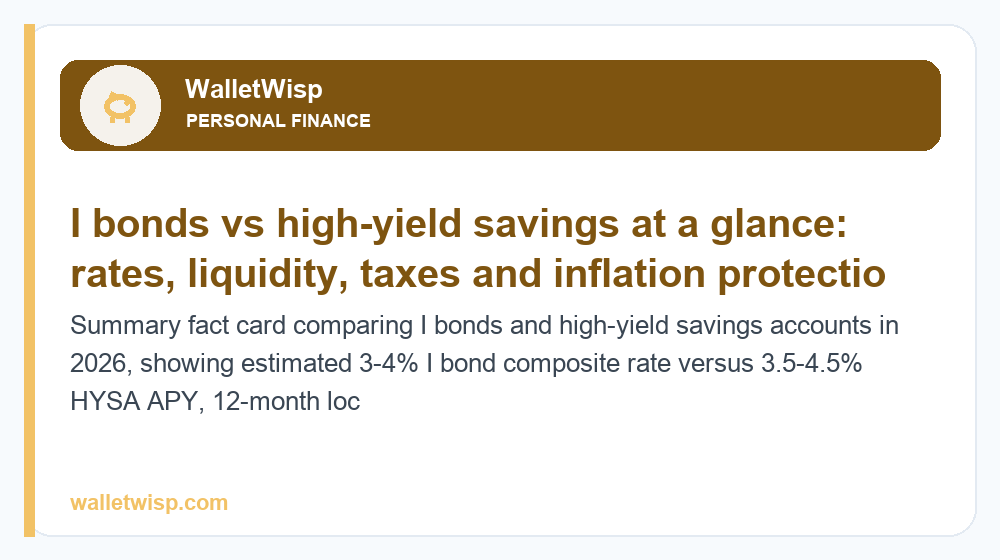
Here’s how the two stack up on the numbers that matter. Treat the specific rates as 2026 estimates and confirm live figures at TreasuryDirect.gov (I bonds) and current bank listings (HYSA):
| Feature | Series I Bonds (2026 est.) | High-Yield Savings (2026 est.) |
|---|---|---|
| Headline yield | ~3% to 4% composite (fixed + inflation) | ~3.5% to 4.5% APY at top online banks |
| Rate type | Fixed portion locked; inflation portion resets every 6 months | Fully variable; can change any day |
| Rate reset schedule | May 1 and November 1 | At the bank’s discretion |
| Guaranteed to beat inflation? | Yes, if fixed rate is above 0% | No guarantee |
| Insurance / backing | Full faith and credit of U.S. government | FDIC insured up to $250,000 per depositor, per bank |
| Minimum to open/buy | $25 | Often $0 to $100 |
Notice that a top HYSA can actually out-yield an I bond in the short run, especially right after a period of low inflation. The difference is durability: if inflation spikes, the I bond’s inflation component rises with it, while a HYSA’s rate may or may not keep up. You can track the latest bank offers in our roundup of the best high-yield savings rates for 2026, which we refresh as the Fed moves.
Liquidity and lock-up: the biggest practical difference
This is where the two part ways most sharply, and it’s the factor that should drive your decision more than a fraction of a percent in yield.
High-yield savings: fully liquid
A HYSA lets you withdraw or transfer money whenever you want. There’s no maturity date and no penalty for taking your cash out. Historically banks limited savings withdrawals to six per month, but that federal rule (Regulation D) was relaxed in 2020, so many banks now allow more, though some still charge fees for excess transactions. For an emergency fund, this on-demand access is the whole point.
I bonds: 12-month lock, then a 5-year penalty window
I bonds come with two liquidity rules you must understand before buying:
- 12-month minimum hold: You cannot redeem an I bond at all during the first 12 months. The money is completely locked. (The only exceptions are federally declared disaster areas.)
- 3-month interest penalty before year 5: If you cash out between months 12 and 60, you forfeit the most recent three months of interest. Redeem after five years and there’s no penalty at all.
So an I bond is never a place for money you might need next month. It’s best thought of as a 1-to-5-year (or longer) commitment. Because of that lock-up, an I bond should sit behind a fully funded emergency fund, never in place of one. If you’re still building that cushion, start with our guide to building an emergency fund in 2026 and park it in a HYSA first.
Tax treatment: where I bonds pull ahead
Taxes are one of the strongest arguments for I bonds, and one of the most overlooked parts of the I bonds vs high-yield savings comparison.
I bond taxes
- Federal tax: Interest is taxable at the federal level, but you can defer reporting it until you redeem the bond or it reaches final maturity at 30 years. That means no annual tax bill while it grows.
- State and local tax: Completely exempt. This is a real edge if you live in a high-tax state like California, New York, or New Jersey.
- Education exclusion: If you use I bond proceeds for qualified higher-education expenses and meet income limits, the interest can be fully or partially federal tax-free.
HYSA taxes
Interest from a high-yield savings account is taxed as ordinary income every year, at both the federal and state level. Your bank sends a 1099-INT if you earn $10 or more, and you owe tax on that interest whether you withdraw it or not. There’s no deferral and no state exemption.
For a saver in a high-tax state, the I bond’s state exemption plus federal deferral can meaningfully boost the after-tax return even when the headline rates look similar. Run your own after-tax comparison rather than trusting the sticker yield.
Inflation protection: the reason I bonds exist
The “I” in I bond stands for inflation, and protecting purchasing power is the instrument’s entire purpose. Every six months, the inflation portion of the rate is recalculated from the CPI-U. When prices rise, your I bond rate rises with them, so a dollar of I bond savings holds its real value over time (as long as the fixed rate is at least 0%).
A high-yield savings account has no built-in inflation link. Banks often raise HYSA rates when the Fed hikes to fight inflation, so there’s a loose, indirect relationship, but nothing is guaranteed. In a scenario where inflation jumps but the Fed is slow to act, a HYSA can quietly lose real value while an I bond keeps pace.
The flip side: when inflation cools, the I bond’s inflation component shrinks, and a competitive HYSA or a short-term CD may temporarily pay more. That’s why timing and goals matter more than chasing whichever rate is highest this quarter. If you’re weighing other safe options too, our comparison of HYSA vs CD vs money market accounts in 2026 shows where each fits.
Which is best for an emergency fund vs long-term savings?
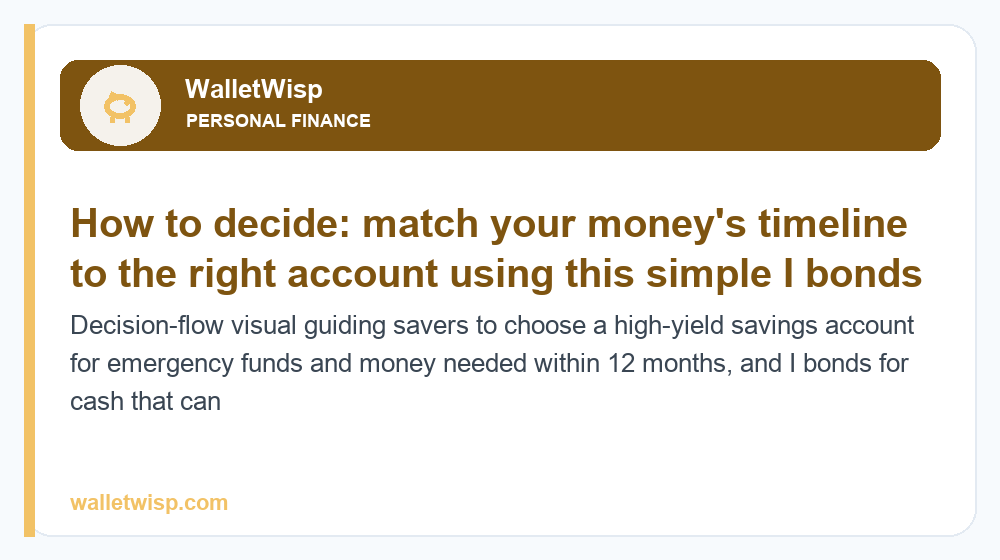
Match the tool to the timeline. Here’s a practical breakdown by goal:
| Your goal / money type | Best fit | Why |
|---|---|---|
| Emergency fund (3–6 months of expenses) | High-yield savings | Instant access; no lock-up; FDIC insured |
| Money needed within 12 months | High-yield savings | I bonds are fully locked for the first year |
| Cash for a 1–5 year goal you won’t touch | I bonds (accept the 3-month penalty risk) | Inflation protection plus tax deferral |
| Money you can leave 5+ years | I bonds | No penalty after 5 years; state-tax-free growth |
| High-tax-state saver wanting safety | I bonds | State and local tax exemption boosts after-tax yield |
| Surplus cash above a full emergency fund | Both, in a tiered plan | HYSA stays liquid; I bonds fight inflation |
A simple two-tier system
Most households do best combining them rather than choosing one:
- Tier 1 (HYSA): Fully fund 3–6 months of essential expenses in a high-yield savings account. This is your always-available safety net.
- Tier 2 (I bonds): Once Tier 1 is complete, direct extra savings into I bonds each year (up to the annual limit) as inflation-protected medium-term savings. After the first 12 months, these bonds can even act as a secondary emergency reserve, since you can access them (minus a small penalty) if you ever truly need to.
Purchase limits and how to buy
One reason you can’t put your whole savings into I bonds is the annual cap. As of 2026, electronic I bonds are limited to $10,000 per person per calendar year, bought directly at TreasuryDirect.gov. The old option to buy an extra $5,000 in paper I bonds with your federal tax refund was discontinued starting January 2025, so the electronic $10,000 is now the practical ceiling per individual (a married couple can buy $10,000 each, and you can also buy for children or a trust). By contrast, HYSA deposits are effectively unlimited, though FDIC insurance covers up to $250,000 per depositor, per bank.
Opening either is straightforward. For a HYSA, apply online with a bank or credit union, link your checking account, and transfer funds, usually the same day. For I bonds, create a free TreasuryDirect account, link your bank, and buy in any amount from $25 up to your annual limit. There are no fees or commissions on either.
Bottom line
In the 2026 I bonds vs high-yield savings matchup, there’s rarely a single winner because they play different roles. High-yield savings is your liquid, penalty-free home base for emergencies and near-term goals. I bonds are your locked-up, inflation-protected, tax-advantaged layer for money you can leave alone for at least a year and preferably five. Build the HYSA first, then let I bonds do the heavy lifting against inflation. Confirm current rates and limits before you commit, and remember that the best portfolio for most savers uses both.
Frequently Asked Questions
Are I bonds or high-yield savings better in 2026?
Neither is universally better; they serve different needs. In 2026, a top HYSA (roughly 3.5%–4.5% APY, estimated) may out-yield an I bond in the short term and offers instant access, making it ideal for emergency funds. I bonds are better for money you can lock away 12 months or more, thanks to guaranteed inflation protection and tax advantages. Most people benefit from using both.
What is the current I bond rate for 2026?
I bond rates reset every May 1 and November 1. The composite rate in 2026 is estimated to be in the low-to-mid single digits (roughly 3%–4%), combining a fixed rate that stays for the life of the bond with an inflation rate tied to CPI. Because it changes twice a year, always check the official current rate at TreasuryDirect.gov before buying.
Can I lose money in an I bond?
You cannot lose your principal in an I bond; it’s backed by the U.S. government and the composite rate can never fall below 0%. The only “loss” scenario is the 3-month interest penalty if you redeem before holding for five years. You also cannot redeem at all in the first 12 months, so it’s not a place for money you may need soon.
How much can I put in I bonds each year?
As of 2026, you can buy up to $10,000 in electronic I bonds per person per calendar year through TreasuryDirect. The former $5,000 paper-bond option via tax refund was discontinued in January 2025. A married couple can buy $10,000 each, and you can purchase additional bonds for children or a trust, but the individual electronic cap is the main constraint.
Do I pay taxes on high-yield savings account interest?
Yes. HYSA interest is taxed as ordinary income every year at both the federal and state level, and your bank issues a 1099-INT if you earn $10 or more. Unlike I bonds, there’s no option to defer the tax and no state-tax exemption, so your effective after-tax return can be lower than the headline APY suggests.
Is a high-yield savings account safe?
Yes, as long as it’s at an FDIC-insured bank (or NCUA-insured credit union). Your deposits are protected up to $250,000 per depositor, per institution, per ownership category. The main “risk” is that the interest rate is variable and can drop when the Federal Reserve cuts rates, which reduces your yield but never your principal.
Should I put my emergency fund in I bonds?
Not entirely. Because I bonds are locked for the first 12 months, they can’t be your primary emergency fund. Keep your core 3–6 month cushion in a liquid high-yield savings account. Once that’s fully funded and your I bonds are past the one-year mark, they can serve as a secondary reserve you’d tap only in a genuine emergency, accepting the small penalty.
Can I own both I bonds and a high-yield savings account?
Absolutely, and it’s often the smartest approach. A common strategy is a two-tier system: fund your full emergency fund in a HYSA for liquidity, then move surplus savings into I bonds each year for inflation protection and tax benefits. This gives you both on-demand access and a guaranteed real return without choosing one over the other.


