
To build a $1,000 emergency fund fast in 2026, set a deadline, open a separate high-yield savings account, and automate a fixed weekly transfer while temporarily redirecting any extra cash, side-gig income, and windfalls into the same account until you hit the goal. Most people can get there in roughly 8 to 12 weeks with a focused plan.
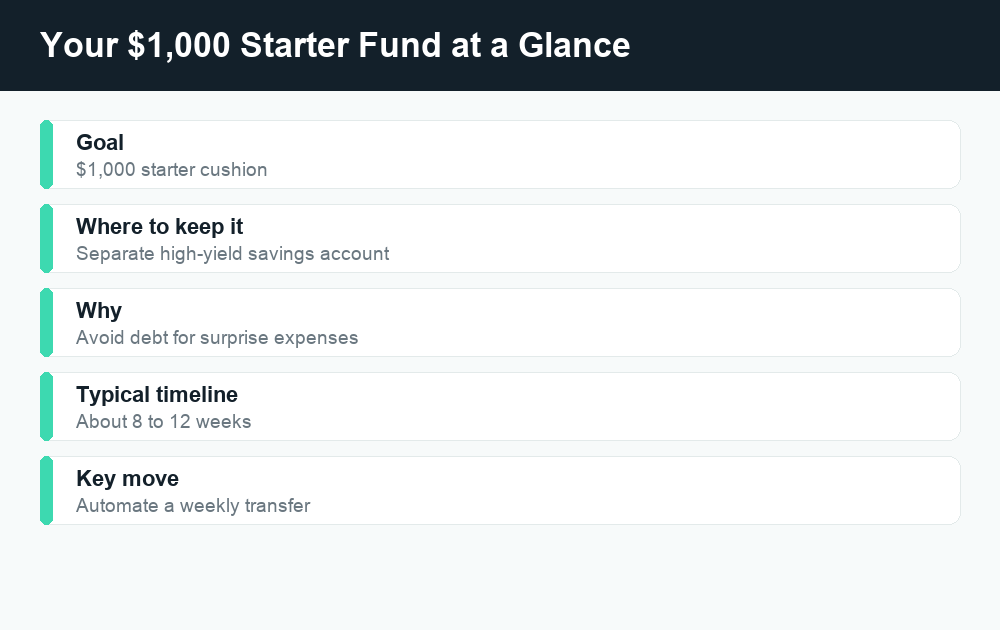
Quick answer: A $1,000 starter emergency fund is the cushion that keeps a surprise car repair or medical bill from turning into credit-card debt. Keep it in a separate high-yield savings account so it’s easy to reach but hard to spend by accident. Pick a deadline, automate a weekly transfer (around $90 a week reaches $1,000 in about 11 weeks), and speed things up by selling unused items, banking windfalls, and cutting a few subscriptions. Once it’s funded, you can start building toward the bigger three-to-six-month goal.
Why a $1,000 starter emergency fund matters
Life runs on surprises, and most of them cost money. A flat tire, an urgent dentist visit, a broken refrigerator, or an unexpected co-pay can land at the worst possible time. Without cash set aside, those moments often get charged to a credit card or covered by a payday loan, which is how a one-time $400 problem quietly becomes a months-long debt with interest attached.
A $1,000 starter emergency fund is designed to break that cycle. It’s not meant to cover months of lost income. It’s meant to absorb the everyday financial shocks that would otherwise push you into borrowing. Think of it as a buffer between you and the next “uh-oh” moment. When you have it, a surprise expense becomes an inconvenience instead of an emergency.
There’s a psychological payoff, too. Knowing you have a thousand dollars ready to go lowers stress, helps you sleep better, and makes it easier to stick to the rest of your money plan. You stop reacting to every bump and start making calmer, longer-term decisions. That confidence is one of the most underrated returns on a small pile of cash.
For most households, $1,000 is also a realistic first milestone. It’s big enough to be useful but small enough that you can reach it in a couple of months with effort, rather than the year-plus it can take to build a full cushion. Hitting a real, finite goal builds the saving habit you’ll need later.
Where to keep your emergency fund
The right home for this money is a separate, dedicated savings account, not your everyday checking account and not a pile of cash in a drawer. The goal is to make the money accessible when you genuinely need it but inconvenient to spend on a whim.
A high-yield savings account (often called an HYSA) is the standard choice. These accounts, frequently offered by online banks, typically pay meaningfully more interest than a traditional big-bank savings account while still letting you transfer money to checking within a day or two. Rates change with the broader economy, so check current numbers on the bank’s official site rather than relying on a figure you saw months ago. Either way, the interest is a bonus; the real job of this account is safety and separation.
A few features matter when you choose one:
- No monthly fees and no minimum balance that could quietly eat into your savings.
- FDIC insurance (or NCUA insurance at a credit union) so your money is federally protected up to the legal limits.
- Easy transfers to and from your main checking account, ideally within a business day or two.
- No debit card attached, or one you deliberately leave at home, so this isn’t money you tap for coffee runs.
Keeping the fund at a different bank than your checking account adds a small but helpful speed bump. The one-day transfer delay is just enough friction to stop impulse spending while still being fast enough for a true emergency. Avoid putting starter emergency money in investments, stocks, or anything that can drop in value. This cash needs to be there in full on the day you need it.
Your step-by-step plan to save $1,000 fast in 2026
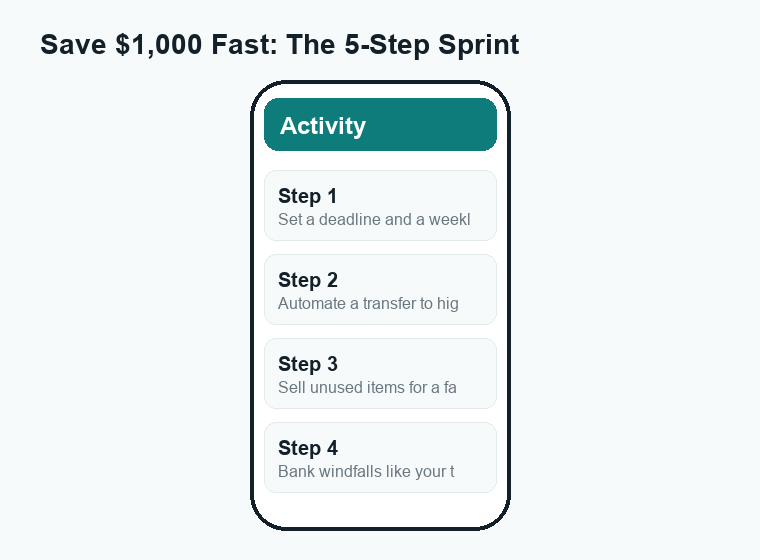
Speed comes from stacking several tactics at once rather than relying on a single trick. Here’s a practical sequence that works for most people.
1. Set a real deadline
A goal without a date is just a wish. Decide when you want the $1,000 in the bank, whether that’s 8 weeks, 12 weeks, or by a specific date you can picture. Write it down somewhere you’ll see it. A clear deadline turns “save more” into a concrete weekly number you can actually hit, and it makes it obvious when you’re falling behind so you can adjust early.
2. Automate a weekly transfer
Automation is the single most powerful move here because it removes willpower from the equation. Set up a recurring automatic transfer from checking to your high-yield savings account on the day after you get paid, so the money is gone before you can spend it. Even if you can only start with $25 or $50 a week, the habit and the momentum matter more than the amount at first. You can always increase it as the other steps free up cash.
3. Sell unused items
Most homes are sitting on a few hundred dollars in things nobody uses: old electronics, clothes, furniture, a bike in the garage, a gaming console. Spend a weekend listing them on local marketplaces or resale apps. This is one of the fastest ways to inject a lump sum into your fund early, which is motivating because it makes the goal feel reachable right away. Send every dollar you earn straight into the savings account.
4. Run a no-spend sprint
Pick a defined window, say one or two weeks, and pause all non-essential spending. No takeout, no impulse online orders, no “treat yourself” purchases. Cook at home, use what’s already in your pantry, and find free entertainment. A short, intense no-spend sprint is more effective than a vague intention to “cut back” because it has a clear start and end. Move whatever you would normally have spent into savings.
5. Bank every windfall
Any money you weren’t already counting on should go straight to the fund. The big one for many people in early 2026 is a tax refund, but the same rule applies to a work bonus, a cash gift, a rebate, a class-action check, or a reimbursement. Because this money was never part of your normal budget, you won’t miss it, and a single refund can sometimes get you most of the way to $1,000 on its own. Always verify refund timing and amounts through official sources like IRS.gov rather than third-party estimates.
6. Pick up a short side gig
You don’t need a permanent second job. A few weeks of focused extra work can close the gap quickly: rideshare or delivery driving, pet sitting, babysitting, freelance tasks, seasonal retail hours, or selling a skill you already have. Treat it as a temporary sprint with a finish line, your $1,000 goal, so it doesn’t feel like an open-ended grind. Route every dollar of that income into the emergency fund.
7. Cut two or three subscriptions
Recurring charges are easy to forget and add up fast. Review your bank and card statements and cancel two or three subscriptions you don’t really use: a streaming service you rarely watch, an app you forgot about, a membership that lapsed in usefulness. Even if each cancellation only frees up $10 to $15 a month, redirecting that into savings adds steady fuel, and you can always resubscribe later once your fund is built.
The simple savings math
The fastest way to feel in control is to turn $1,000 into a weekly number. Divide your goal by the number of weeks you’ve given yourself, and you have your automatic transfer amount. Here’s how a few common timelines look:
| Weekly amount | Weeks to reach $1,000 | Roughly |
|---|---|---|
| $50 / week | 20 weeks | About 5 months |
| $65 / week | ~16 weeks | About 4 months |
| $90 / week | ~11 weeks | Under 3 months |
| $125 / week | 8 weeks | 2 months |
| $200 / week | 5 weeks | About 1 month |
Take the $90-a-week line as an example. Saving $90 each week reaches $1,000 in about 11 weeks, since 11 transfers add up to $990 and the twelfth easily clears the line. That $90 doesn’t have to come from one place. It might be $40 from your automated transfer, $25 from skipping takeout, $15 from a canceled subscription, and $10 from selling something, all stacked together. Breaking the target into a weekly figure makes a big round number feel completely doable.
If $90 a week isn’t realistic right now, that’s fine. Pick the row you can sustain, automate it, and use windfalls and one-time sales to jump ahead of schedule. A slower plan you actually follow beats an aggressive plan you abandon in week two.
Stay scam-aware while you save
When you’re focused on making money fast, you become a target for people who want to take it. Be cautious with any “side gig” or “investment” that asks you to pay an upfront fee, buy gift cards, or hand over banking passwords. Legitimate work pays you, not the other way around. Treat guaranteed-return or “double your money” pitches as red flags, and never move your emergency fund into something risky chasing a quick gain. When in doubt about an app or offer, check its official help center and look up independent reviews before sharing any personal or financial information.
What comes after your first $1,000
Reaching $1,000 is a real win, so take a moment to acknowledge it. But it’s the starting line, not the finish. The longer-term target most financial guidance points to is three to six months of essential living expenses, the kind of cushion that can carry you through a job loss or a major life disruption, not just a surprise bill.
The good news is that the habits you just built are exactly what you need for the bigger goal. Keep the automatic transfer running, even at a smaller amount, and let it quietly grow. As you pay down high-interest debt and free up more room in your budget, you can bump the transfer back up. Many people aim to knock out toxic debt first, then return their full attention to growing the emergency fund toward that three-to-six-month mark. The starter fund protects you in the meantime so a single emergency doesn’t undo your progress.
Frequently asked questions
Is $1,000 enough for an emergency fund?
For a starter fund, yes. A thousand dollars covers most common surprise expenses, like a car repair or an urgent medical bill, without forcing you into debt. It’s intentionally a first milestone, not your final goal. Once it’s funded, you build toward the larger three-to-six-month cushion over time.
Where should I keep my emergency fund?
Keep it in a separate high-yield savings account at a bank or credit union that’s federally insured (FDIC or NCUA). That keeps the money accessible within a day or two but separate enough that you won’t spend it by accident. Avoid investing starter emergency cash, since it needs to be safe and available in full.
How fast can I realistically build $1,000?
With a focused plan, many people reach $1,000 in about 8 to 12 weeks. Saving $90 a week gets you there in roughly 11 weeks, and stacking a tax refund or a few item sales on top can shave that down. Pick a weekly amount you can actually sustain and use windfalls to move faster.
Should I save or pay off debt first?
A common approach is to build the small $1,000 starter fund first, then attack high-interest debt aggressively. The starter fund keeps a new surprise from sending you deeper into debt while you pay things down. After your toxic debt is gone, you return to growing the emergency fund toward several months of expenses. Your exact order can vary, so weigh your interest rates and personal situation.
What counts as a real emergency?
A true emergency is something urgent, necessary, and unexpected, like a medical bill, an essential car or home repair, or covering basics after a sudden loss of income. A sale, a vacation, or a new gadget doesn’t qualify. Keeping the fund in a separate account makes it easier to pause and ask whether a given expense truly meets that bar.
Conclusion
Building a $1,000 emergency fund in 2026 is far more about a clear system than about earning a huge income. Set a deadline, automate a weekly transfer into a separate high-yield savings account, and stack quick wins like selling unused items, banking your tax refund, running a short no-spend sprint, and canceling a few subscriptions. Do that, and a goal that once felt out of reach can be done in a couple of months, giving you a real buffer against life’s surprises and a foundation for the bigger cushion to come.
For your next steps, explore our related WalletWisp guides on choosing a high-yield savings account, finding flexible side gigs, and budgeting tools that make automating your savings effortless.


