
When comparing FSA vs HSA in 2026, the short answer is this: a Health Savings Account (HSA) is the more powerful long-term account because you own it, it rolls over every year, and it delivers a triple tax advantage — but you can only open one if you are enrolled in a qualifying high-deductible health plan (HDHP). A Flexible Spending Account (FSA) is employer-owned, works with almost any health plan, and is handy for predictable yearly costs, yet it is largely “use it or lose it” and rarely follows you when you change jobs. In practice: choose an HSA if you are eligible and want to build tax-free medical savings, and use an FSA when an HSA is off the table or when you want to cover specific out-of-pocket expenses you know are coming.
Both accounts let you pay for medical costs with pre-tax dollars, which lowers your taxable income. The differences that matter are eligibility, how much you can contribute, what happens to unused money, and whether the account is yours to keep. Below we break down each factor for the 2026 plan year so you can make the right call.
FSA vs HSA at a glance
The table below summarizes the core differences between a Health Savings Account and a health Flexible Spending Account. If you only read one section, read this one.
| Feature | HSA | Health FSA |
|---|---|---|
| Who owns it | You (individual) | Your employer |
| Eligibility | Must be enrolled in a qualifying HDHP | Offered through an employer; works with most plans |
| 2026 contribution limit | $4,400 self / $8,750 family (+$1,000 if 55+) | $3,400 per employee |
| Unused funds | Roll over indefinitely, no limit | Forfeited, or up to $680 carryover / grace period if plan allows |
| Tax treatment | Triple tax advantage (in, growth, out) | Pre-tax contributions only |
| Portability | Keeps going when you change jobs | Usually lost when you leave the employer |
| Invest the balance | Yes, once you hit a threshold | No, cash only |
| Access to full amount | Only what you have contributed | Full annual election available on day one |
| Best for | Long-term, tax-advantaged medical savings | Known, near-term out-of-pocket costs |
What is an HSA and who qualifies?
A Health Savings Account is a personal, tax-advantaged account designed to pair with a high-deductible health plan. Think of it as a medical savings and investment account that you own for life — similar in spirit to a retirement account, but earmarked (at least at first) for healthcare.
HSA eligibility rules for 2026
To open or contribute to an HSA in 2026, you generally must meet all of these conditions:
- You are covered by a qualifying HDHP.
- You have no other disqualifying health coverage (including a general-purpose FSA or most secondary plans).
- You are not enrolled in Medicare.
- You cannot be claimed as a dependent on someone else’s tax return.
For 2026, a plan counts as an HDHP if it has a minimum deductible of at least $1,700 for self-only coverage or $3,400 for family coverage, and if its annual out-of-pocket maximum does not exceed $8,500 (self-only) or $17,000 (family). If your plan does not meet these thresholds, you are not HSA-eligible, and the FSA vs HSA decision is settled for you — the FSA is your route.
The HSA triple tax advantage
The HSA’s headline feature is the “triple tax advantage,” a benefit no other common account offers all at once:
- Tax-free in: Contributions are pre-tax through payroll or tax-deductible if you contribute on your own, lowering your taxable income.
- Tax-free growth: Interest and investment gains inside the account are never taxed while they compound.
- Tax-free out: Withdrawals for qualified medical expenses are completely tax-free, at any age.
Because unused money rolls over and can be invested, many savers treat the HSA as a stealth retirement account. After age 65, you can withdraw HSA funds for any purpose without the 20% penalty — you simply pay ordinary income tax on non-medical withdrawals, which makes it behave much like a traditional IRA. If you want the deeper mechanics, see our HSA explained for 2026 guide.
What is an FSA and how does it work?
A Flexible Spending Account is an employer-sponsored account you fund with pre-tax salary. You elect an annual amount during open enrollment, and that money is deducted from your paychecks over the year. The big convenience: your entire annual election is available on the first day of the plan year, even though you have not funded it yet. That makes an FSA useful for a large, predictable expense — braces, LASIK, a planned procedure — early in the year.
FSA eligibility and coordination with an HSA
An FSA is available only if your employer offers one, and there is no HDHP requirement. However, a standard general-purpose health FSA disqualifies you from contributing to an HSA. If you want both, your employer must offer a limited-purpose FSA (restricted to dental and vision), which is allowed alongside an HSA. Self-employed people cannot open a health FSA at all — another point that often decides the FSA vs HSA question by default.
Rollover vs. use-it-or-lose-it
The FSA’s biggest drawback is the “use it or lose it” rule. Money left in the account at the end of the plan year is generally forfeited. The IRS permits employers to soften this in one of two ways (a plan can offer one, not both):
- Carryover: Roll over up to $680 of unused funds into the next plan year (2026 maximum).
- Grace period: An extra period of up to 2.5 months to spend the prior year’s balance.
Employers are not required to offer either, so check your specific plan. Even with a carryover, you can still lose anything above $680, which is why careful annual budgeting matters far more with an FSA than with an HSA.
2026 contribution limits
Contribution limits are set by the IRS and adjusted for inflation. The table below shows the key 2026 figures for both account types, plus the closely related Dependent Care FSA.
| Account / item | 2026 amount | Notes |
|---|---|---|
| HSA — self-only coverage | $4,400 | Combined employer + employee |
| HSA — family coverage | $8,750 | Combined employer + employee |
| HSA catch-up (age 55+) | +$1,000 | Added on top of the standard limit |
| Health FSA | $3,400 | Per employee, regardless of family size |
| Health FSA carryover | Up to $680 | Only if your plan offers carryover |
| Dependent Care FSA | $7,500 (est.) | Increased for 2026 under 2025 tax law; $3,750 if married filing separately |
A few nuances worth noting. HSA limits are per person for self-only coverage but per account for family coverage, so a married couple with family HDHP coverage shares the $8,750 family cap — though each spouse who is 55+ can add their own $1,000 catch-up (the second catch-up must go in that spouse’s own HSA). The Health FSA limit is per employee, so two working spouses can each elect up to $3,400 through their own employers. The Dependent Care FSA figure reflects the increase enacted in 2025 tax legislation and is an estimate pending final IRS guidance; confirm the number your plan uses before you elect.
Portability: who keeps the money?
Portability is where the FSA vs HSA gap is widest. An HSA belongs to you, not your employer. The balance stays yours forever, keeps rolling over, and travels with you when you switch jobs, retire, or drop your HDHP (you just can’t add new contributions once you lose HDHP eligibility). You can even move an HSA to a different custodian if you want lower fees or better investment options.
An FSA, by contrast, is tied to your employer’s plan. If you leave your job mid-year, you typically forfeit any remaining balance — unless you elect COBRA continuation for the FSA, which is only worth it in narrow situations. This “you don’t keep it” reality is the single biggest reason financial planners favor the HSA when both are available. The account you own and can invest compounds in your favor for decades, much like the tax-advantaged retirement accounts we cover in our 2026 IRA contribution limits guide.
FSA vs HSA: which should you choose?
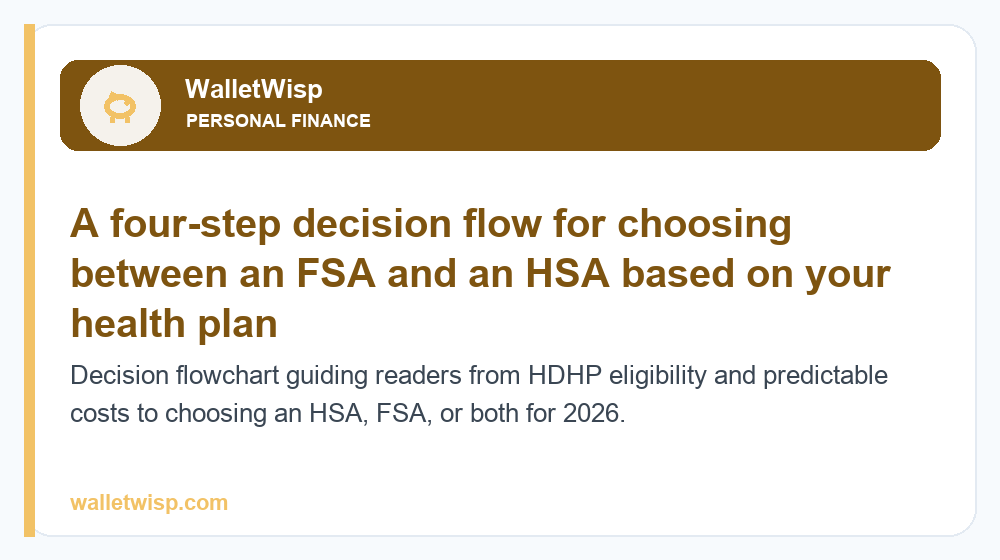
There is no universally correct answer — it depends on your health plan and your goals. Use this framework:
- Choose an HSA if you are enrolled in (or can switch to) an HDHP, you have some cash flow flexibility, and you want to build long-term, tax-free medical savings you can invest. The triple tax advantage and portability make it hard to beat.
- Choose an FSA if your health plan is not HDHP-qualified, your employer only offers an FSA, or you have a specific, predictable expense this year and want the full amount available up front.
- Consider both if your employer offers a limited-purpose FSA (dental/vision only) alongside an HDHP with an HSA. This lets you preserve your HSA for medical and long-term savings while using the FSA for routine eye and dental costs.
A common strategy for HSA-eligible savers: contribute enough to the HSA to capture any employer match, cover current bills from cash flow when possible, and let the HSA balance grow invested for future or retirement healthcare. If you are weighing where extra dollars should go across all your tax-advantaged accounts, our comparison of traditional vs Roth IRA for 2026 pairs naturally with the HSA decision, since both are pillars of a tax-efficient plan.
A quick decision checklist
- Does your health plan qualify as an HDHP? If yes, you can use an HSA.
- Do you have predictable, near-term medical costs? An FSA front-loads that money.
- Do you value keeping and investing the balance? That points to the HSA.
- Are you self-employed? A health FSA is not available — the HSA is your option.
Frequently Asked Questions
Can I have both an FSA and an HSA at the same time?
Not with a standard general-purpose health FSA — it disqualifies you from HSA contributions. You can, however, pair an HSA with a limited-purpose FSA that only covers dental and vision expenses, if your employer offers one. Always confirm the FSA type before enrolling in both.
What are the 2026 HSA contribution limits?
For 2026, you can contribute up to $4,400 with self-only HDHP coverage and $8,750 with family coverage. If you are 55 or older, you can add a $1,000 catch-up contribution on top of those amounts, and this is separate from IRA catch-up rules.
What is the 2026 FSA contribution limit?
The health FSA limit for 2026 is $3,400 per employee, regardless of family size. If your plan allows carryover, you can roll up to $680 of unused funds into the next plan year. The Dependent Care FSA has its own separate, higher limit.
What is the HSA triple tax advantage?
Contributions go in tax-free (deductible or pre-tax), the balance grows tax-free through interest and investment gains, and withdrawals for qualified medical expenses come out tax-free. No other common account combines all three benefits, which is why HSAs are prized for long-term savings.
Do FSA funds roll over each year?
Generally no — FSAs are use-it-or-lose-it. Employers may optionally offer a carryover of up to $680 for 2026 or a grace period of up to 2.5 months to spend the prior year’s balance, but not both. If your plan offers neither, unused funds are forfeited.
What happens to my HSA or FSA when I change jobs?
Your HSA is yours to keep — the balance follows you to your next job or into retirement, and you can move it to another custodian. An FSA is tied to your employer, so you typically forfeit any remaining balance when you leave, unless you elect COBRA continuation for it.
Can I invest the money in an HSA or FSA?
You can invest HSA funds once your balance passes your custodian’s investment threshold, allowing it to grow like a retirement account. FSA balances cannot be invested — they are held as cash and are meant to be spent on eligible expenses within the plan year.
Which is better for retirement, an FSA or an HSA?
The HSA, without question. Its funds roll over, can be invested, and after age 65 can be withdrawn penalty-free for any purpose (taxed as income for non-medical use, like a traditional IRA). An FSA offers no retirement benefit because balances generally must be spent each year.


