If you received a message saying a Cash App compensation payment is on the way, the honest answer is: it can be real, but a huge share of these messages are scams — and the only safe move is to verify through official channels before you click, reply, or pay anything. Real redress for Cash App customers does exist (it traces back to a 2025 settlement involving the Consumer Financial Protection Bureau), but scammers have latched onto that exact wording to trick people into handing over codes, fees, and account access.
This guide walks you through what the legitimate settlement actually is, how a genuine payment reaches you, the red flags that scream “fake,” and the simple rule that protects you no matter how convincing the message looks. By the end you’ll be able to glance at one of these messages and know in seconds whether to act on it or delete it.
Quick answer: There is a real basis for Cash App customer redress — Block, Inc. (Cash App’s owner) reached a settlement with regulators in 2025 over how it handled fraud complaints and account security. Eligible customers may receive money. But legitimate redress is processed automatically through your Cash App balance, your linked bank, or an official settlement administrator — it never requires you to pay a fee, share a verification code, “confirm” your PIN, or click a link in an unsolicited text. If a “compensation payment” message asks for any of those things, it’s a scam.
Where the real “Cash App compensation payment” comes from
The reason this phrase is everywhere is that something genuine sits underneath it. In early 2025, the Consumer Financial Protection Bureau (CFPB) ordered Block, Inc. — the company behind Cash App — to provide redress to consumers and pay a civil penalty over the way it handled fraud disputes, unauthorized transactions, and customer support. As part of that kind of action, affected customers can be entitled to refunds or compensation.
That is the seed of truth scammers exploit. Because real headlines ran about a “Cash App settlement” and “compensation for affected users,” a text or email using those words feels plausible. Fraudsters don’t have to invent a story from scratch — they just borrow a real one and bolt on a malicious link or a request for money.
It’s worth being precise about what the legitimate process looks like, because the differences are your defense. When regulators require a company to pay redress, the money is distributed in controlled, predictable ways — not through random texts that demand urgent action.
How genuine redress actually reaches you
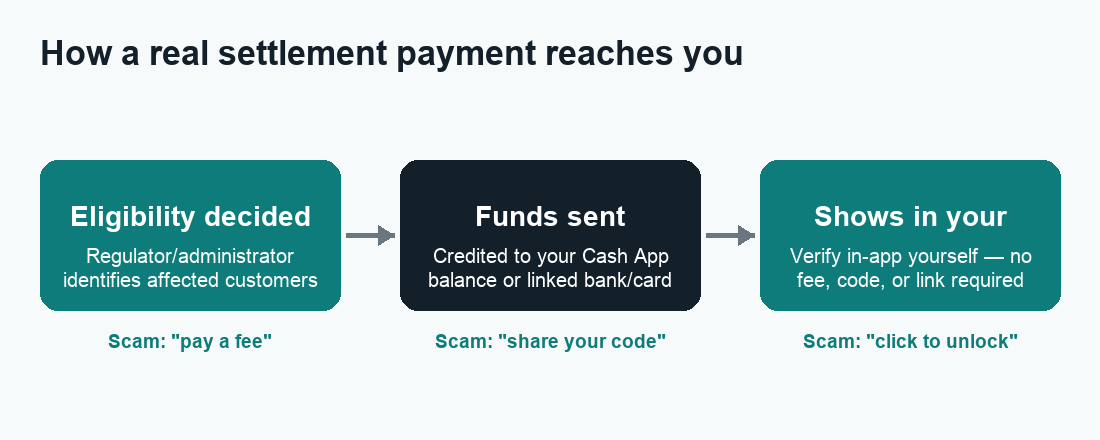
- Automatically, in most cases. If you’re eligible, the company or a court-appointed settlement administrator typically credits your Cash App balance or sends funds to the bank or card on file. You usually don’t have to “claim” anything urgently.
- Through an official administrator, if a claim is needed. Some settlements use a dedicated claims website run by an independent administrator. The web address is published in official notices — not delivered to you in a surprise text.
- With no fees, ever. You never pay to receive money you’re owed. Not a “processing fee,” not “taxes upfront,” not a “release fee.”
- Without asking for secrets. A legitimate payout never needs your PIN, your sign-in code, your full card number, or remote access to your phone.
If you want to confirm whether a real program applies to you, go directly to the source: open the Cash App app and check your activity and notifications, or look up announcements on consumerfinance.gov (the CFPB’s official site). Type those addresses yourself — don’t follow a link someone sent you.
Why scammers love the words “compensation payment”
“Compensation” does something powerful to the brain: it frames the message as money you’re owed, not money you’re being asked for. That flips your guard down. People scrutinize a “you owe us” message far more carefully than a “here’s your refund” message. Scammers know this, so they wrap a theft inside the language of a gift.
They also pair it with urgency (“claim within 24 hours”), authority (“official Cash App / CFPB notice”), and a small action that feels harmless (“just confirm your details”). Each of those is a lever, and together they push a surprising number of careful people into a costly mistake.
Red flags: how to spot a fake compensation message
You don’t need to be a security expert. Almost every scam version of this message trips at least one of these wires. If you see even one, treat the message as fraudulent.
| What the message does | Real settlement payment? | What it usually means |
|---|---|---|
| Asks you to pay a fee or “taxes” to release the money | Never | Advance-fee scam — you’ll pay and get nothing |
| Requests a verification / sign-in code from your phone | Never | Account takeover — they’re logging into your account |
| Asks for your PIN, full card number, or password | Never | Credential theft |
| Includes a link to “claim now” from a text or DM | Almost never | Phishing site that mimics Cash App |
| Demands action within hours or the payment is “lost” | No | Pressure tactic to stop you thinking |
| Comes from a personal phone number, Gmail, or random handle | No | Spoofed sender impersonating support |
| Tells you to download an app or grant screen access | Never | Remote-control takeover of your device |
| Sends a “payment” then asks you to send some back | No | Reversal/overpayment scam |
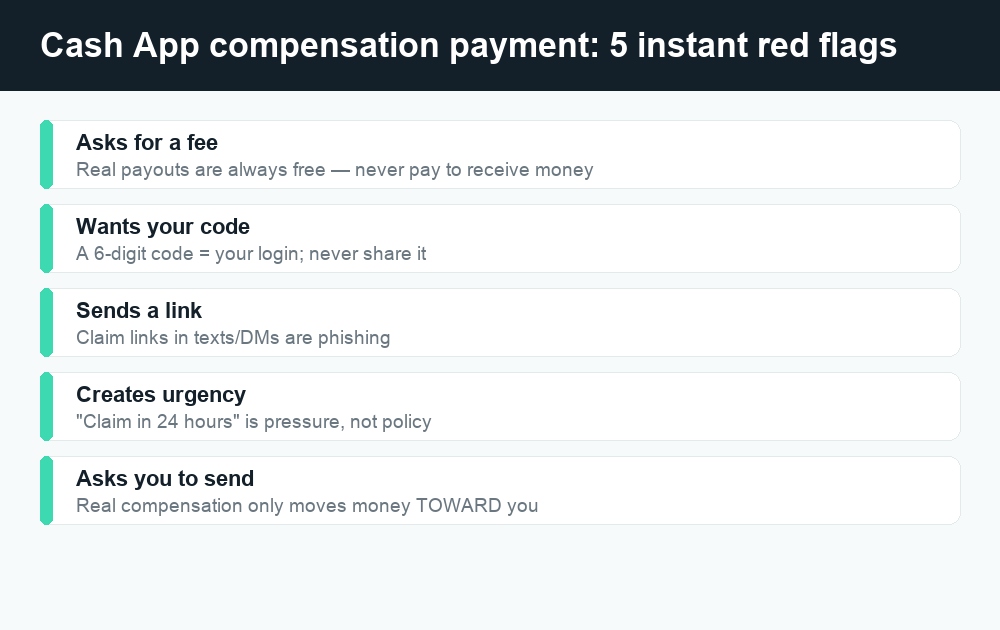
Here’s the single rule that covers all of them: a real compensation payment only ever moves money toward you. The moment a message asks you to send money, send a code, or send personal secrets, it’s a scam — full stop.
The most common scam scripts going around
Understanding the playbook makes the next message easy to read. These are the variations people report most often:
- The fee trap. “Your $750 compensation is approved. Pay a $25 processing fee to release it.” You pay, the money never arrives, and now they have your card details too.
- The code thief. “To verify your identity for your payout, read me the 6-digit code we just texted you.” That code is your login or password-reset code. Hand it over and they take your account.
- The fake claim site. A link to a page that looks like Cash App and asks you to “sign in” to receive funds. You’re typing your real password straight into their hands.
- The overpayment reversal. They send a small “compensation,” then claim they accidentally sent too much and ask you to return the difference. The original “payment” is fake or reversed; your repayment is real.
- The support impostor. Someone claiming to be Cash App support “helping” you claim compensation, who then walks you into installing a screen-sharing app so they can drain your balance live.
What Cash App and the CFPB will never ask you to do
Memorize this short list. If a message crosses any of these lines, it isn’t legitimate, no matter how official the logo looks.
- They will never ask you to pay a fee to receive money you’re owed.
- They will never ask for your sign-in code, PIN, password, or the full number on your card.
- They will never ask you to download a screen-sharing or “remote support” app.
- They will never pressure you to act in minutes or threaten that your payment will vanish.
- They will never ask you to move money to a “safe account,” buy gift cards, or send crypto.
- The CFPB will never contact you to demand payment or personal account secrets to release a settlement.
Real Cash App support lives inside the app (Profile, then Support) and at the official cash.app website. The CFPB lives only at consumerfinance.gov. Anything outside those isn’t them.
What to do if you get one of these messages
Stay calm — receiving the message doesn’t put you at risk. Acting on it does. Here’s the safe sequence:
- Don’t click, reply, or call back. Treat any link or callback number in the message as hostile.
- Open Cash App yourself. Launch the app directly (not via any link) and check your Activity and notifications. A real credit shows up in your balance and history — you won’t need a stranger to “unlock” it.
- Verify the settlement independently. Search for the official CFPB action at consumerfinance.gov and look for any official settlement administrator. Confirm eligibility there, not through the message.
- Report and block. Mark the text as junk/spam, report the sender, and in the U.S. you can forward suspicious texts to 7726 (SPAM). Report phishing emails through your email provider.
- If you already shared something, act fast. Change your Cash App PIN and password, revoke any device or app access you were tricked into granting, contact your bank or card issuer, and report it to the FTC at reportfraud.ftc.gov.
A quick way to sanity-check any “payment is on the way” message
Before reacting to a surprise message about money — whether it’s a Cash App compensation payment, a refund, or a transfer that’s “stuck” — ask three questions: Am I being asked to send anything (money, a code, a password)? Is there urgency designed to rush me? Did this arrive unsolicited from a sender I can’t verify? A “yes” to any one of them means stop. This same instinct helps with everyday confusion too, like a Cash App payment that shows as pending or a Venmo payment stuck on pending — real money movements have clear, in-app explanations and never demand secrets.
Real settlement payment vs. scam: side by side
| Feature | Legitimate redress | Scam message |
|---|---|---|
| How it arrives | Auto-credit to your balance/bank, or via an official administrator | Unexpected text, email, DM, or call |
| Cost to you | $0 — always free | “Fee,” “tax,” or “release charge” required |
| Info requested | None secret; eligibility confirmed on official site | Code, PIN, password, card number, or remote access |
| Timing pressure | None — you have time to verify | “Act in 24 hours or lose it” |
| Where to confirm | cash.app and consumerfinance.gov (typed yourself) | A link or number they provide |
| Direction of money | Toward you only | They eventually ask you to send |
Protect your Cash App account either way
Whether or not any compensation applies to you, this surge of impersonation is a good reason to tighten up your account. A few minutes now removes most of a scammer’s leverage.
- Turn on the Security Lock so a PIN or biometric is required for payments.
- Enable notifications so you see every transaction instantly and can react fast to anything unexpected.
- Never share a verification code — it’s the single most common takeover trick.
- Only use in-app support. There is no real “Cash App support phone line” that calls you out of the blue; reach support through the app.
- Be skeptical of “free money.” Fake giveaways and “compensation” offers thrive on social media and in your DMs.
While you’re reviewing your money apps, it’s also worth understanding the everyday basics — what you actually pay in Cash App fees, and how those compare to Venmo’s fees — so an inflated “fee to release your payment” looks obviously wrong the moment it lands.
Frequently asked questions
Is the Cash App compensation payment real?
There is a real basis for redress: a 2025 settlement involving Block, Inc. (Cash App’s owner) and the CFPB. Some customers may be eligible for money. But the existence of a real settlement is exactly why scam versions spread so easily — verify any specific message through cash.app and consumerfinance.gov before acting on it.
How will I actually receive a legitimate settlement payment?
Typically as an automatic credit to your Cash App balance or your linked bank/card, or through an official, court- or regulator-approved claims administrator. You won’t need a stranger, a fee, or a code to “unlock” it, and it will appear in your in-app Activity.
Do I have to pay a fee to claim my compensation?
No. You never pay to receive money you’re owed. Any request for a processing fee, tax, or release charge upfront is a definitive sign of a scam.
Someone asked for the 6-digit code to “verify” my payout — is that safe?
No. That code is your login or password-reset code. Anyone asking for it is trying to take over your account. Cash App will never ask you to read a code to a person, and a legitimate payout never requires it.
I clicked a link and entered my details — what now?
Act quickly. Change your Cash App PIN and password, remove any device or app access you granted, alert your bank or card issuer, watch your Activity for unauthorized transactions, and report it to the FTC at reportfraud.ftc.gov. If your password is reused elsewhere, change it on those accounts too.
How do I report a Cash App scam text?
Don’t reply. In the U.S., forward the text to 7726 (SPAM), mark it as junk, and block the sender. Report phishing emails through your email provider, and report the fraud to the FTC at reportfraud.ftc.gov.
Will the CFPB ever contact me directly about a payment?
The CFPB will never call, text, or email you to demand a fee or your account secrets to release money. Genuine settlement communications come from an official administrator and are published on the CFPB’s own site, consumerfinance.gov. Anyone contacting you “from the CFPB” asking for payment or codes is impersonating it.
Is it safer to just delete these messages?
Yes — for the vast majority, deleting (after reporting) is the right call. If you’re genuinely eligible for redress, you’ll be reached through official, no-strings channels and the money will show up in your balance or bank on its own. You lose nothing by ignoring an unsolicited “compensation” message and verifying on your own terms.
Last updated: June 2026. Fees, limits, and features can change — always confirm current details in the app. WalletWisp is an independent guide and is not affiliated with any app mentioned. This article is general information, not financial advice.
Related: Why is my Cash App payment pending? · Is Zelle safe to use? · More Cash App guides