
The best cash back credit cards in 2026 fall into three types: flat-rate cards that pay one simple rate (typically 1.5%–2%) on everything, bonus-category cards that pay 3%–6% in fixed categories like groceries or dining, and rotating-category cards that pay 5% in quarterly categories you activate. For most people, the smartest move is a no-annual-fee 2% flat-rate card as a base, paired with one bonus-category card for your biggest spending area. Stack two or three cards and you can realistically earn an effective 2.5%–4% back across all your spending without paying a single annual fee.
Below, we break down each card type, share no-annual-fee picks, and show you exactly how to combine cards, redeem rewards, and match a strategy to how you actually spend. The best cash back credit cards aren’t about finding one perfect card, they’re about building a simple system you’ll actually use.
The three types of cash back credit cards
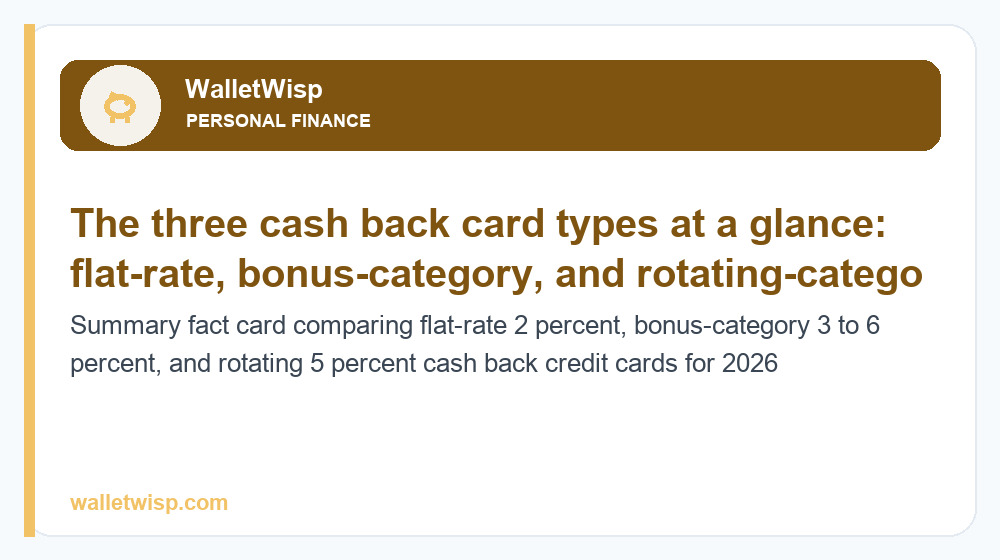
Every cash back card fits into one of three buckets. Understanding the trade-offs is the whole game, because the “best” card depends entirely on your spending habits and how much effort you want to put in.
1. Flat-rate cards (simple, set-and-forget)
Flat-rate cards pay the same percentage on every purchase, no categories, no activation, no tracking. The market standard in 2026 is 2% on everything, though 1.5% cards are still common and a few premium options push to 2.5% or higher with conditions (like keeping deposits at the same bank).
These are ideal if you value simplicity, have spending spread across many categories, or want a reliable “catch-all” card for purchases that don’t earn bonus rewards elsewhere. The downside: you’ll never beat a 5% category card in its sweet spot.
2. Bonus-category cards (fixed high rates where you spend)
Bonus-category cards pay elevated rates, usually 3%–6%, in specific, unchanging categories such as groceries, dining, gas, streaming, or online shopping. Everything outside those categories typically earns just 1%.
The best fit is someone with concentrated spending. If groceries and dining are your two biggest line items, a card paying 4%–6% there can dramatically out-earn a flat 2% card. Watch for annual spending caps (common on grocery cards, often $6,000/year) after which the rate drops to 1%.
3. Rotating-category cards (5% that changes quarterly)
Rotating-category cards pay a high rate, classically 5%, in categories that change every three months, up to a quarterly cap (usually $1,500 in spending, then 1%). You must activate each quarter’s categories, and forgetting means you earn the base rate instead.
These reward engaged users who don’t mind logging in four times a year and shifting spending to match the calendar. Many issuers also offer a first-year cash back match, effectively doubling your earnings to 10% in those categories for 12 months, which can make them the highest-value card for an attentive user.
Cash back card types compared
Here’s how the three types stack up on the factors that actually affect your wallet:
| Feature | Flat-rate | Bonus-category | Rotating-category |
|---|---|---|---|
| Typical rate | 1.5%–2% on all | 3%–6% in fixed categories, 1% else | 5% in rotating categories, 1% else |
| Effort required | None | Low | Medium (quarterly activation) |
| Spending caps | Usually none | Often $6,000/yr per category | ~$1,500/quarter, then 1% |
| Annual fee | Usually $0 | $0 to ~$95 | Usually $0 |
| Best for | Simplicity seekers, broad spenders | Concentrated spenders | Engaged optimizers |
| Biggest weakness | Never beats 5% in a category | Low rate outside categories | Caps + activation hassle |
Note: all rates and caps above are typical 2026 ranges, not guarantees for any specific card. Always confirm current terms on the issuer’s page before applying, since rewards structures change frequently.
Best no-annual-fee cash back picks by need
You do not need to pay an annual fee to earn excellent cash back in 2026. No-fee cards dominate this space because the math is cleaner, there’s no break-even hurdle to clear. Here’s how to think about picks by category rather than chasing a single “winner,” since approval odds and available cards vary by person and country.
| If you want… | Card type to look for | Target features |
|---|---|---|
| One card, zero effort | Flat-rate | 2% on everything, $0 fee, no foreign transaction fee |
| Max grocery/dining rewards | Bonus-category | 3%–6% groceries or dining, watch the annual cap |
| Highest possible rate | Rotating-category | 5% quarterly + first-year cash back match |
| Online + everyday mix | Bonus-category | Customizable or 3% online shopping + 2% everyday |
| Building credit while earning | Flat-rate (starter/secured) | 1%–2% flat, reports to all bureaus, $0 fee |
| Travel flexibility with cash option | Flat-rate travel | 1.5%–2% back, redeem as cash or travel |
If your credit isn’t where you want it yet, focus on approval first. A starter or secured flat-rate card that reports to all three bureaus lets you earn rewards while you build history. See our guide on how to improve your credit score in 2026 for the fastest levers, since a higher score unlocks the premium bonus-category cards later.
How to choose the right card for you
Skip the “best card” listicles and start with your own spending. Follow these steps:
- Pull 2–3 months of statements. Add up spending by category: groceries, dining, gas, online shopping, bills, everything else.
- Find your top 1–2 categories. If they make up 40%+ of your spending, a bonus-category card will likely out-earn a flat-rate card.
- Estimate the math. Multiply annual spend in each category by the reward rate. A 2% flat card on $30,000/year is $600. A 5% category card on $6,000 of groceries is $300, but only $60 more than the flat card would earn on that same $6,000.
- Weigh the effort. If you’ll forget to activate rotating categories, that 5% is really 1%. Be honest.
- Check the fee break-even. A $95 annual-fee card needs to out-earn a $0 card by more than $95/year to be worth it. Many people never clear that bar.
- Confirm the fine print. Foreign transaction fees, redemption minimums, and category caps all quietly erode value.
How to stack cards for maximum rewards
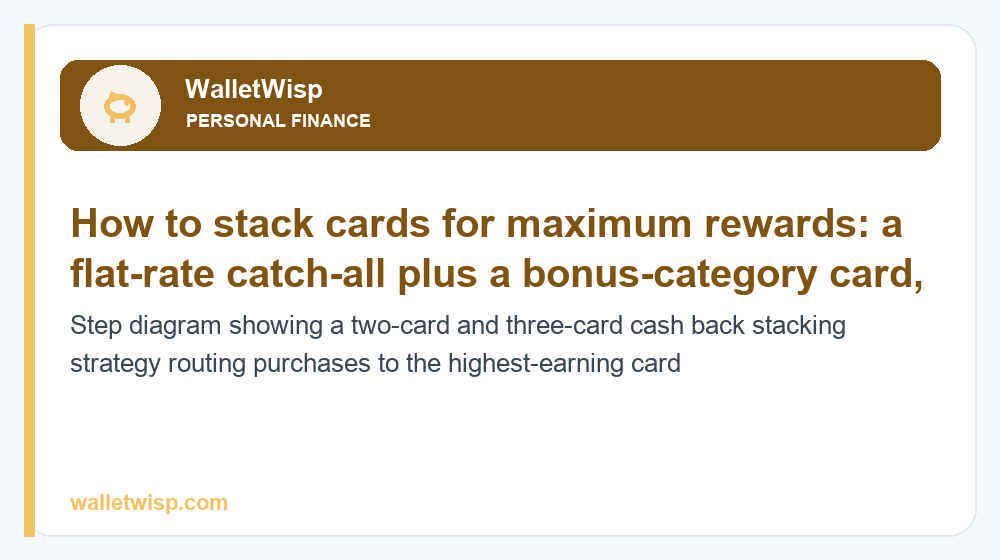
The real earning power comes from combining cards so each purchase lands on the card that pays the most. This is often called building a “card stack” or “trifecta.” The best cash back credit cards work as a team, not solo acts.
The two-card core (recommended for most)
- Card A – Flat-rate 2% catch-all: Use for everything that doesn’t earn a bonus elsewhere.
- Card B – Bonus-category: Use only for its high-earning categories (say, 4%–6% groceries and dining).
This simple pair can lift your blended rate from a flat 2% to roughly 2.5%–3% with almost no extra effort, because your biggest categories now earn much more while everything else still earns a solid 2%.
The three-card power stack (for optimizers)
- Card A – Flat-rate 2% for the true catch-all.
- Card B – Bonus-category for groceries/dining year-round.
- Card C – Rotating 5% for whatever quarter’s category applies (gas, wholesale clubs, online shopping, etc.).
Done well, this can push your effective rate toward 3.5%–4% across all spending. The trade-off is managing three due dates, three statements, and quarterly activations, so only build this if you’ll stay organized.
Stacking rules that protect you
- Always pay in full. Cash back is worthless if you carry a balance, interest rates in 2026 routinely exceed 20% APR, which dwarfs any 2%–5% reward.
- Automate payments so juggling multiple cards never causes a missed payment. Payment history is the single biggest factor in your credit score.
- Don’t overspend to chase rewards. Earning 5% back by buying things you don’t need is a 95% loss.
- Watch your credit utilization across all cards. More cards actually raise your total available credit, which can help your score if you keep balances low.
Curious how newer payment methods interact with your credit file as you stack? Read whether Buy Now, Pay Later affects your credit score before mixing BNPL with your cash back strategy.
Redemption tips: getting full value
Earning cash back is only half the equation, how you redeem it determines what it’s actually worth.
- Statement credit and direct deposit are usually the cleanest 1:1 redemptions, your points/cash convert dollar-for-dollar with no gimmicks.
- Avoid low-value redemptions. Some portals let you redeem for gift cards or merchandise at less than 1 cent per point. Cash or statement credit almost always wins.
- Mind redemption minimums. A few cards require you to accumulate $20–$25 before redeeming. Set rewards to auto-redeem if the option exists.
- Don’t hoard rewards indefinitely. Cash back rarely appreciates and can be forfeited if you close the account. Redeem regularly.
- Check for redemption bonuses. Some issuers add a bonus (e.g., 10%) when you redeem into a linked checking or savings account, effectively boosting your rate.
Speaking of linked accounts, cash back pairs well with other easy wins. If you’re optimizing your finances this year, our roundup of the best bank account bonuses shows how to earn hundreds more with a one-time account switch.
Who each card type is best for
Flat-rate: the busy simplifier
You want one card, one rate, no thinking. Your spending is spread across many categories, or you simply refuse to track quarters. A 2% flat card is your best friend and often the single most valuable card a “one-card person” can own.
Bonus-category: the concentrated spender
Your grocery and dining (or gas, or online) spending is heavy and predictable. You’ll happily use a dedicated card for those purchases and a catch-all for the rest. This is the sweet spot for most households with kids and regular grocery runs.
Rotating-category: the engaged optimizer
You enjoy squeezing out every dollar, you’ll activate quarterly categories, shift spending to match, and chase a first-year cash back match. If that sounds fun rather than annoying, rotating cards can deliver the highest headline rate of all.
Frequently Asked Questions
What is the best type of cash back credit card for beginners?
A no-annual-fee flat-rate card paying 2% on everything is the best starting point. It requires zero tracking, no category activation, and no math, making it nearly impossible to “use wrong.” Once you’re comfortable, you can add a bonus-category card for your top spending area.
Is a flat-rate or bonus-category card better?
It depends on your spending. If one or two categories make up 40% or more of your budget, a bonus-category card usually wins. If your spending is spread evenly across many categories, a flat 2% card typically earns more overall with far less effort.
How many cash back cards should I have?
Most people do best with one or two: a flat-rate catch-all plus one bonus-category card. Dedicated optimizers can benefit from a three-card stack, but only add cards you’ll manage responsibly. More cards mean more due dates, though they also raise your total available credit.
Do cash back rewards expire?
On most cards, rewards don’t expire as long as your account stays open and in good standing. However, closing the account (or a long period of inactivity, on some cards) can forfeit unredeemed cash back. Redeem regularly to avoid losing anything.
Will opening multiple cards hurt my credit score?
Each application triggers a small, temporary dip from the hard inquiry, but the long-term effect is often positive. More cards increase your total available credit, which lowers your utilization ratio if you keep balances low. Paying every card on time is what matters most.
Are no-annual-fee cash back cards worth it?
Absolutely, they’re often the best value in 2026. Because there’s no fee to overcome, every dollar of cash back is pure profit. Annual-fee cards only make sense if their higher rewards clearly out-earn a $0 card by more than the fee each year.
How do I actually redeem cash back for the most value?
Choose statement credit or direct deposit, which typically convert dollar-for-dollar. Avoid gift-card or merchandise redemptions that value points below 1 cent each. If your issuer offers a bonus for redeeming into a linked bank account, that’s usually the highest-value option.
Can I use cash back cards while building credit?
Yes. Several starter and secured cards offer 1%–2% flat cash back while reporting to all three credit bureaus, so you build history and earn rewards at once. Keep utilization low and pay in full, then upgrade to premium bonus-category cards as your score improves.


