
Yes, buy now, pay later (BNPL) can affect your credit score in 2026 — but how much depends entirely on which provider you use and how you pay. Affirm now reports its plans to two major credit bureaus, Klarna reports its longer financing loans, and Afterpay still does not report at all, so the same purchase could touch your credit file differently depending on the app you tapped at checkout.
Quick answer: BNPL affects your credit differently by provider. Affirm reports pay-over-time loans to Experian and TransUnion, so on-time payments can help and missed ones can hurt. Klarna reports its longer term-loan financing (not standard Pay in 4) to bureaus, while Afterpay does not report on-time activity to U.S. bureaus as of mid-2026. Missed payments and debt sent to collections can damage your score with any provider, and FICO now has scoring models that can factor BNPL in. Always confirm current policies in the app before you rely on BNPL to build credit.
How buy now, pay later actually works
Buy now, pay later lets you split a purchase into smaller payments instead of paying the full price at checkout. There are two main flavors, and the difference matters a lot for your credit.
The first and most common is the "Pay in 4" model: you split the total into four equal, interest-free installments, typically paid every two weeks over about six weeks. You make the first payment at checkout and the rest are auto-charged to your linked debit card, credit card, or bank account. This is the classic short-term BNPL that Klarna, Afterpay, and others popularized.
The second is monthly financing: a longer installment loan spread over 3, 6, 12, 24, or even 36 months. These larger plans often carry interest (sometimes 0% promotional, sometimes not), and they behave much more like a traditional loan. Affirm is well known for this style, and it is these longer plans that are most likely to show up on your credit report.
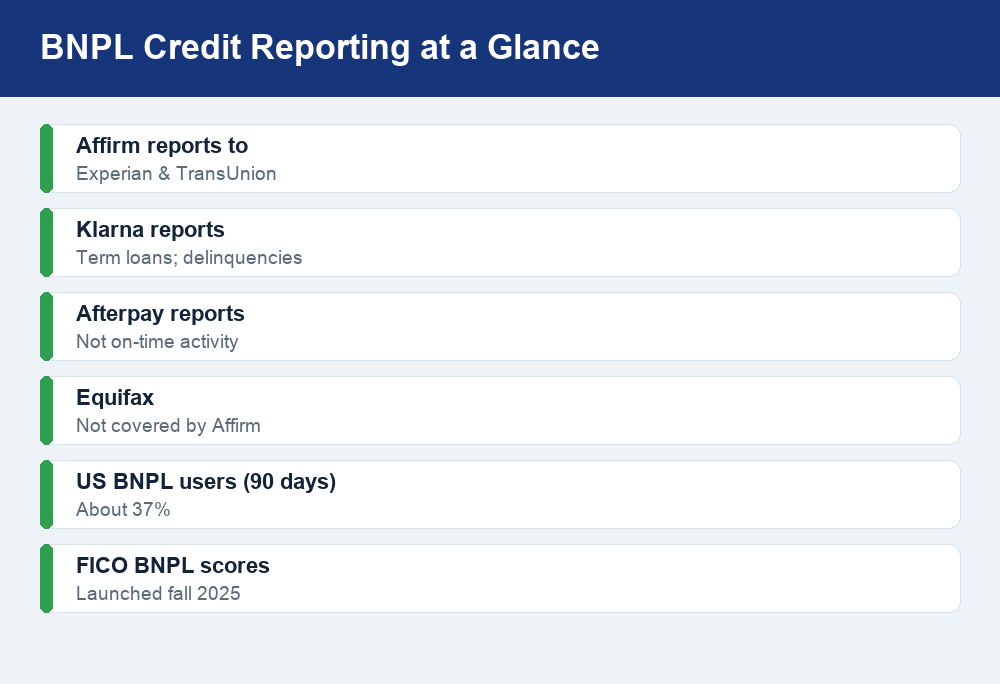
BNPL exploded in popularity because it is fast and feels frictionless. Roughly 37% of U.S. consumers reported using a BNPL service in a recent 90-day window, and it is especially common with younger shoppers and online checkouts. That convenience is real — but it is also exactly why overspending and credit surprises can sneak up on people. If you want the mechanics of one popular option, our breakdown of how PayPal Pay in 4 works in 2026 walks through a typical Pay in 4 schedule step by step.
Which BNPL providers report to credit bureaus?
This is the heart of the question. For years, the big selling point of BNPL was that it stayed off your credit report — no hard inquiry, no new account, no impact either way. That is changing quickly in 2026 as regulators, credit bureaus, and the scoring companies push for more transparency. Here is where the three biggest names stand.
Affirm
Affirm is the most credit-report-active of the three. In 2025 it expanded its reporting so that all of its pay-over-time products — including short Pay in 4 plans and longer monthly loans — are reported to Experian and TransUnion. That means responsible, on-time Affirm payments can add positive history to two of your three main credit files, and missed payments can now show up as negatives on both. As of mid-2026, Affirm still does not report to Equifax.
One important nuance: appearing on your credit file is not the same as instantly moving your credit score. Much of this newer BNPL data was not yet fully weighted in traditional FICO and VantageScore calculations at launch, and the two bureaus have handled visibility differently. The trend, though, is clearly toward BNPL activity counting more over time — so treat every Affirm plan as if it can affect your score.
Klarna
Klarna began sharing U.S. data with TransUnion, and it reports its longer term-loan financing (the multi-month plans) to the bureaus. Klarna has also said it reports delinquencies — meaning if you fall seriously behind, that negative mark can reach your credit file even on products that otherwise stay off it. As of 2026, Klarna’s standard, interest-free Pay in 4 generally does not report on-time activity to the bureaus for score-building purposes, so paying those four installments perfectly usually will not help your score the way a reported loan would.
Afterpay
Afterpay has historically kept its BNPL activity off U.S. credit reports entirely, and as of mid-2026 it still does not report on-time payment activity to the bureaus. The company has publicly said it wants clear evidence that reporting short-term BNPL data will help rather than hurt consumers before it does so, and it declined to participate in FICO’s newest BNPL-inclusive scoring model at launch. That said, the whole industry is shifting toward reporting under regulatory pressure, so this could change — and even today, if an Afterpay balance goes unpaid and is sent to a collections agency, that collection can land on your credit report and hurt your score.
| Provider | Reports to bureaus? | Which bureaus | Reports missed payments? |
|---|---|---|---|
| Affirm | Yes — all pay-over-time products | Experian & TransUnion (not Equifax) | Yes |
| Klarna | Longer term-loan financing yes; standard Pay in 4 generally no | TransUnion (U.S. reporting); term loans to bureaus | Yes — reports delinquencies |
| Afterpay | Not currently for on-time activity | None for on-time payments | Unpaid debt sent to collections can still appear |
Because these policies are shifting fast, the single most reliable move is to check the current terms inside the app or on the provider’s official website before you assume a plan will (or won’t) touch your credit. What was true last year may not be true today.
How BNPL can help your credit — and how it can hurt
Now that some BNPL activity reaches the bureaus, it can cut both ways.
How it can help: When a provider like Affirm reports your loan and you pay every installment on time, you build positive payment history — the single biggest factor in most credit scores. For someone with a thin credit file (few accounts), a reported and well-managed BNPL loan can add data that helps establish a track record. FICO even launched dedicated scoring models in fall 2025 — FICO Score 10 BNPL and 10 T BNPL — designed to fold BNPL behavior into the score, and its research found that many responsible BNPL users saw their scores hold steady or improve.
How it can hurt: The flip side is just as real. A single missed or late payment on a reported loan can become a negative mark on your credit file. Opening several BNPL plans in a short window can look risky to lenders, and any balance that spirals into collections is a serious drag on your score with any provider — even one that doesn’t report on-time activity. BNPL can also crowd out room in your budget for bills that clearly do affect your credit, like your credit card minimums. If you’re actively trying to raise your number, our guide to practical ways to improve your credit score in 2026 pairs well with a cautious BNPL habit.
The hidden risk: loan stacking and overspending
The biggest danger with BNPL usually isn’t the credit reporting — it’s the psychology. Splitting a $200 purchase into four $50 payments makes it feel cheaper, which nudges people to buy more than they otherwise would. That’s by design.
The problem compounds with loan stacking: opening several BNPL plans across different apps at the same time. Because each provider approves you independently and many don’t share data in real time, it’s easy to end up juggling five or six overlapping payment schedules from Affirm, Klarna, Afterpay, and others at once. Suddenly a big chunk of your paycheck is committed to auto-charges you’ve half forgotten about, and one bounced payment can trigger late fees or a cascade of overdrafts.
This is exactly the behavior FICO flagged in its research: a large number of BNPL loans opened in a short period is a distinctive pattern, and the new models are built to notice it. The fix is simple in principle — treat every BNPL plan as real debt, because it is. If BNPL has already helped you run up balances you’re struggling to clear, our walkthrough on how to pay off credit card and installment debt in 2026 can help you build a payoff plan before the interest and fees pile up.
Responsible-use tips for BNPL in 2026
BNPL isn’t inherently bad — used carefully, it’s a convenient, often interest-free way to spread a cost. These habits keep it from wrecking your credit or your budget:
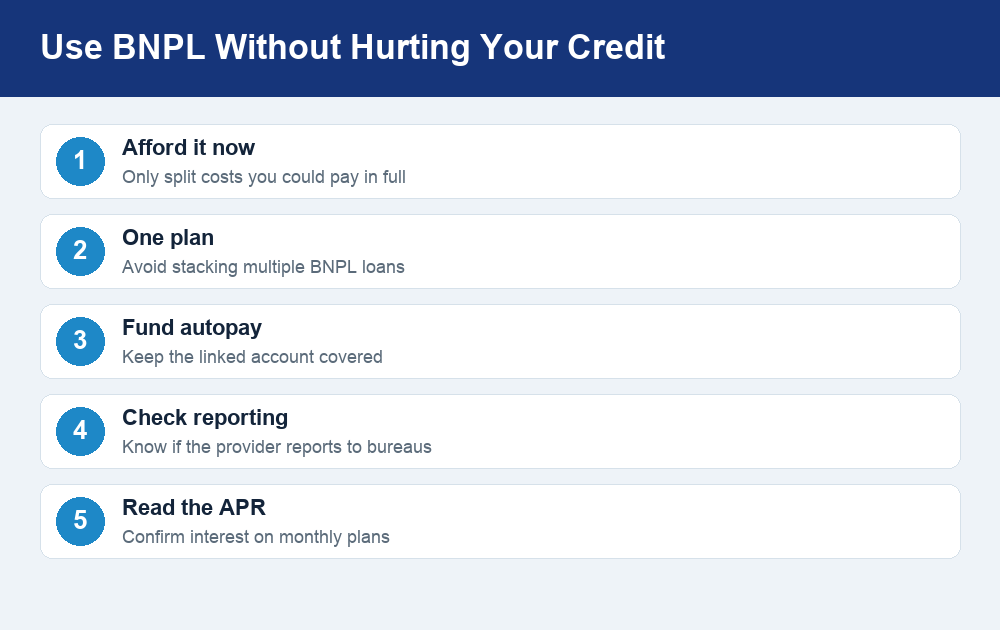
- Only buy what you could pay for in full today. If the full price would strain your budget, splitting it into four payments doesn’t make it affordable — it just delays the strain.
- Limit yourself to one plan at a time. Avoiding loan stacking is the easiest way to prevent a pile-up of overlapping auto-charges.
- Turn on autopay with a funded account. The most common way BNPL hurts credit is a missed payment. Make sure the linked account always has enough to cover the next installment.
- Know your provider’s reporting policy. If your goal is building credit, use a provider that reports on-time activity (like Affirm). If you just want convenience, know that a missed payment or collection can still bite even with non-reporting providers.
- Read the interest terms on monthly plans. Pay in 4 is usually interest-free, but longer financing can carry real APR. Confirm the rate and total cost before you commit.
- Track every plan in one place. A simple note or budgeting app listing each BNPL due date keeps surprises off your calendar — and off your credit report.
Frequently asked questions
Does using BNPL show up on my credit report?
It depends on the provider and product. Affirm reports its pay-over-time loans to Experian and TransUnion, so those can appear on your report. Klarna reports its longer term-loan financing to bureaus (and reports delinquencies), while its standard Pay in 4 generally does not report on-time activity. Afterpay does not currently report on-time activity to U.S. bureaus. Because these policies keep changing, confirm the current terms in the app before assuming.
Can buy now, pay later help me build credit?
It can, but only if the provider actually reports your on-time payments to the credit bureaus — and you pay every installment on time. Affirm is currently the most likely of the three to add positive history to your file. A BNPL plan that never reaches the bureaus won’t build your score no matter how perfectly you pay it.
Will a missed BNPL payment hurt my credit score?
It can. With providers that report to the bureaus, a late or missed payment can post as a negative mark. And with any provider, an unpaid balance that gets sent to a collections agency can appear on your credit report and drag your score down. Turning on autopay with a funded account is the simplest safeguard.
Does opening a BNPL plan trigger a hard credit inquiry?
Most short-term Pay in 4 plans use only a soft check or no bureau check at all, so they typically don’t cause the hard inquiry that can nick your score. Longer monthly financing loans are more likely to involve a hard pull. The provider will usually disclose which type of check it runs during checkout — look for that detail before you confirm.
How does the new FICO BNPL scoring work?
In fall 2025, FICO introduced scoring models — FICO Score 10 BNPL and 10 T BNPL — that can incorporate BNPL data, including a method that aggregates multiple BNPL loans to reflect how these products are actually used. Lenders have to choose to use these models, so adoption is gradual. The practical takeaway is unchanged: pay on time and don’t stack loans.
The bottom line
So, does buy now, pay later affect your credit score? Increasingly, yes — but the answer is provider-specific. In 2026, Affirm reports pay-over-time loans to Experian and TransUnion, Klarna reports its longer financing (and delinquencies), and Afterpay still holds most activity off U.S. reports while the industry drifts toward more reporting under regulatory pressure. The safest approach is to treat every BNPL plan as a real loan: borrow only what you can already afford, avoid stacking multiple plans, keep autopay funded, and verify each provider’s current reporting policy in the app. Do that, and BNPL can be a handy tool instead of a quiet threat to your credit.


