Chime vs Varo in 2026 comes down to one core trade-off: Varo is a real, federally chartered bank with a much higher savings APY, while Chime is a fintech (backed by partner banks) with a more generous fee-free overdraft cushion. Both charge no monthly fee, no minimum balance, and offer early direct deposit plus a no-interest credit-builder card. Pick Varo if a top savings rate and a larger cash advance matter most; pick Chime if you want the biggest fee-free overdraft (SpotMe) and one of the widest ATM networks.
Below is a full, side-by-side breakdown of how Chime and Varo compare on the features that actually move money in and out of your account — so you can match the right account to how you bank.
Chime vs Varo at a glance
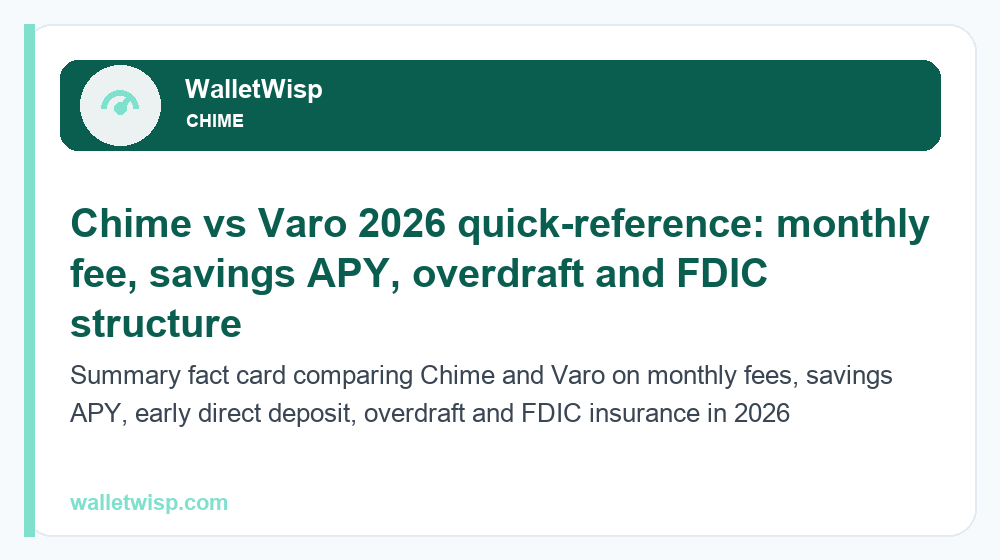
Here is the fast comparison. Rates and limits are typical 2026 figures and can change, so always confirm the current number in each app before you open an account.
| Feature | Chime | Varo |
|---|---|---|
| Monthly fee | $0 | $0 |
| Minimum balance / opening deposit | None | None |
| Savings APY (typical) | ~2.00% APY | ~3.00% base, up to ~5.00% with conditions (first $5,000) |
| Early direct deposit | Up to 2 days early | Up to 2 days early |
| Overdraft / short-term cash | SpotMe: fee-free, $20–$200 | Varo Advance: $20–$500 (fee applies) |
| Credit-builder card | Credit Builder Secured Visa (no interest, no annual fee) | Varo Believe secured card (no interest, no annual fee) |
| Fee-free ATM network | 60,000+ (MoneyPass, Visa Plus Alliance) | 55,000+ (Allpoint) |
| Cash deposits | Green Dot retailers; free at Walgreens | Green Dot retailers |
| Who holds your money | Partner banks (The Bancorp Bank, N.A.; Stride Bank, N.A.) | Varo Bank, N.A. (chartered bank) |
| FDIC insured | Yes, via partner banks (up to $250,000) | Yes, directly (up to $250,000) |
Monthly fees and account basics
This is the easiest tie to call: neither Chime nor Varo charges a monthly maintenance fee, an overdraft fee, or a minimum-balance fee. Both drop the usual traditional-bank costs — no monthly service charge, no minimum to open, and no penalty for a low balance. Both also give you a Visa debit card, a mobile app, mobile check deposit, and instant transaction alerts.
Where you can still be charged with either provider: out-of-network ATM withdrawals, cash-deposit fees at third-party retailers, and — with Varo specifically — a fee to take a cash advance. So “no monthly fee” is true for both, but it does not mean “zero fees in every scenario.” Read the ATM and cash-deposit sections below before you assume a fully free experience.
Savings APY: where Varo pulls ahead
If growing your money is the priority, Varo is the stronger of the two. Chime’s Savings Account pays a flat rate in the neighborhood of 2.00% APY with no balance caps and no hoops — you just need to turn on the savings features. It is simple and solid, but it is not a headline rate.
Varo uses a tiered structure: a base APY around 3.00% for everyone, and a boosted rate up to roughly 5.00% APY on your first ~$5,000 in savings if you meet monthly conditions (typically receiving $1,000+ in qualifying direct deposits and keeping a positive balance). Balances above the cap, or months where you miss the requirements, earn the base rate. That makes Varo excellent for a small-to-mid emergency fund and less differentiated once you are saving well beyond $5,000.
For a deeper look at how Chime’s rate, auto-save round-ups, and payday transfers work, see our guide to Chime high-yield savings in 2026. The short version: Chime wins on simplicity, Varo wins on maximum yield for a modest balance.
Early direct deposit
Both apps advertise getting your paycheck up to two days early, and in practice they work the same way. Neither is doing anything magic — your employer’s payroll provider submits the deposit ahead of the official payday, and instead of holding the funds, Chime and Varo release them as soon as the file arrives. Government benefits (Social Security, tax refunds, etc.) can also land early through both.
The “up to 2 days” caveat is real for each: the exact lead time depends on when your payer sends the file, so some pay cycles you may see a full two days and others closer to one. On early direct deposit specifically, this is a genuine tie.
Overdraft: Chime SpotMe vs Varo Advance
This is the most misunderstood comparison, because the two features solve the same problem in opposite ways.
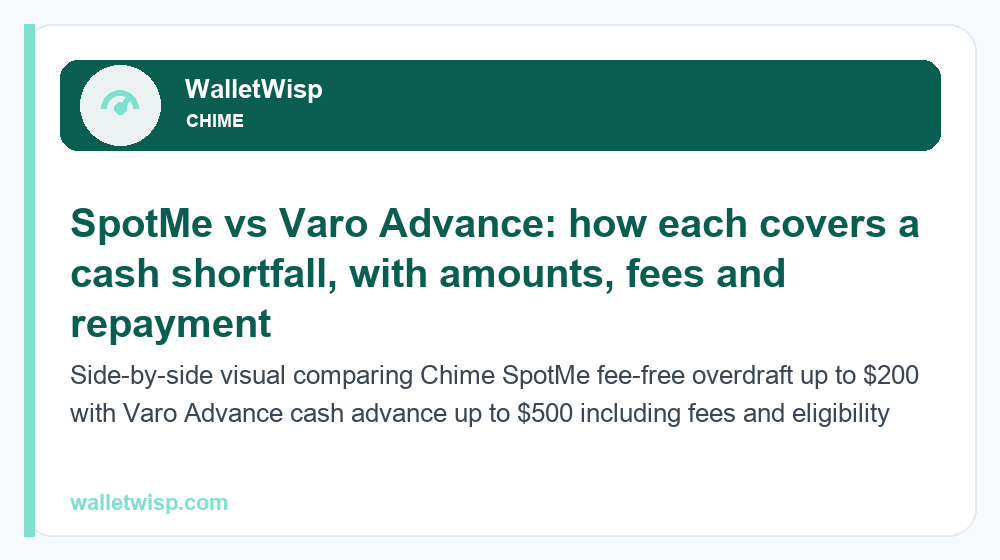
Chime SpotMe is fee-free overdraft. It lets debit-card purchases (and some other transactions) go through when your balance would otherwise go negative, with no fee and no interest. Your limit starts around $20 and can grow up to $200 based on your direct-deposit history and account activity; Chime recovers the amount from your next deposit. To qualify you generally need $200+ in monthly direct deposits.
Varo Advance is a small cash advance, not fee-free overdraft. You can borrow from $20 up to $500, the cash lands in your account, and you repay it (plus a fee) within a set window. Eligibility usually requires an account open ~30 days and qualifying direct deposits. The fee scales with the amount, so a small advance is cheap or free while a large one costs more.
| Short-term cash feature | Chime SpotMe | Varo Advance |
|---|---|---|
| Type | Fee-free overdraft coverage | Cash advance (deposited to you) |
| Amount | $20 up to $200 | $20 up to $500 |
| Fee (typical/estimated) | $0 | $0 on the smallest amounts, scaling up to ~$40 near $500 |
| Interest | None | None (flat fee instead) |
| How it triggers | Automatic when a purchase would overdraw | You request the advance in-app |
| Repayment | Pulled from your next deposit | Repaid within a set term |
| Basic eligibility | ~$200+ monthly direct deposits | Account ~30 days + qualifying direct deposits |
Bottom line: if you occasionally overspend on your debit card and want it covered for free, SpotMe is the better tool. If you need actual cash in your account — potentially up to $500 — and are fine paying a modest fee for the larger ones, Varo Advance covers scenarios SpotMe can’t. Many people find Chime cheaper for everyday small overdrafts and Varo more useful for a bigger one-time gap.
Credit-building tools
Both providers offer a secured credit-builder card with no annual fee, no interest, and no hard credit check to apply. The idea is identical: you move money onto the card to act as your spending limit, use it like a normal Visa, and the issuer reports your on-time payments to the credit bureaus to help build history.
Chime Credit Builder is a secured Visa tied to a “Credit Builder” balance you fund from your Chime Checking Account (a qualifying direct deposit is required to open it). There’s no set minimum security deposit, and a “Safer Credit Building” setting can auto-pay your balance from that reserved money so you don’t miss a payment. We break down exactly how it reports and how fast scores tend to move in our Chime Credit Builder card guide for 2026.
Varo Believe works the same way — a secured card with no minimum deposit, no annual fee, and no interest, reporting to the major bureaus. For most users the two cards are functionally comparable, so the deciding factor is usually which checking account you already use, since each card is designed to pair with its own ecosystem.
ATM network and cash deposits
On free ATM access, Chime has a slight edge: it offers 60,000+ fee-free ATMs across the MoneyPass and Visa Plus Alliance networks, versus Varo’s 55,000+ through Allpoint. Both networks are large enough that most people can find a free machine, and both charge a fee (plus any owner surcharge) if you use an out-of-network ATM, so the practical difference is minor unless a specific network is common where you live.
For cash deposits, both rely on the Green Dot retail network, letting you add cash at stores like Walmart, CVS, and Walgreens. The key detail: Chime lets you deposit cash free at Walgreens, while most other retailers (for either provider) charge a fee of roughly $4–$6 per deposit and cap how much you can load per day and per month. If you handle cash often, check which participating store is nearest you and what it charges before choosing.
FDIC insurance: partner banks vs a real bank charter
This is the most important structural difference between the two. Chime is a financial technology company, not a bank. Your money is held and insured through its partner banks — The Bancorp Bank, N.A. and Stride Bank, N.A. — and FDIC coverage of up to $250,000 flows through those banks.
Varo is an actual nationally chartered bank (Varo Bank, N.A.), one of the few consumer fintechs to obtain its own charter. That means your deposits are insured directly by the FDIC up to $250,000 without a middleman bank.
For the everyday customer, both approaches deliver the same $250,000 of protection, so your cash is equally safe either way. The distinction matters more if you value dealing with a single chartered institution, or if you want to avoid the extra layer that partner-bank arrangements add. It is a meaningful “how it’s built” difference, not a “your money is at risk” difference.
Which should you choose? Recommendation by use-case
There’s no universal winner — the better account depends on what you need most.
- Choose Varo if: you want the highest savings APY on a small-to-mid balance, you might need a larger short-term cash advance (up to $500), or you prefer banking with a single, directly-chartered FDIC bank.
- Choose Chime if: fee-free overdraft is your top priority (SpotMe up to $200 with no fee), you want the widest fee-free ATM footprint, or you deposit cash at Walgreens and want it free.
- For everyday spending with a paycheck deposit: it’s close to a tie — both give no fees, early pay, and a debit card, so default to whichever overdraft style (free coverage vs. borrowable cash) fits your habits.
- For building credit: either card works; let your checking choice decide, since each secured card is designed to pair with its own app.
- If you also considered a cash-transfer app: the trade-offs shift again — see our Chime vs Cash App 2026 comparison before you commit.
Some savers even keep both: Varo for the higher-yield savings bucket and Chime for the fee-free overdraft cushion. Because both are free to open and free to keep, running them side by side costs nothing but a little app-switching.
Frequently Asked Questions
Is Chime or Varo a real bank?
Varo is a real, nationally chartered bank (Varo Bank, N.A.), so it holds and insures your deposits directly. Chime is a fintech company, not a bank; it provides accounts through partner banks (The Bancorp Bank, N.A. and Stride Bank, N.A.), which carry the FDIC insurance. Both give you up to $250,000 in FDIC coverage.
Does Chime or Varo have higher savings APY in 2026?
Varo generally pays more. Chime’s savings sits around 2.00% APY with no conditions, while Varo offers roughly a 3.00% base rate and up to about 5.00% APY on your first $5,000 if you meet monthly direct-deposit and balance requirements. Varo is the better pick for maximizing yield on a modest balance.
What’s the difference between SpotMe and Varo Advance?
SpotMe is fee-free overdraft that automatically covers debit-card purchases up to $200 with no fee or interest, repaid from your next deposit. Varo Advance is a cash advance you request in-app for $20 to $500, deposited into your account and repaid with a fee that scales up on larger amounts. SpotMe is cheaper for small overdrafts; Varo Advance offers more cash.
Do both Chime and Varo offer early direct deposit?
Yes. Both advertise getting your paycheck or eligible government benefits up to two days early, and they work the same way — releasing funds as soon as your payer’s payroll file arrives. The exact number of days early depends on when your employer submits the deposit, so it can vary each pay cycle.
Are there any monthly fees with Chime or Varo?
No. Neither charges a monthly maintenance fee, a minimum-balance fee, or an overdraft fee. You can still incur costs in specific situations, such as out-of-network ATM use, cash-deposit fees at some retailers, and (with Varo) a fee for larger cash advances.
Can I build credit with Chime or Varo?
Yes, both offer a secured credit-builder card — Chime Credit Builder and Varo Believe — with no annual fee, no interest, and no hard credit check to apply. You fund the card and use it like a normal Visa, and on-time activity is reported to the major credit bureaus to help build your credit history.
Which has more fee-free ATMs, Chime or Varo?
Chime has a slightly larger network, with 60,000+ fee-free ATMs via MoneyPass and Visa Plus Alliance, compared with Varo’s 55,000+ through Allpoint. Both charge a fee for out-of-network withdrawals. For most people the difference is minor unless one network is far more common in your area.
Can I use both Chime and Varo at the same time?
Yes. Both accounts are free to open and maintain, so many people keep both — using Varo for its higher-yield savings and Chime for its fee-free overdraft. There’s no penalty for running them side by side, and each can receive direct deposits, though you’ll want to route your qualifying deposits to whichever account’s perks you rely on.