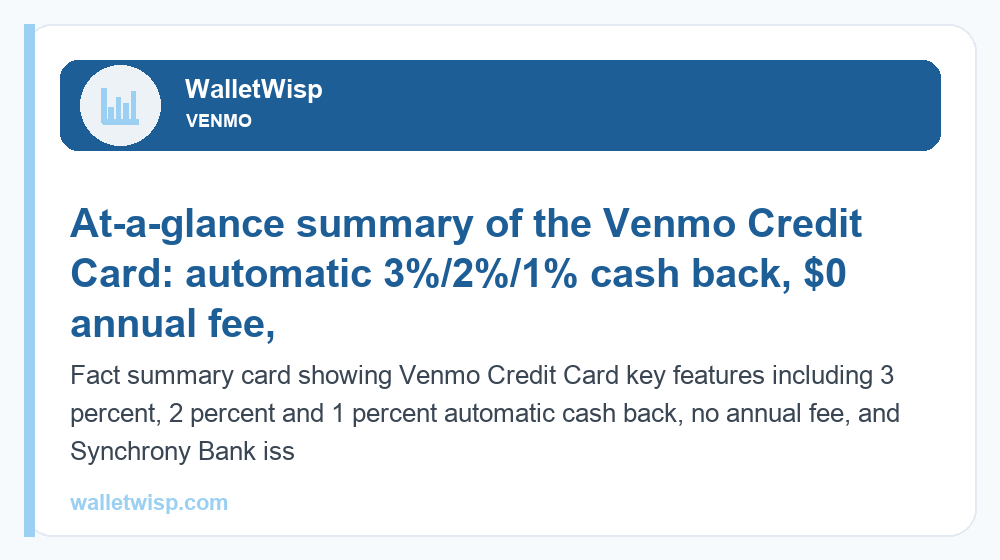
The Venmo Credit Card is a no-annual-fee Visa Signature card issued by Synchrony Bank that automatically pays 3% cash back on your single highest spending category each month, 2% on your second-highest, and 1% on everything else — with no categories to activate and rewards paid straight into your Venmo balance. For 2026, it is a genuinely solid pick if most of your spending lands in one or two categories (like groceries or dining) and you already live inside the Venmo app. It is less compelling if you would rather have a flat 2% card or premium travel perks. You will typically need fair-to-good credit, roughly a 640–670+ FICO score, to be approved.
Below is a full breakdown of how the automatic 3%/2%/1% structure works, the fees and APR to expect, the credit profile Synchrony tends to approve, and an honest pros-and-cons verdict on whether the Venmo Credit Card is worth carrying.
What is the Venmo Credit Card?
The Venmo Credit Card is a Visa Signature credit card issued by Synchrony Bank and tied directly to your Venmo account. You apply inside the Venmo app, and once approved you can often use a virtual card immediately for online purchases before the physical card arrives. The physical card is customizable in a range of colors and prints a personalized QR code on the front that links to your Venmo profile, so friends can scan it to pay you.
Because it is a real credit card (not a debit card or a Venmo balance card), it reports to the major credit bureaus. That means responsible use — paying on time and keeping your balance low — can help you build or rebuild credit over time. It also means missed payments and high utilization can hurt your score, so it should be treated like any other credit card, not like tapping your Venmo balance.
Who issues it and what network is it on?
Synchrony Bank is the issuer and lender of record, while Visa Signature is the payment network. Synchrony is one of the largest store-card and co-brand issuers in the US and is generally known for being accessible to applicants with fair credit, which is part of why the Venmo Credit Card tends to have friendlier approval odds than a premium travel card.
How the automatic cash back works (3% / 2% / 1%)
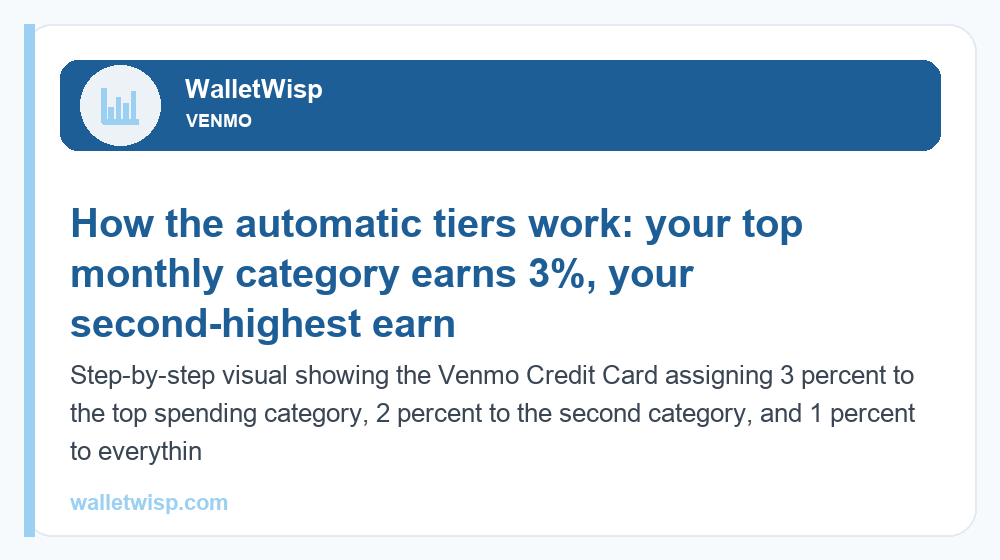
The headline feature is that you never pick or activate a bonus category. Each statement period, Venmo looks at where you spent the most across eight eligible categories, then automatically awards 3% cash back on your top category, 2% on your second-highest category, and 1% on all other purchases. The bonus categories can shift month to month based on your actual behavior, so a month of heavy grocery shopping earns 3% on groceries, while a travel-heavy month can flip your 3% to travel.
There are no rotating calendars, no enrollment, and (per current terms) no annual cap on how much cash back you can earn at the elevated rates. Cash back is calculated at the end of each monthly statement and deposited into your Venmo balance automatically, where you can spend it, transfer it to a linked bank, or use it to pay down the card.
The eight eligible bonus categories
The 3% and 2% tiers are chosen from the following eight categories. Everything that does not fall into your top two categories earns the flat 1% base rate.
| Eligible category | Typical purchases it covers | Reward tier (auto-assigned) |
|---|---|---|
| Grocery | Supermarkets and grocery stores | Top category = 3% |
| Bills & utilities | Phone, internet, electricity, water | 2nd category = 2% |
| Health & beauty | Pharmacies, salons, cosmetics | Elevated if top 2 |
| Gas | Fuel and gas stations | Elevated if top 2 |
| Dining & nightlife | Restaurants, bars, cafes | Elevated if top 2 |
| Entertainment | Streaming, events, movies, games | Elevated if top 2 |
| Transportation | Rideshare, transit, parking, tolls | Elevated if top 2 |
| Travel | Airfare, hotels, car rentals | Elevated if top 2 |
| Everything else | All non-category spending | Base = 1% |
How the assignment actually works: Say in a given month you spend $600 on groceries, $400 on dining, and $300 on gas. Groceries become your 3% category, dining becomes your 2% category, and gas plus all other spending drops to 1% for that statement. Next month, if dining jumps to the top, the tiers reshuffle automatically. This “set it and forget it” model is ideal for people who do not want to track spending categories but whose habits are lopsided toward a couple of areas.
Fees, APR, and the no-annual-fee promise
The Venmo Credit Card charges no annual fee, which is a real advantage — you can hold it long-term as a credit-building or everyday card without paying to keep it open. As with any credit card, though, the value only holds if you avoid interest by paying your statement balance in full. The variable APR on this card is on the higher side, so carrying a balance quickly erases any cash back you earn.
The table below summarizes the key costs. APR ranges are 2026 estimates that move with the Prime Rate and your creditworthiness, so always confirm your exact terms in your cardholder agreement before applying.
| Feature | Details (2026, estimates where noted) |
|---|---|
| Annual fee | $0 |
| Cash back rate | 3% top category / 2% second / 1% everything else |
| Rewards payout | Monthly, auto-deposited to your Venmo balance |
| Purchase APR | Variable, typically ~20%–30%+ (est., credit-based) |
| Cash advance APR | Higher variable rate, interest from day one (est.) |
| Foreign transaction fee | May apply (commonly ~3%) — confirm current terms |
| Late payment fee | Up to the Synchrony maximum allowed by law |
| Sign-up bonus | None as a standing feature (limited promos may vary) |
| Issuer / network | Synchrony Bank / Visa Signature |
Because interest and certain transaction costs can eat your rewards, it is worth understanding the full cost picture of the Venmo ecosystem before you lean on it. Our guide to Venmo fees breaks down instant-transfer charges, card-loading costs, and other add-ons that can apply when you move your cash back out of the app.
Credit score and approval odds (Synchrony)
Approval is handled by Synchrony Bank, and the practical bar is fair-to-good credit. Many approved applicants report scores in the 640–700 range, and Synchrony is generally more forgiving of thin or rebuilding credit files than premium issuers. That said, higher scores get better APRs and higher starting credit limits, so a 700+ score meaningfully improves your terms.
To be eligible you must have a Venmo account in good standing — verified identity, no account restrictions, and a history of normal use. Venmo offers a prequalification check that uses a soft credit pull, so you can gauge your odds without affecting your score. Only when you submit a full application does Synchrony run a hard inquiry, which can temporarily ding your score by a few points.
What can hurt your approval
- Recent late payments, collections, or a very short credit history.
- High existing credit utilization across your other cards.
- A brand-new or unverified Venmo account with little activity.
- Several recent hard inquiries or newly opened accounts.
If you are early in your credit journey, note that this is a standard revolving credit card — different from the “pay in 4” products many apps push. If you are weighing installment options too, our explainer on whether BNPL affects your credit score in 2026 covers how buy-now-pay-later plans can help or hurt the same score Synchrony reviews here.
How to apply for the Venmo Credit Card
The entire process happens inside the Venmo app — there is no separate website application flow for most users. Here is the typical path:
- Open the Venmo app and make sure your identity is verified and your account is in good standing.
- Tap into the Venmo Credit Card section (often found under the “Cards” or wallet area).
- Complete the prequalification check, which uses a soft pull and shows your likely approval without hurting your score.
- Submit the full application if prequalified; Synchrony runs a hard inquiry and returns a decision, frequently within minutes.
- On approval, start using the virtual card in the app right away, then activate the physical card when it arrives and customize its color.
Once you are spending, keep an eye on how the card interacts with the rest of your Venmo activity, including transfer ceilings and payment caps. See our current rundown of Venmo limits for 2026 so a large purchase or payoff transfer does not bump into a weekly cap at the wrong moment.
Pros and cons of the Venmo Credit Card
Pros
- Automatic 3%/2%/1% cash back with no categories to activate or track.
- No annual fee, so it is cheap to hold long-term.
- Rewards land in your Venmo balance monthly — instantly usable in the app.
- Fair-credit friendly approval through Synchrony, with a soft-pull prequalification.
- Deep Venmo integration: pay your bill, split purchases with friends, and manage the card without leaving the app.
- Builds credit because it reports to the major bureaus.
- Personalized QR code card design that doubles as a way to get paid.
Cons
- High variable APR — carrying a balance wipes out the rewards fast.
- No sign-up bonus and no premium travel or purchase protections beyond standard Visa Signature benefits.
- Requires a Venmo account, so it is not a fit if you do not use the app.
- Possible foreign transaction fees make it a weak choice for international travel.
- Rewards flow into Venmo, not a statement credit or bank account directly, which some people find less flexible.
- A flat 2% card can beat it for people whose spending is evenly spread across many categories.
Is the Venmo Credit Card worth it in 2026?
For the right person, yes. If you already use Venmo daily, have fair-to-good credit, and concentrate most of your spending in one or two categories, the automatic 3% and 2% tiers can out-earn a flat 2% card without any effort on your part. The lack of an annual fee means there is little downside to holding it as long as you pay in full each month.
It is not the right card if your spending is spread thinly across many categories (a flat 2% card likely earns more), if you travel abroad often (foreign transaction fees hurt), or if you tend to carry a balance (the high APR outweighs any cash back). And if you do not use Venmo at all, the app requirement alone rules it out. Treat it as a no-fee, low-effort rewards card that shines for concentrated spenders inside the Venmo ecosystem — not as a premium travel or flat-rate powerhouse.
Frequently Asked Questions
How does the Venmo Credit Card choose my 3% category?
Each statement period, Venmo automatically identifies the eligible category where you spent the most and applies 3% cash back to it, 2% to your second-highest category, and 1% to everything else. You do not activate or select anything, and the categories can change month to month based on your actual spending.
Does the Venmo Credit Card have an annual fee?
No. The Venmo Credit Card charges a $0 annual fee, so you can keep it open long-term without a recurring cost. Just remember that interest on carried balances and possible foreign transaction fees can still add up, so pay in full to protect your rewards.
What credit score do I need to get approved?
Approval is through Synchrony Bank, and most approved applicants have fair-to-good credit, roughly a 640–670+ FICO score. Higher scores earn lower APRs and larger credit limits. Venmo offers a soft-pull prequalification so you can check your odds before a hard inquiry hits your report.
Where does my cash back go?
Your cash back is calculated at the end of each monthly statement and deposited automatically into your Venmo balance. From there you can spend it in the app, transfer it to a linked bank account, or apply it toward your card balance. Note that some transfers out of Venmo can carry fees.
Can I use the Venmo Credit Card without a Venmo account?
No. A verified Venmo account in good standing is required to apply for and manage the card, since the application, rewards, and card controls all live inside the Venmo app. If you do not use Venmo, this card is not a practical option.
Is there a foreign transaction fee?
A foreign transaction fee may apply on purchases made outside the US (commonly around 3% for cards like this), which makes the Venmo Credit Card a weak choice for international travel. Always confirm the exact fee in your current cardholder agreement before relying on it abroad.
Will the Venmo Credit Card help me build credit?
Yes, potentially. It is a standard revolving credit card that reports to the major credit bureaus, so on-time payments and low utilization can help build or rebuild your score. The flip side is that late payments or maxing out the card can lower it, just like any credit card.
Is the Venmo Credit Card better than a flat 2% cash back card?
It depends on your spending. If most of your purchases fall into one or two categories, the automatic 3% and 2% tiers can beat a flat 2% card. But if your spending is spread evenly across many categories, a simple flat-rate 2% card often earns more overall and may waive foreign transaction fees.