

A Roth IRA is a retirement account you fund with money you have already paid taxes on, so your qualified withdrawals in retirement come out completely tax-free. For most beginners, it is one of the simplest and most powerful ways to build long-term wealth, because your investments grow for decades and the IRS never touches the gains again as long as you follow the rules.
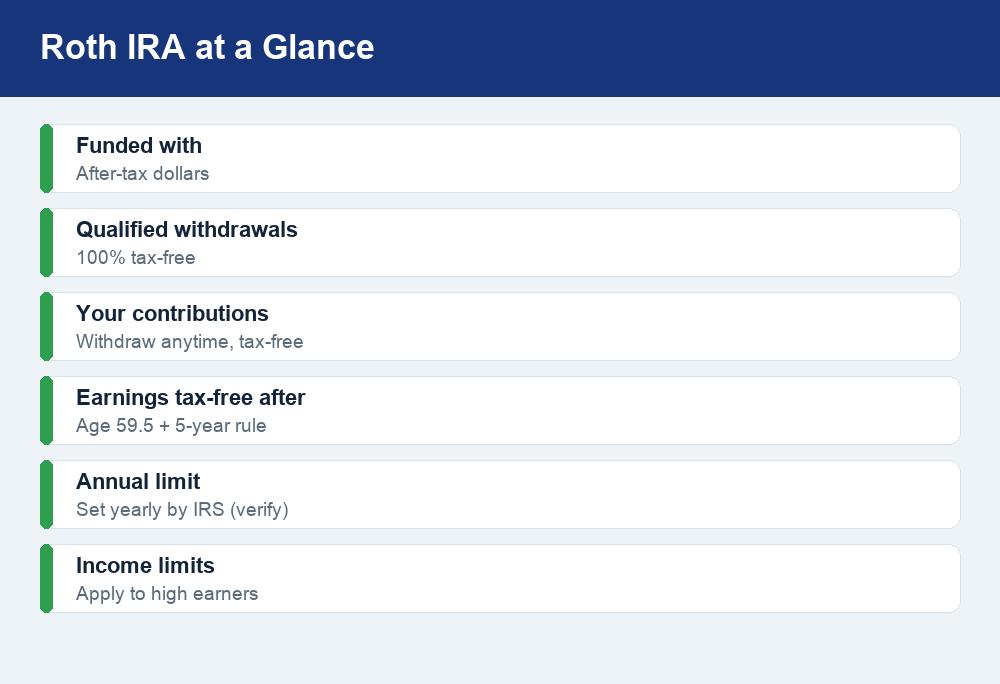
Quick answer: A Roth IRA lets you contribute after-tax dollars, invest them, and withdraw the money tax-free in retirement after age 59½ once you have met the 5-year rule. You can pull out your own contributions anytime without taxes or penalties, but earnings have conditions. The IRS sets the annual contribution limit and income phase-out ranges each year, so always confirm the current 2026 figures at IRS.gov before you contribute.
What is a Roth IRA?
IRA stands for Individual Retirement Arrangement (most people say “account”). It is a tax-advantaged account you open on your own, separate from any workplace 401(k). The “Roth” part refers to the tax treatment: you contribute money you have already been taxed on, and in exchange the government lets your money grow and come out tax-free later.
That is the opposite of a traditional IRA, where you often get a tax deduction now but pay ordinary income tax on every dollar you withdraw in retirement. With a Roth, you pay the tax bill upfront, while you are working, and skip it entirely on the back end. For a lot of younger or lower-earning savers, paying tax now at a modest rate and locking in decades of tax-free growth is a very good trade.
A Roth IRA is not an investment itself. It is a container. Inside it, you choose what to hold, such as index funds, ETFs, stocks, bonds, or a target-date fund. The account is just the wrapper that gives those investments their tax benefits.
How a Roth IRA works
The mechanics are more approachable than the jargon suggests. Here is the lifecycle in plain English:
- You contribute after-tax money. You move cash from your checking account into the Roth IRA. There is no upfront deduction, because you already paid income tax on those dollars.
- You invest it. Uninvested cash just sits there. To get growth, you buy investments inside the account. This is the step beginners most often forget.
- It grows tax-deferred. Dividends, interest, and capital gains inside the Roth are not taxed year to year, so your money compounds without an annual tax drag.
- You withdraw tax-free in retirement. Once you are 59½ and have satisfied the 5-year rule, every dollar, including all the growth, comes out with zero federal income tax.
Two features make the Roth especially forgiving for beginners. First, your contributions (the money you put in, not the earnings) can be withdrawn at any time, at any age, tax- and penalty-free. That flexibility is real, though it is still smart to leave the money invested. Second, unlike a traditional IRA, a Roth IRA has no required minimum distributions during the original owner’s lifetime, so you are never forced to pull money out at a certain age.
The 5-year rule trips people up, so it is worth understanding. It means at least five tax years must pass from your first Roth contribution before the earnings can come out tax-free. The clock starts January 1 of the year of your first contribution. Meeting age 59½ alone is not enough; you need both the age and the five years to withdraw earnings completely tax-free.
Roth IRA contribution limits for 2026
The IRS sets a maximum you can contribute across all your IRAs each year, and it adjusts periodically for inflation. There is also an extra “catch-up” amount allowed once you reach age 50. Because these numbers can change from year to year, this guide will not state a hard 2026 dollar figure as gospel. Confirm the current 2026 contribution limit and catch-up amount directly at IRS.gov or inside your brokerage app before you fund the account.
A few rules stay consistent regardless of the exact dollar amount:
- The limit is combined. If you have both a Roth and a traditional IRA, the annual cap applies to the two of them together, not to each separately.
- You need earned income. You can only contribute up to the amount you earned from work that year (a spousal IRA is an exception for married couples filing jointly).
- You get a deadline extension. You can contribute for a given tax year up until the federal tax filing deadline the following spring, which effectively gives you a long runway.
- High earners face income limits. Above certain income thresholds, your ability to contribute directly phases out and eventually disappears. More on the workaround below.
Roth IRA vs. traditional IRA
The core decision most beginners wrestle with is Roth versus traditional. The honest answer is that it comes down to whether you would rather pay tax now or later, which depends on your current tax rate versus your expected rate in retirement. Here is a side-by-side to make the trade-offs concrete.
| Feature | Roth IRA | Traditional IRA |
|---|---|---|
| Tax on contributions | Paid now (after-tax) | Often deductible now |
| Tax on qualified withdrawals | None, fully tax-free | Taxed as ordinary income |
| Withdraw contributions early | Anytime, tax- and penalty-free | Usually taxed plus 10% penalty |
| Income limits to contribute | Yes, phases out for high earners | No limit to contribute |
| Required minimum distributions | None for the original owner | Required starting at the set age |
| Best suited for | Expecting equal or higher tax rate later | Expecting a lower tax rate later |
A useful rule of thumb: if you are early in your career and in a relatively low tax bracket, the Roth is often the stronger pick, because you lock in today’s low rate and enjoy tax-free growth for decades. If you are a peak earner today and expect to drop into a lower bracket in retirement, the traditional deduction may save you more. Many people eventually hold both to give themselves tax flexibility later.
How to open a Roth IRA
Opening a Roth IRA is genuinely a same-day, do-it-from-your-couch task. The steps are straightforward:
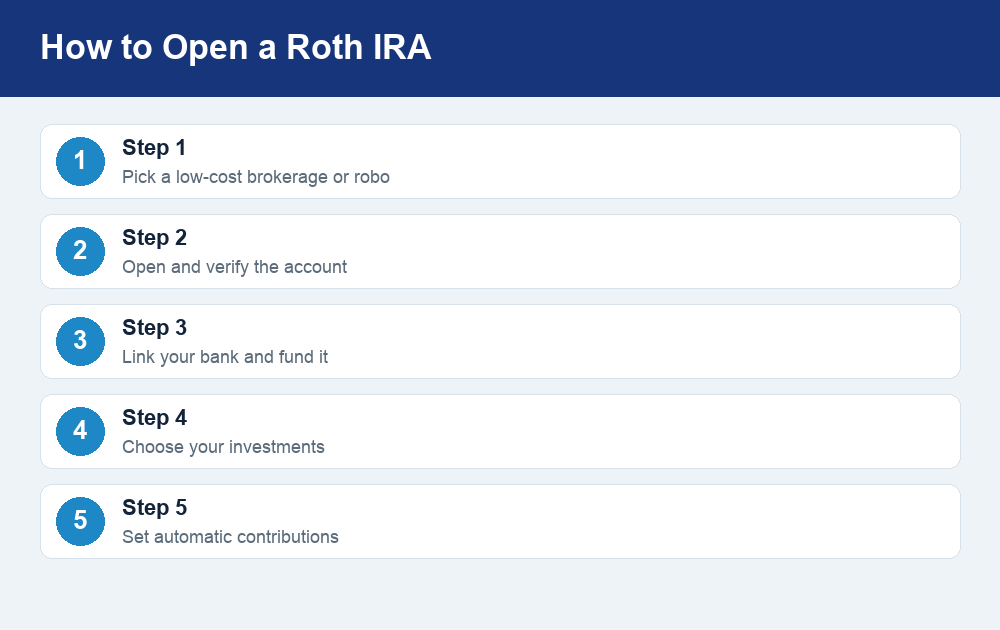
- Pick a provider. Choose a reputable, low-cost brokerage or a robo-advisor. Look for no account fees, no minimum to open, and a wide menu of low-cost index funds and ETFs. Stick to well-known, established firms and avoid anyone promising guaranteed high returns.
- Open and verify the account. You will provide your name, address, Social Security number, and employment info. Select “Roth IRA” specifically, since these firms offer several account types.
- Link your bank and fund it. Connect your checking or savings account and transfer your first contribution. Even a small starter amount is fine; consistency matters more than the opening balance.
- Choose your investments. This is the step that actually puts your money to work. Until you buy something, your contribution just sits in cash.
- Automate contributions. Set up a recurring monthly transfer so you invest steadily without having to think about it.
One planning note: a Roth IRA is a long-term, invest-and-forget vehicle, not a place for money you might need soon. Before you lock money away for retirement, make sure you have a cash cushion in place. Our guide to building an emergency fund in 2026 walks through how much to set aside first so you are never forced to raid your investments.
What to invest in inside your Roth IRA
Once the account is open, you still have to decide what to hold. For most beginners, simple beats clever. A few widely used, low-maintenance options:
- A target-date fund. You pick the fund closest to your expected retirement year and it automatically holds a diversified mix that gets more conservative over time. It is the closest thing to a one-and-done choice.
- A total-market or S&P 500 index fund. Broad, low-cost exposure to the U.S. stock market in a single fund, often paired with a total international fund for global diversification.
- A simple two- or three-fund portfolio. A U.S. stock index, an international stock index, and a bond index, in proportions that match your risk tolerance.
Because the Roth grows tax-free, it is a natural home for long-term, growth-oriented investments. Keep fees low, stay diversified, and resist the urge to chase hot stocks or trade frequently. The Roth’s real superpower is decades of uninterrupted compounding, and that rewards patience far more than activity.
Keep in mind that a Roth IRA is invested money and can lose value in the short term, unlike an FDIC-insured bank account. If you are comparing where to park cash versus where to invest for retirement, it helps to understand the difference between vehicles built for safety and those built for growth. Our breakdown of high-yield savings vs. CDs vs. money market accounts covers the safe side, while a Roth IRA sits firmly on the long-term-growth side of your plan.
Income limits and the backdoor Roth
Roth IRAs come with an income catch that traditional IRAs do not have. Once your modified adjusted gross income climbs past a certain point, your allowed direct contribution shrinks, and above the top of that phase-out range you cannot contribute directly at all. Those thresholds depend on your tax filing status and are updated by the IRS each year, so check the current 2026 phase-out ranges at IRS.gov to see where you land.
High earners who are shut out of direct contributions often use a legal workaround known as a “backdoor Roth.” In simple terms, you contribute to a traditional IRA (which has no income limit to contribute) and then convert those funds to a Roth. It is a legitimate, widely used strategy, but the tax mechanics, especially the pro-rata rule if you hold other pre-tax IRA money, can get complicated. If your income is near or above the phase-out range, it is worth a conversation with a qualified tax professional before you attempt it.
Common beginner mistakes to avoid
A Roth IRA is forgiving, but a handful of avoidable errors cost beginners real money and growth:
- Contributing but never investing. The single most common mistake. Money sitting as uninvested cash in your Roth earns almost nothing. Always complete the buy order.
- Over-contributing. Putting in more than the annual limit, or contributing with no earned income, can trigger an IRS penalty. Track your total across all IRAs.
- Withdrawing earnings too early. Taking out contributions is fine, but pulling earnings before 59½ and the 5-year rule can mean taxes plus a penalty.
- Waiting for the “perfect” moment. Time in the market is the Roth’s biggest advantage. Starting small now beats waiting for a bigger paycheck later.
- Chasing scams. Be wary of anyone pushing exotic “self-directed” Roth investments with guaranteed returns, high-pressure deadlines, or crypto schemes promising to make you rich. Legitimate providers do not promise guaranteed high returns, and the IRS rules are public and free to read.
One more habit worth building: keep short-term savings and long-term retirement money in separate buckets so you are never tempted to mix them. Parking your near-term cash somewhere it earns a solid, safe return, such as a competitive account from our roundup of the best high-yield savings rates this month, keeps your Roth invested and untouched for its real job.
Frequently asked questions
Can I withdraw money from a Roth IRA before retirement?
You can withdraw your own contributions at any time, at any age, with no taxes or penalties, because you already paid tax on that money. The earnings, however, generally need to stay until you are 59½ and have met the 5-year rule to come out tax- and penalty-free. Treat early withdrawals as a last resort, since pulling money out permanently forfeits future tax-free growth.
What is the Roth IRA contribution limit for 2026?
The IRS sets the annual limit each year, with an extra catch-up amount for those age 50 and older. Because the figure can be adjusted for inflation, verify the exact 2026 limit at IRS.gov or in your brokerage app before contributing. Remember the cap is combined across all of your IRAs, and you cannot contribute more than you earned from work that year.
Roth IRA or 401(k), which should I fund first?
If your employer offers a 401(k) match, contribute at least enough to capture the full match first, because that is an immediate, guaranteed return on your money. After the match, many people turn to a Roth IRA for its tax-free growth and wider investment choices, then circle back to the 401(k) for additional savings. The two work well together.
What happens to my Roth IRA if I switch jobs?
Nothing changes. A Roth IRA is an individual account you own directly, not tied to any employer, so changing jobs, going freelance, or taking a break from work has no effect on it. It stays open and invested wherever you set it up, and you keep contributing whenever you have earned income.
Do I have to report Roth IRA contributions on my taxes?
Roth contributions are not deductible, so they do not lower your taxable income, and you generally do not report the contribution itself the way you would a deduction. Your provider will send tax forms documenting the account, and it is smart to keep records of your contributions so you can prove your basis if you ever withdraw early. When in doubt, confirm the details at IRS.gov or with a tax professional.
The bottom line
A Roth IRA rewards beginners who start early and keep it simple: contribute after-tax dollars, invest them in low-cost diversified funds, and let decades of tax-free compounding do the heavy lifting. The flexibility to withdraw your contributions, the absence of required distributions, and the promise of tax-free income in retirement make it one of the friendliest accounts in personal finance. Just remember to actually invest the money, stay within the annual limit, and confirm the current 2026 contribution limit and income phase-out ranges at IRS.gov before you fund your account. Open one, automate your contributions, and let time do the rest.


