The choice between PayPal friends and family vs goods and services comes down to one question: are you sending money to someone you trust for no product, or are you paying for something you expect to receive? Use Friends & Family only when you’re gifting or splitting costs with people you personally trust and no purchase is involved — and use Goods & Services any time you’re actually buying something, because that’s the only option that comes with PayPal Purchase Protection. Picking the wrong one can cost you a fee, leave you with zero buyer coverage, or even get a payment reversed.
Quick answer: Friends & Family (F&F) is for gifts, repaying a friend, or splitting a bill — it usually has no fee when funded by your PayPal balance or linked bank, but it gives the buyer no protection. Goods & Services (G&S) is for buying anything; the seller pays a transaction fee, and in exchange the buyer is covered by PayPal Purchase Protection. If money is changing hands for a product or service, always choose Goods & Services.
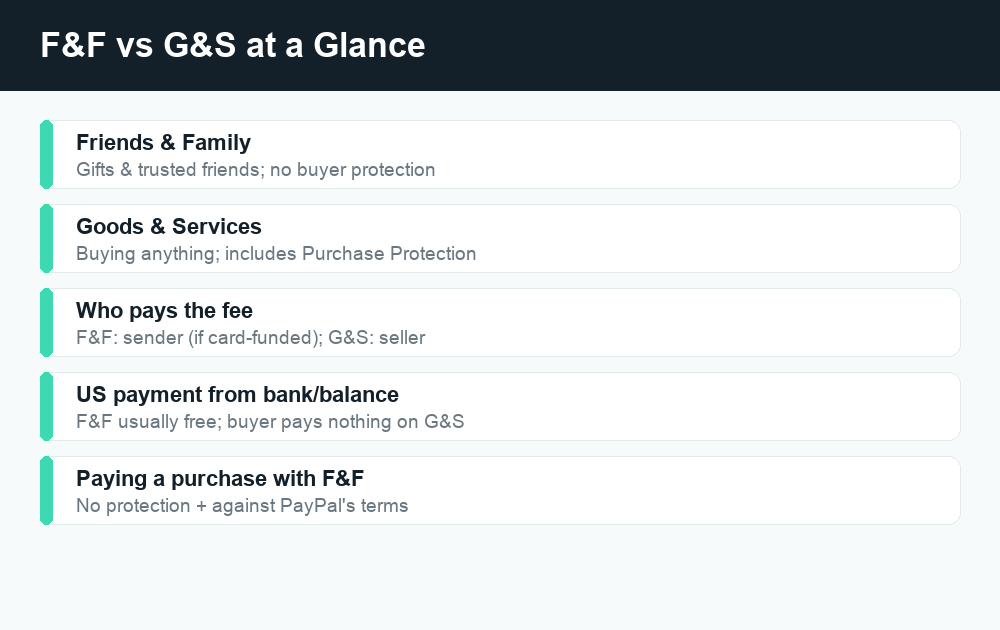
The core difference between Friends & Family and Goods & Services
PayPal offers two “modes” for sending money to another person, and they exist for very different situations. The label you pick changes three things at once: who pays the fee, whether the payment is protected, and how disputes are handled.
Friends & Family is designed for personal, non-commercial transfers. Think of paying back a roommate for groceries, chipping in for a group gift, or sending cash to a family member. PayPal treats these as personal payments, so there’s typically no fee when you fund them from your PayPal balance or a linked bank account in the US. The trade-off is simple but important: there is no buyer or seller protection on Friends & Family payments. Once the money lands, it’s effectively gone from your control.
Goods & Services is designed for commercial transactions — anything where you’re paying for a product, a service, a digital item, or a booking. The person receiving the money (the seller) pays a transaction fee. In return, the buyer gets PayPal Purchase Protection, which can refund eligible payments if an item never arrives or shows up significantly not as described. This is the mode you see automatically at most online checkouts.
Who pays the fee — and how much
This is where a lot of confusion starts. The fee rules depend on the payment type and how it’s funded.
For Friends & Family payments inside the US, sending money from your PayPal balance or a linked bank account is generally free. If you fund a Friends & Family payment with a credit card, debit card, or PayPal Credit, a fee usually applies — and that fee is normally charged to the sender. International Friends & Family transfers can also carry a fee plus a currency-conversion spread.
For Goods & Services payments, the seller (recipient) pays a percentage of the transaction plus a small fixed amount. The buyer typically pays nothing extra. This is the cost a legitimate business builds into its pricing, and it’s the price of the protection you receive.
Exact fee percentages and fixed amounts change over time and vary by country, funding source, and whether the payment is domestic or international, so always confirm the current numbers on PayPal’s official fees page before you assume.
| Factor | Friends & Family | Goods & Services |
|---|---|---|
| Intended use | Gifts, repaying friends, splitting bills | Buying products, services, bookings |
| Who pays the fee | Sender (only if card/credit-funded or international) | Seller / recipient |
| Typical US fee from balance/bank | No fee | Buyer pays nothing; seller pays a % + fixed fee |
| Purchase Protection for buyer | No | Yes (if eligible) |
| Seller Protection | No | May apply if seller meets requirements |
| Can you dispute a bad transaction? | Very limited | Yes, through Resolution Center |
| Best for | People you personally trust | Anyone you’re buying from |
What PayPal Purchase Protection actually covers
Purchase Protection is the single biggest reason to use Goods & Services. When you pay this way and something goes wrong, you can open a dispute and potentially get your money back. The two classic eligible scenarios are:
- Item Not Received (INR): you paid, but the product never showed up.
- Significantly Not As Described (SNAD): what arrived is materially different from the listing — wrong item, fake, broken, or missing major features.
Protection has limits and exclusions, though. It generally does not cover things like real estate, motor vehicles, custom-made items in some cases, items you picked up in person, or buyer’s remorse (you simply changed your mind). There are also deadlines for opening a dispute and providing evidence. Because the fine print evolves, read PayPal’s current Purchase Protection terms before relying on it for a high-value purchase.
How a Goods & Services dispute usually works
- Contact the seller first through PayPal — many problems get solved without a formal claim.
- If that fails, open a dispute in PayPal’s Resolution Center within the allowed window.
- If you and the seller can’t agree, escalate the dispute to a claim so PayPal reviews it.
- Provide any evidence PayPal asks for (screenshots, tracking, messages, photos).
- Wait for PayPal’s decision; if it’s in your favor, you’re refunded per the outcome.
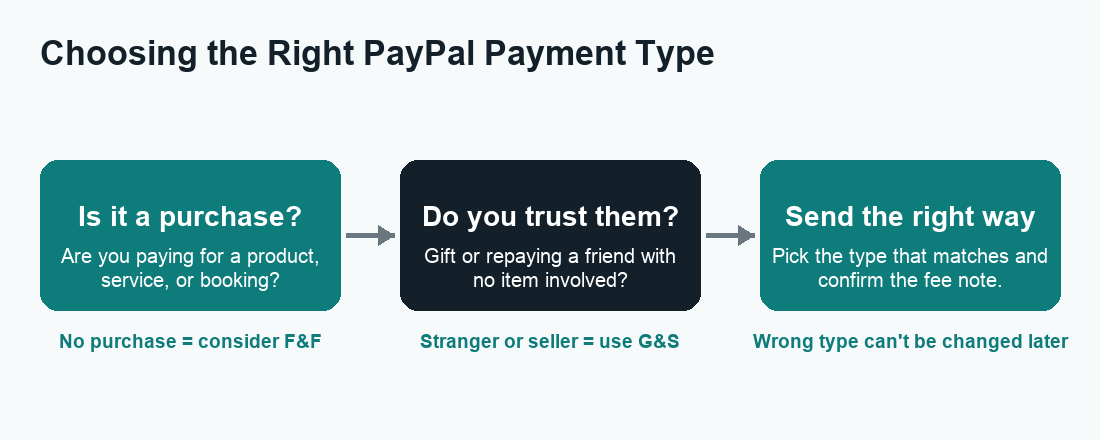
Why paying for a purchase with Friends & Family is risky
Here’s the trap that catches the most people. A seller — especially on a marketplace, social platform, or a stranger you met online — asks you to “just send it Friends & Family to avoid the fee.” It sounds like a small favor that saves a few dollars. It is not.
When you pay for a product or service using Friends & Family, three bad things happen at once:
- You lose all Purchase Protection. If the item never arrives or is a scam, you generally cannot open a Goods & Services dispute, because PayPal treats your payment as a personal gift to a friend.
- It violates PayPal’s terms of service. Using personal payments for commercial transactions is against PayPal’s User Agreement. Doing it repeatedly can put limits or holds on your account.
- You’re funding the scammer’s “no recourse” plan. Scammers specifically request Friends & Family because they know you’ll have no way to claw the money back. The fee they claim to be “saving” is really the cost of your safety.
The rule of thumb is blunt: if a seller insists on Friends & Family for a purchase, treat it as a red flag and walk away — or only proceed if you’re truly fine with never seeing that money again. A legitimate business expects to pay the Goods & Services fee; it’s a normal cost of doing business.
“But the seller says the fee makes it too expensive”
If a small fee genuinely matters, the honest fix is for the buyer and seller to agree on a price that accounts for it, or for the seller to use proper invoicing. Asking the buyer to give up protection so the seller dodges a business cost is not a fair deal — it shifts 100% of the risk onto you.
When to use Friends & Family (the right way)
Friends & Family is a great tool when it’s used as intended. Reach for it when:
- You’re paying back someone you personally know — a friend covered lunch, your sibling spotted you for concert tickets.
- You’re splitting a shared bill with people you trust (rent, a group dinner, a vacation rental).
- You’re sending a genuine gift with nothing expected in return.
- You’re moving money to your own family for personal reasons, not a transaction.
The common thread: there’s no product or service on the other side, and you’d trust this person with the money even without PayPal in the middle. If that’s not true, don’t use Friends & Family.
When to use Goods & Services (almost any purchase)
Use Goods & Services whenever money is exchanged for something of value:
- Buying from an online store, an independent seller, or a marketplace listing.
- Paying a freelancer, tutor, contractor, or service provider.
- Purchasing event tickets, bookings, or digital products from someone you don’t know well.
- Any first-time transaction with a stranger, even if it “feels” legit.
Yes, the seller pays a fee — but you, the buyer, gain a real safety net. For anything you can’t easily afford to lose, Goods & Services is the only responsible choice.
How to choose Goods & Services when you send money
- Open PayPal and start a payment to the recipient.
- Enter the amount and look for the payment-type selector (wording varies, but you’ll see a choice like “Paying for an item or service” vs “Sending to a friend”).
- Choose the Goods & Services / “item or service” option.
- Confirm the fee and protection note shown, then send.
- Keep your receipt, the listing, and all messages in case you ever need to file a claim.
If you’re a seller, the cleanest approach is to send a proper PayPal invoice or use a Goods & Services request, so both sides have a clear, protected record.
How PayPal compares to other money apps
PayPal isn’t the only app with a “personal vs. purchase” distinction, and the protection rules differ across platforms. Cash App, Venmo, and Zelle each handle buyer safety differently, so it’s worth knowing the landscape before you send a stranger money on any of them. For example, peer-to-peer apps often warn that personal transfers behave like cash and can’t be reversed once sent.
If you use more than one app, it helps to read up on each one’s quirks — like why a Venmo payment can sit as pending, what Cash App charges in fees, and whether Zelle is safe for the kind of payment you’re making. The same core lesson applies everywhere: personal/instant transfers usually have little or no recourse, while “buying” flows are the ones built to protect you.
Quick decision guide
- Repaying a trusted friend? Friends & Family.
- Buying anything at all? Goods & Services.
- Seller demands Friends & Family for a product? Red flag — switch to Goods & Services or walk away.
- Not sure if you trust the person? Default to Goods & Services.
- Sending a gift to family? Friends & Family is fine.
Frequently asked questions
Can I get my money back if I paid Friends & Family by mistake?
It’s difficult. Friends & Family payments aren’t covered by Purchase Protection, so you can’t open a standard Goods & Services dispute. Your best option is to ask the recipient to refund you voluntarily. If you were scammed, report it to PayPal and your card issuer (if you funded it with a card), but recovery isn’t guaranteed. Always confirm options through PayPal’s official Resolution Center, not a number from a random search result.
Does the buyer or the seller pay the Goods & Services fee?
The seller (the person receiving the money) pays the Goods & Services transaction fee. The buyer typically pays nothing extra. That’s why some sellers try to push buyers toward Friends & Family — but doing so strips away your protection, so it’s not worth it.
Is it illegal to use Friends & Family for a purchase?
It’s not a crime, but it does violate PayPal’s User Agreement, which prohibits using personal payments for commercial transactions. Repeated misuse can lead to account limitations or holds. More importantly, it leaves you with no buyer protection, which is the real danger.
Why do scammers ask for Friends & Family?
Because it removes your ability to dispute the payment. Once you send Friends & Family, PayPal treats it as a gift to someone you trust, so there’s no Goods & Services claim to file. Scammers frame it as “saving the fee,” but the real goal is making sure you can’t get your money back.
Can I switch a payment from Friends & Family to Goods & Services after sending?
No. You choose the payment type before you send, and it can’t be changed afterward. If you picked the wrong type, you’d need the recipient to refund the payment so you can resend it correctly. This is why it’s worth double-checking the selector before you hit send.
Does Goods & Services protect the seller too?
It can. PayPal Seller Protection may cover eligible sellers against certain claims and chargebacks — but only if the seller meets specific requirements, like shipping to the address on file and keeping proof of delivery. Friends & Family offers no Seller Protection at all, which is another reason businesses shouldn’t accept personal payments.
Are there fees for Friends & Family in the US?
Generally no fee when you fund a domestic Friends & Family payment with your PayPal balance or a linked bank account. A fee usually applies if you use a credit card, debit card, or PayPal Credit, and that fee is charged to the sender. International transfers can add a fee plus currency conversion. Confirm current rates on PayPal’s official fees page, as they change.
What if an item I bought with Goods & Services never arrives?
You can open an “Item Not Received” dispute in PayPal’s Resolution Center within the allowed time window, then escalate it to a claim if the seller doesn’t resolve it. Keep your order details and any tracking or messages. If it’s eligible under Purchase Protection, you may be refunded. Always verify deadlines and steps directly in your PayPal account.
Last updated: June 2026. Fees, limits, and features can change — always confirm current details in the app. WalletWisp is an independent guide and is not affiliated with any app mentioned. This article is general information, not financial advice.
Related: PayPal guides, Venmo fees explained, and Is Zelle safe?