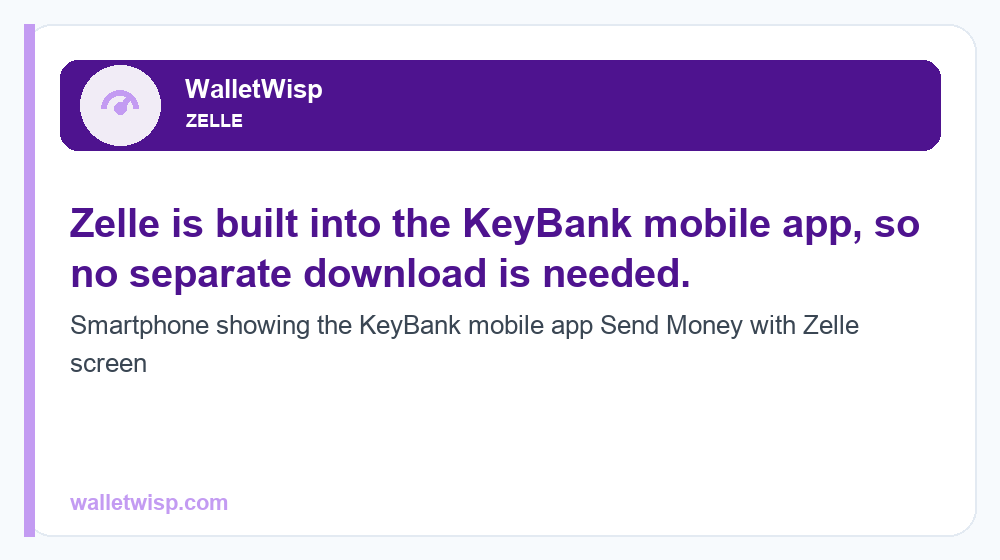
Yes, KeyBank has Zelle, and it is built directly into the KeyBank mobile app and online banking, so you do not need a separate app to use it. If you have wondered “does KeyBank have Zelle,” the short answer is that KeyBank is a full Zelle member bank, letting you send and receive money in minutes using just a recipient’s U.S. mobile number or email address. There is no extra download, no separate login, and no KeyBank fee to use the service. In this guide we will walk through exactly how to enroll, what the typical send limits look like, how long transfers take, whether Zelle is free and safe, and how to fix the most common problems people run into.
One important note up front: the standalone Zelle app was discontinued in 2025. If you previously used the separate Zelle app, you now need to send and receive money through your bank’s app instead. For KeyBank customers, that means everything happens inside the KeyBank mobile app or online banking, which is actually simpler and more secure because your Zelle activity lives alongside your regular accounts.
How to enroll in and set up Zelle with KeyBank
Getting started with Zelle at KeyBank takes just a few minutes. Because the feature is embedded in KeyBank’s own digital banking, enrolling essentially means linking your KeyBank checking account and confirming a contact method. Here is the typical process:
- Open the KeyBank mobile app or log in to online banking. Make sure you already have an active KeyBank checking or eligible deposit account.
- Find “Send Money with Zelle” in the main menu, transfers section, or payments hub.
- Choose an email address or U.S. mobile phone number to enroll. This is the “token” people will use to send you money.
- Verify that contact method with the one-time code KeyBank sends you.
- Select the KeyBank account you want money to be deposited into and sent from.
Once enrolled, you can immediately start sending. A key rule to remember: your email or phone number can only be enrolled with Zelle at one bank at a time. If you previously used that same email or number with another bank’s Zelle, you will need to move it over to KeyBank, which the app will prompt you to do. This “contact already enrolled elsewhere” situation is one of the most common setup hiccups, and we cover it in troubleshooting below.
| Setup step | Where it happens | What you need |
|---|---|---|
| Access Zelle | KeyBank app or online banking | Active KeyBank login |
| Enroll a token | “Send Money with Zelle” menu | U.S. mobile number or email |
| Verify identity | One-time passcode | Access to that phone/email |
| Link account | Account selection screen | KeyBank checking account |
| Send money | Recipient entry screen | Recipient’s phone or email |
If you bank elsewhere too, it is worth knowing that most major U.S. banks now offer Zelle the same way KeyBank does. For example, you can compare how the feature works at other institutions in our guides on whether PNC has Zelle and whether Capital One has Zelle, or see the full picture of what banks use Zelle.
KeyBank Zelle send limits (typical ranges, verify in-app)
Zelle limits are set by each individual bank, not by Zelle itself, and KeyBank does not publish one universal number that applies to every customer. Your personal limits can vary based on your account type, how long you have banked with KeyBank, and your account history. That said, the ranges below reflect what KeyBank customers typically see. Always confirm your exact figures inside the KeyBank app, where your real limits are displayed on the send screen.
| Limit type | Typical KeyBank range | Notes |
|---|---|---|
| Per transaction | ~$1,000 | May be lower for newer accounts |
| Daily send limit | ~$1,000 – $2,000 | Resets each calendar day |
| Rolling 30-day send limit | ~$5,000 – $10,000 | Trailing window, not monthly |
| Receiving money | No limit | You can receive any amount |
A few things worth understanding about these limits. First, there is no receive limit with Zelle at KeyBank, so if someone sends you a large amount, you can accept it regardless of the sending caps. Second, the 30-day figure is a rolling window, meaning it looks back at the last 30 days from today rather than resetting on the first of the month. Third, if you hit a limit, the app will tell you, and you generally just need to wait until the window resets or split a large payment across a few days. KeyBank does not typically raise Zelle limits on request, so plan larger transfers around wire transfers or other methods instead.
How long do KeyBank Zelle transfers take?
When both you and your recipient are already enrolled with Zelle at their respective banks, money typically moves within minutes. This near-instant speed is the biggest reason people use Zelle instead of a traditional bank transfer, which can take one to three business days. The funds pull from your linked KeyBank account and land in the recipient’s account almost immediately.
The timing changes if your recipient has not yet enrolled in Zelle. In that case, they will receive a notification prompting them to enroll with any participating bank. Once they do, the money is deposited. If they never enroll, the payment expires after 14 days and the funds are returned to your KeyBank account automatically. So if you send money and the recipient says it never arrived, the first thing to check is whether they have actually enrolled and used the exact email or phone number you sent to.
| Scenario | Typical timing |
|---|---|
| Both parties enrolled | Minutes |
| Recipient not yet enrolled | After they enroll (up to 14 days) |
| Recipient never enrolls | Returned to your account after 14 days |
| First-time or flagged transfer | Occasionally up to 1-3 business days for review |
Is Zelle free at KeyBank?
Yes. KeyBank does not charge a fee to send or receive money with Zelle. This is consistent across nearly all banks in the Zelle network, since Zelle is designed as a free person-to-person payment service. Just be aware that standard account terms still apply, so if a Zelle payment overdraws your checking account, normal overdraft policies could come into play. There are no per-transaction fees, monthly fees, or receiving fees for using Zelle itself.
Is KeyBank Zelle safe to use?
Zelle is safe when you use it the way it is intended: to send money to people you know and trust. The critical thing to understand is that Zelle payments are essentially irreversible. Once money leaves your account and is claimed by the recipient, there is generally no way to cancel it or force a refund, much like handing someone cash. That design is exactly why it is fast, but it also means you should treat every Zelle payment as final.
Because of this, Zelle is a favorite tool for scammers. The most important safety rules for KeyBank customers are:
- Never send Zelle to “verify” your account or “protect” it. No legitimate bank will ever ask you to Zelle money to yourself or to a “safe account.” This is always a scam.
- Never Zelle money to someone claiming to be a KeyBank representative, fraud investigator, or government agency. Real bank employees do not ask for Zelle transfers.
- Only pay people you personally know. Avoid using Zelle to buy items from strangers on marketplaces, since you have no buyer protection.
- Double-check the recipient’s email or phone number before sending, because money sent to the wrong contact can be very hard to recover.
- Ignore urgency and pressure. Scammers create panic (“your account is compromised, act now”) to rush you past your better judgment.
If someone contacts you unexpectedly and pressures you to send a Zelle payment, stop and call KeyBank directly using the number on the back of your card. When you use Zelle only among trusted friends, family, and known people, it is a secure and convenient way to move money.
Common KeyBank Zelle issues and troubleshooting
Most Zelle problems fall into a handful of familiar categories. Here is how to diagnose and resolve them:
Payment is stuck as “pending”
A pending status almost always means the recipient has not yet enrolled in Zelle. The payment is waiting for them to sign up with the email or phone number you used. Ask them to enroll through their own bank’s app. If it stays pending past 14 days, the money returns to your KeyBank account automatically.
Recipient says they did not get the money
First, confirm you sent to the exact email or U.S. mobile number they use for Zelle. A typo, or an old number enrolled at a different bank, is the usual culprit. Also have them check whether their Zelle token is registered at the bank they expect the money in.
You hit your send limit
The app will display a message when you reach a per-transaction, daily, or 30-day cap. Wait for the window to reset, send a smaller amount, or use an alternative like a wire transfer for large sums. Remember these limits are set by KeyBank and generally cannot be raised on demand.
“This contact is already enrolled elsewhere”
Your email or phone can only be tied to one bank’s Zelle at a time. If you see this, the app will offer to move that token to KeyBank. Confirming the transfer reassigns it so future payments land in your KeyBank account.
Payment sent to the wrong person
Because Zelle is irreversible, contact the recipient directly and ask them to send it back. If they will not, report it to KeyBank, though recovery is not guaranteed. This is why verifying the recipient before sending is so important.
A note on taxes
Personal Zelle payments between friends and family, such as splitting rent or repaying a loan, are not taxable income and are not reported by Zelle on a 1099-K. However, if you use Zelle to receive payments for goods or services as a business, that income may still be taxable and you are responsible for reporting it. This is general information, not tax advice — consult a qualified tax professional about your specific situation.
Bottom line
So, does KeyBank have Zelle? Absolutely — Zelle is fully integrated into the KeyBank mobile app and online banking, letting you send and receive money in minutes with no KeyBank fee. Enrollment takes just a few minutes, send limits typically fall around $1,000 to $2,000 per day and $5,000 to $10,000 over a rolling 30 days (always verify your exact limits in the app), and there is no limit on what you can receive. Just remember that Zelle payments are fast because they are irreversible, so only send money to people you trust and never respond to anyone asking you to Zelle funds to “verify” or “protect” your account. Used carefully, KeyBank’s Zelle is one of the easiest and safest ways to move money between people you know.
Frequently asked questions
Is Zelle free with KeyBank?
Yes. KeyBank does not charge any fee to send or receive money through Zelle. Standard account terms, such as overdraft policies, still apply to the underlying transaction.
What is the KeyBank Zelle daily limit?
Limits vary by customer and account, but a typical daily send limit is around $1,000 to $2,000. Your exact limit is shown on the send screen inside the KeyBank app, so always check there.
Is there a limit on how much I can receive with Zelle at KeyBank?
No. There is no receiving limit with Zelle. The caps only apply to sending money, so you can accept any amount someone sends you.
How long does a KeyBank Zelle transfer take?
If both people are enrolled in Zelle, money usually arrives within minutes. If the recipient is not yet enrolled, they have 14 days to sign up before the payment is returned to you.
Do I need the separate Zelle app to use it with KeyBank?
No. The standalone Zelle app was discontinued in 2025. You now use Zelle directly inside the KeyBank mobile app or online banking, which is where all your transfers happen.
Can I cancel a Zelle payment sent from KeyBank?
Only if the recipient has not yet enrolled — then you can cancel it while it is pending. Once a recipient is enrolled and the money is delivered, the payment is final and cannot be reversed.
Why does my KeyBank Zelle payment say pending?
A pending payment means the recipient has not enrolled in Zelle yet. It stays pending until they sign up with the email or phone number you used, or it returns to your account after 14 days.
Is it safe to use Zelle through KeyBank?
Yes, when you send only to people you know and trust. Never Zelle money to someone claiming to be a bank rep or asking you to “verify” your account — that is always a scam, and Zelle payments cannot be reversed.