The BNPL new rules 2026 pull buy now, pay later much closer to the way credit cards are regulated. In the US, the Consumer Financial Protection Bureau (CFPB) has treated Pay-in-4 products like credit cards under the Truth in Lending Act, which brings dispute rights, refund handling and clearer disclosures. In the UK, the Financial Conduct Authority (FCA) is set to bring BNPL under formal oversight in 2026, adding mandatory affordability checks and access to the Financial Ombudsman Service.
For anyone using Klarna, Afterpay, Affirm or PayPal Pay-in-4, the practical upshot is threefold: stronger legal protections, more paperwork and disclosures at checkout, and a rising chance that your instalment loans start showing up on your credit report. Here is what actually changes, what is still uncertain, and how to stay protected.
What the BNPL new rules 2026 actually require
“BNPL” usually means splitting a purchase into four interest-free instalments (Pay-in-4) or paying over several months, sometimes with interest. Until recently, the classic Pay-in-4 product sat in a regulatory gap: it was not a traditional loan, not a credit card, and often carried few of the disclosures and protections consumers expect from other credit.
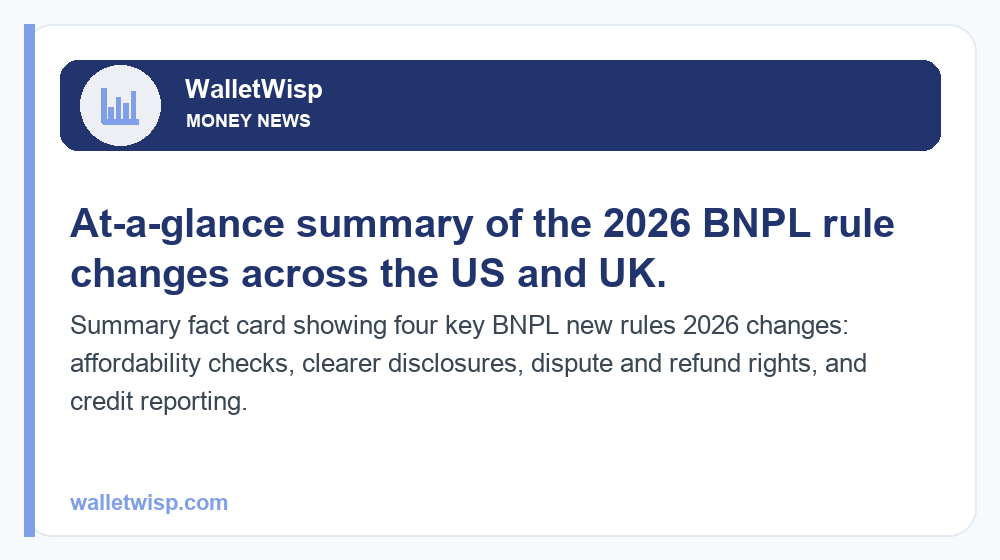
The 2026 rules close much of that gap on two fronts:
- Creditworthiness and affordability checks. Regulators increasingly expect providers to confirm you can repay before extending credit, rather than relying on a soft check or none at all.
- Clearer disclosures. Costs, payment schedules, late-fee triggers and the consequences of missing a payment must be spelled out up front and in periodic statements.
- Dispute and refund rights. If a purchase is faulty, never arrives, or is charged incorrectly, you get a defined path to dispute the charge and pause or recover payments.
- Credit reporting. More BNPL activity is expected to be reported to credit bureaus, which cuts both ways for your score.
The US side: CFPB treats Pay-in-4 like a credit card
The CFPB’s interpretive rule applies parts of the Truth in Lending Act and Regulation Z—the same framework that governs credit cards—to Pay-in-4 BNPL. In plain terms, that gives you the right to dispute billing errors, to have refunds processed when you return goods, and to receive periodic statements. It does not force BNPL to charge interest or turn Pay-in-4 into a revolving credit card; it borrows the consumer-protection pieces.
One important caveat for accuracy: the CFPB’s approach has faced political and legal turbulence. Leadership changes in 2025 created uncertainty about how aggressively the rule would be enforced, and the exact status can shift. What has proven durable is the direction of travel—major providers have already built dispute and refund processes that mirror card-style protections, whether or not every element of the rule survives court challenges. Treat the card-style protections as the practical standard for 2026, while recognizing enforcement details may still move.
The UK side: FCA oversight arrives in 2026
The UK is moving from a voluntary landscape to statutory regulation. Under legislation confirmed by HM Treasury, the FCA is expected to formally regulate BNPL agreements in 2026, with a transitional (temporary permissions) period as firms come into the regime. Once in force, BNPL lenders will need to run affordability checks, provide clearer pre-contract information, and—crucially—consumers will gain access to the Financial Ombudsman Service to escalate complaints. Purchases may also attract Section 75-style protections in some cases, giving added recourse when things go wrong. Exact commencement dates and scope are set by the FCA’s rules and can be refined, so treat mid-2026 as the expected window rather than a fixed guarantee.
US vs UK: how the two 2026 regimes compare
The US and UK are arriving at similar consumer protections by different legal routes. The table below summarizes the main differences.
| Protection | US (CFPB / Reg Z approach) | UK (FCA regime) |
|---|---|---|
| Legal basis | Truth in Lending Act / Regulation Z applied to Pay-in-4 | FCA authorisation under UK consumer-credit rules |
| Affordability checks | Expected; providers moving toward stronger checks | Mandatory affordability/creditworthiness assessment |
| Disclosures | Periodic statements, cost and schedule disclosure | Clear pre-contract information required |
| Dispute / refund rights | Billing-error and refund rights, card-style | Complaint rights plus possible Section 75-style cover |
| Independent complaints body | CFPB complaint process | Financial Ombudsman Service access |
| Expected timing | Framework active, enforcement details evolving | Oversight expected to take effect in 2026 |
Does BNPL now show on your credit report?
Increasingly, yes—but it is still inconsistent, and it depends heavily on the provider and product type. Historically, most Pay-in-4 loans did not appear on credit reports, which is why BNPL was invisible to lenders assessing your debt. That is changing on two levels in 2026.
First, the credit bureaus (Experian, TransUnion and Equifax in the US) have built the ability to accept BNPL data. Second, the scoring models are catching up: FICO and VantageScore have introduced approaches that can incorporate BNPL history, so on-time instalment payments may help build credit while missed payments can hurt it. If you want the full picture of how this feeds into your number, see our guide on how BNPL affects your credit score in 2026.
The nuance: not every provider reports every loan, and some report only longer-term instalment loans rather than the four-payment splits. So two people using “the same” BNPL feature can have very different credit outcomes depending on which company and which product they chose.
What changes for Klarna, Afterpay, Affirm and PayPal Pay-in-4 users
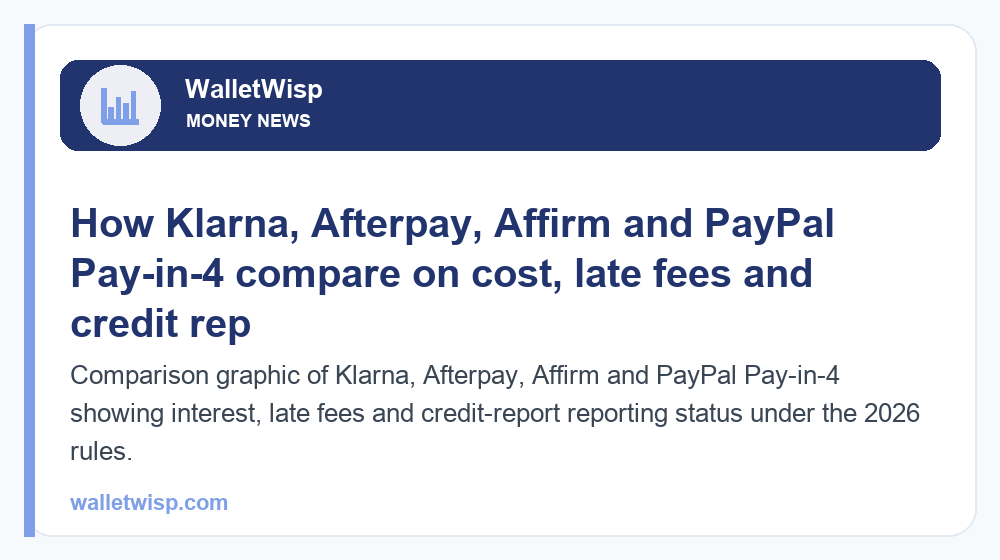
The headline protections apply across the board, but the day-to-day experience differs by provider. The table below shows typical 2026 positioning. Fees, APR ranges and reporting practices are estimates based on publicly stated policies and can vary by market, product and your individual terms—always check your agreement.
| Provider | Typical Pay-in-4 cost | Longer plans | Credit reporting (2026, estimated) | Late fees |
|---|---|---|---|---|
| Klarna | 0% interest on Pay-in-4 | Financing with interest available | Expanding; piloting bureau reporting | Capped late fee (typically up to ~$7 US) |
| Afterpay / Clearpay | 0% interest on Pay-in-4 | Limited longer options | Historically minimal; under review | Capped (up to ~25% of order, ~$8 max/instalment US) |
| Affirm | 0% on some Pay-in-4 | Interest-bearing loans, ~0–36% APR | Reports many loans to Experian / TransUnion | No late fees on most products |
| PayPal Pay-in-4 | 0% interest | Pay Monthly with interest | Historically not reported; may change | No late fees |
A few things worth highlighting. Affirm is the most likely of the four to already influence your credit report, because it has long reported many of its loans to bureaus. Klarna has moved toward reporting and partnerships with bureaus, so users should assume their history may become visible. Afterpay and PayPal Pay-in-4 have historically stayed off standard credit files, though that could shift under the new framework. If PayPal is your go-to option, our dedicated breakdown of PayPal Pay-in-4 in 2026 covers its terms and protections in detail.
More checks at checkout
Expect the sign-up and approval flow to feel a little more like applying for credit. Affordability assessments mean some shoppers who breezed through before may now be declined or offered a lower limit—an intended feature of the rules, designed to reduce over-borrowing. In most cases these are soft checks that do not dent your score, but heavier or repeated checks can leave a footprint, so avoid opening several BNPL plans in quick succession.
Clearer bills and stronger dispute paths
You should see more upfront detail on total cost, due dates and what happens if you miss a payment, plus periodic statements. If a retailer ships a faulty item or nothing at all, you now have a defined route to dispute the charge and pause payments while it is investigated—closer to how a credit-card chargeback works.
How to stay protected under the BNPL new rules 2026
The new protections help, but they do not replace good habits. Use this checklist to keep BNPL working for you rather than against you.
- Track every active plan in one place. The biggest BNPL risk is stacking multiple plans across providers and losing track of due dates. List them all—amount, provider, next payment—so nothing slips.
- Assume it can hit your credit file. Treat each instalment like a reported debt. On-time payments may help your profile; a missed one can now do real damage.
- Read the disclosure before you confirm. Check the total cost, whether interest applies to longer plans, and the exact late-fee trigger. The 2026 rules make this information clearer—use it.
- Keep the purchase evidence. Save order confirmations and delivery details so you can exercise your new dispute and refund rights quickly if something goes wrong.
- Do not use BNPL to plug a budget gap. If you could not pay for the item outright within a month or two, splitting it rarely fixes the underlying cash-flow problem.
- Use complaints channels. In the UK you can escalate to the Financial Ombudsman once oversight is live; in the US you can file with the CFPB if a provider will not resolve a dispute.
If your goal is to turn responsible BNPL use into a stronger credit profile rather than a liability, pair these habits with the broader tactics in our guide to improving your credit score in 2026.
Frequently Asked Questions
Are BNPL loans now regulated like credit cards?
In substance, yes for the consumer-protection pieces. The US CFPB applies credit-card-style rules (dispute rights, refunds, disclosures, periodic statements) to Pay-in-4 BNPL, and the UK FCA is bringing BNPL under formal consumer-credit oversight in 2026. It does not force BNPL to charge interest or become a revolving card—it borrows the protections, not the product structure.
Do the BNPL new rules 2026 mean my loans show on my credit report?
More often than before, but not universally. Bureaus can now accept BNPL data and scoring models like FICO and VantageScore can factor it in. Whether your specific loan appears depends on the provider and product—Affirm frequently reports, Klarna is expanding reporting, while Afterpay and PayPal Pay-in-4 have historically stayed off standard files.
When do the UK FCA BNPL rules take effect?
Formal FCA oversight is expected during 2026, with a transitional period as firms enter the regime. Exact commencement dates and scope are set by FCA rules and can be refined, so treat mid-2026 as the expected window rather than a locked-in date. Once live, you gain affordability checks, clearer disclosures and access to the Financial Ombudsman Service.
Will BNPL still be interest-free under the new rules?
Yes—classic Pay-in-4 remains 0% interest at most major providers. The rules add protections and disclosures; they do not require interest. Longer, interest-bearing plans (such as Affirm’s monthly loans or PayPal Pay Monthly) still carry APR, so read the cost breakdown before choosing a longer term.
Can I dispute a BNPL charge or get a refund now?
Yes. A core part of the 2026 framework is card-style dispute and refund rights. If an item is faulty, undelivered or wrongly charged, you can dispute the charge and, in many cases, pause payments while it is investigated. Keep your order confirmation and delivery records to support the claim.
Will BNPL affordability checks hurt my credit score?
Usually not. Most approval checks are soft inquiries that do not affect your score. However, heavier assessments or opening several plans in a short window can leave a footprint or signal risk to lenders. Space out applications and avoid stacking multiple active plans to stay on the safe side.
Does PayPal Pay-in-4 report to credit bureaus in 2026?
Historically PayPal Pay-in-4 has not reported to standard credit files, and it charges no late fees. That could change as reporting practices broaden under the new rules, so do not assume it is invisible indefinitely. Check the current terms, and see our PayPal Pay-in-4 guide for the latest on its reporting and protections.
How do I protect myself when using BNPL in 2026?
Track every active plan and due date, treat instalments as reportable debt, read the cost and late-fee disclosure before confirming, and keep purchase evidence for disputes. Avoid using BNPL to cover a budget shortfall, and escalate unresolved issues to the FCA’s Financial Ombudsman (UK) or the CFPB (US).