If you want to know how to claim a Cash App settlement, the short version is this: you file a claim or accept a payment only through the official settlement administrator’s website or the regulator’s official page — never through a random text, email link, or “claims agent” that contacts you out of the blue. Eligible Cash App and Block, Inc. customers generally either submit a simple online claim form before a posted deadline or, in some cases, receive money automatically with no action required at all.
Quick answer: Go to the official settlement website (or the regulator’s page, such as the CFPB) tied to your specific Cash App/Block case, confirm you are a class member, and submit the online claim form with your name, contact info, and any claim ID before the deadline. Some payments are issued automatically. Treat any link that asks for your full Social Security number, Cash App PIN, or sign-in code as a scam.
What is the Cash App / Block settlement?
“Cash App settlement” is a catch-all phrase people use for several different legal and regulatory actions involving Cash App and its parent company, Block, Inc. These have included a major data-breach class action (tied to unauthorized access to Cash App Investing customer information) and regulatory actions over how customer complaints, unauthorized transactions, and fraud were handled. Each of these is a separate matter with its own eligibility rules, claim process, deadline, and payout method.
That distinction matters because there is no single “the” Cash App settlement that everyone qualifies for. When someone tells you that you are owed money, the first job is to figure out which case they mean and whether it actually applies to you. The good news: every legitimate settlement is documented publicly, and you can verify it yourself in a few minutes.
Class-action settlements vs. regulator redress
There are two broad buckets to understand:
- Class-action settlements. These come out of lawsuits. A court approves a settlement, a third-party “settlement administrator” runs the claims process, and there is usually a public website plus a claim deadline. You typically have to either file a claim or do nothing (depending on the rules) to receive a payment.
- Regulator redress. When a regulator such as the Consumer Financial Protection Bureau (CFPB) takes action, the company may be ordered to refund or compensate affected customers. In many redress programs, payments are sent automatically to eligible customers, so there may be no claim form to fill out at all.
Knowing which type you are dealing with tells you whether you need to act before a deadline or simply wait for a payment to arrive.
How to claim a Cash App settlement step by step
Here is the safe, official-channels-only process. Follow it in order and you will avoid the vast majority of scams.
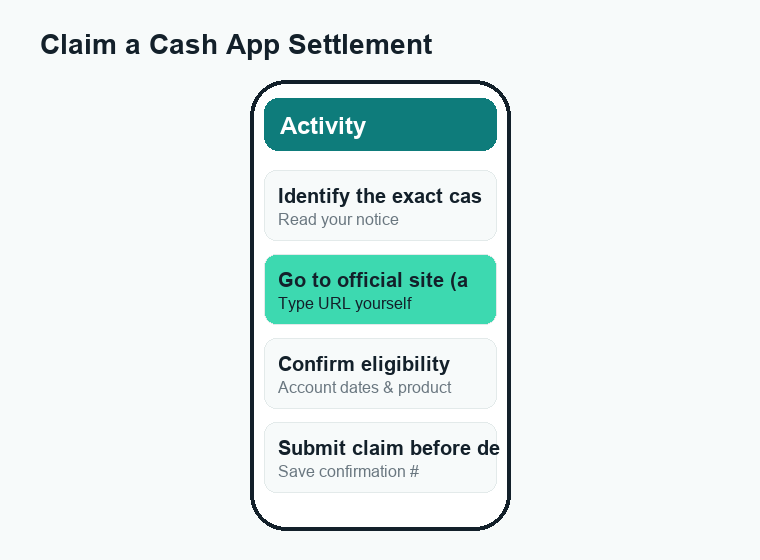
- Find out which case you’re being told about. Read any notice carefully (email, postcard, or in-app message) and note the exact case name, court, or regulator. Legitimate notices name the specific lawsuit or action.
- Go directly to the official source. Type the official settlement administrator’s web address into your browser yourself, or start at the regulator’s official site (for a CFPB matter, that’s the CFPB’s own pages). Do not click links inside an unsolicited text or DM.
- Confirm you’re a class member. The official site will spell out eligibility — for example, having had a Cash App or Cash App Investing account during a specific date range, or having experienced a particular type of unauthorized transaction.
- Gather your information. Most claims ask for your name, mailing address, email, and sometimes a claim ID or notice ID printed on your notice. Have your Cash App account email or phone handy.
- Submit the claim form before the deadline. Fill in the online form on the official site, choose your payment method if offered, review, and submit. Save the confirmation number.
- Or do nothing — if the notice says payment is automatic. Some settlements and most regulator redress programs pay eligible customers automatically. If your notice says no action is required, you simply wait.
- Keep records and watch for payment. Note the deadline, the expected payment timeline, and check back on the official site for status updates.
How to check if you’re eligible
Eligibility is defined by the settlement or order, not by you guessing. Still, you can do a quick self-check before you ever file:
- Account timing. Most settlements cover customers who held an account during a defined window. If you opened your account after the relevant period, you may not qualify.
- Product affected. Some cases are specific to Cash App Investing, others to the core Cash App wallet, others to particular transaction types. Match the case to what you actually used.
- Type of harm. A data-breach claim may cover anyone whose info was exposed; a redress program may target customers who reported specific unauthorized activity or complaints.
- Notice received. If an administrator already has your contact details, you may get a postcard or email with a unique claim ID. That’s a strong sign you’re in the class — but verify it on the official site rather than trusting the message alone.
The most reliable move is to read the eligibility section on the official settlement page and, if available, use the official lookup tool with the claim ID from your notice.
What information you’ll need to file
Legitimate claim forms ask for the minimum needed to confirm identity and route a payment. Expect to provide:
| Info requested | Why it’s needed | Should a real claim ask for it? |
|---|---|---|
| Full name | Match you to the class list | Yes |
| Mailing address & email | Send notices and (sometimes) a check | Yes |
| Claim ID / Notice ID | Link your form to your record | Often, if you got a notice |
| Cash App account email or phone | Confirm you were a customer | Sometimes |
| Payment choice (e.g., digital or check) | Decide how you’re paid | Sometimes |
| Full Social Security number | — | Almost never up front — be cautious |
| Cash App PIN or sign-in code | — | Never — this is a scam sign |
| Card number / bank login password | — | Never — this is a scam sign |
Some legitimate redress or tax processes may eventually require a tax ID for reporting, but a first-step claim form rarely needs your full SSN, and it will never need your Cash App PIN, one-time login code, or banking password. If you see those requests, stop.
Typical timelines: from claim to cash
Settlements move slowly, and that’s normal. The exact dates depend on your specific case, but the general rhythm looks like this. Always confirm the real dates on the official site for your settlement — the table below is a general illustration, not a promise of specific dates.
| Stage | What happens | Rough timing |
|---|---|---|
| Notice period | Class members are notified by email, mail, or in-app | Weeks to a couple of months |
| Claim window | You submit your claim form before the deadline | Until the posted deadline |
| Final approval / objection period | Court holds a fairness hearing; appeals possible | Often several months |
| Payment processing | Administrator validates claims and issues funds | Weeks to many months after approval |
| Payment arrives | Money lands via your chosen method | Varies by method |
The headline takeaway: don’t expect instant money. If a message promises you’ll be paid “today” if you just click a link and enter your details, that urgency is a classic scam tactic.
How settlement payments actually arrive
Payment methods vary by case, but the most common options are:
- Direct digital payment — for example, a deposit to your Cash App balance, a prepaid digital card, or another electronic transfer.
- Paper check mailed to the address on your claim.
- ACH / bank transfer to a linked account, where supported.
If you’re paid into Cash App and the money doesn’t appear right away, it may be processing the same way a normal transfer does — our guide on a Cash App payment pending walks through why funds can sit in limbo and how to nudge them along. Also note that settlement payments themselves should not carry deductions; if you’re curious how everyday transfers are priced, see our breakdown of Cash App fees.
How to spot and avoid Cash App settlement scams
Settlement news is catnip for scammers, because people are primed to expect a payout. Protect yourself with these rules:
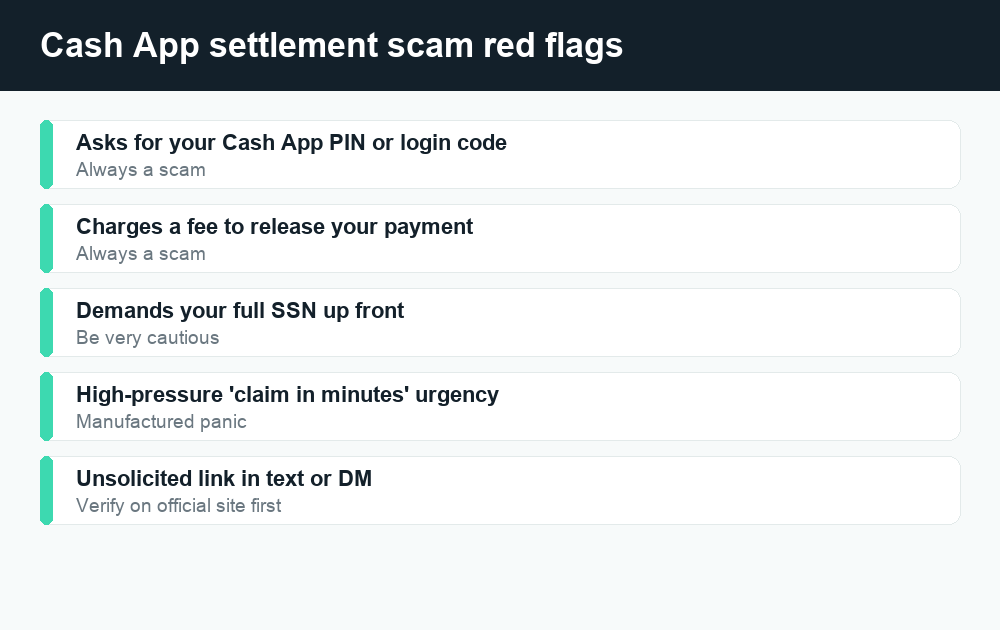
- Never pay to get paid. A real settlement never charges you a “release fee,” “tax prepayment,” or “processing fee” to send you money.
- Guard your credentials. No legitimate claim needs your Cash App PIN, a verification/login code, your card number, or your bank password. Block will never ask for your sign-in code, and neither will a real administrator.
- Verify the web address. Type official URLs yourself. Watch for look-alike domains and odd extensions designed to mimic the real site.
- Ignore high-pressure urgency. “Claim in the next 30 minutes” is manufactured panic. Real deadlines are weeks or months out and posted publicly.
- Be skeptical of unsolicited contact. A surprise text, DM, or call saying you’re owed money — especially asking you to “confirm” sensitive info — is a red flag.
- Cross-check on official sources. Confirm the settlement exists on the administrator’s official site or the regulator’s official page before doing anything.
If something feels off, slow down. You can report suspected scams to the CFPB or the FTC, and you can always reach Cash App support through the app itself rather than a number from a suspicious message.
A note on “claim filing services”
You may see third-party services offering to “file your claim for a small cut.” For a straightforward consumer settlement, you almost never need a middleman — the official form is free and takes minutes. Paying someone a percentage of your payout to do what you can do yourself for free rarely makes sense, and some of these offers are scams in disguise.
What to do if you think you qualify but got no notice
Not receiving a postcard or email doesn’t necessarily mean you’re excluded — administrators only have the contact details they were given. If you believe you’re a class member:
- Find the official settlement site for the specific case and read the eligibility section.
- Use any official “look up my claim” or “register” tool the administrator provides.
- Contact the administrator through the phone number or email listed on the official site (not from a random message) to ask whether you’re on the list.
- If you’ve moved, update your address with the administrator so a check or notice can reach you.
And if you’re cleaning up your finances generally — maybe consolidating apps — just remember to claim any settlement before you make big account changes. Our guide on how to delete a Cash App account explains why it’s smart to settle pending money first.
Frequently asked questions
Is the Cash App settlement real or a scam?
Real legal and regulatory actions involving Cash App and Block, Inc. have existed. But scammers exploit that fact with fake “claim now” messages. The settlement itself can be legitimate while the message in your inbox is fraudulent — so always verify on the official administrator or regulator site before acting.
How do I know which settlement applies to me?
Read your notice for the exact case name, court, or regulator, then look that case up on its official page. Eligibility usually depends on when you had an account and which product or harm was involved. If you can’t identify a specific, verifiable case, treat the claim with suspicion.
Do I have to file a claim, or is payment automatic?
It depends on the case. Many class-action settlements require you to submit a claim form before a deadline, while many regulator redress programs pay eligible customers automatically. Your official notice will state clearly whether action is required.
How much money will I get?
There’s no single fixed amount, and it varies widely by settlement. Per-person payouts depend on the total fund, the number of valid claims, and the type of harm. Be wary of any message promising a specific large sum to lure you into clicking — confirm figures only on the official site.
How long does it take to get paid?
Often months. After the claim deadline, there’s typically a court approval step, then claim validation, then payment processing. Anyone promising instant payment in exchange for your details is almost certainly running a scam.
What info should I never share to “claim” a settlement?
Never share your Cash App PIN, a one-time login or verification code, your full card number, or your bank password. A real claim form may ask for your name, address, email, and a claim ID — but not your secret credentials.
Will the settlement money arrive in my Cash App balance?
Sometimes. Depending on the case you may be paid into Cash App, by paper check, by prepaid card, or by bank transfer. If funds are sent to Cash App and don’t appear immediately, they may just be processing like a normal transfer.
I missed the deadline — can I still claim?
Usually no. Claim deadlines are firm, and late submissions are typically rejected. Check the official site; if the window has closed, there’s generally nothing more to file. This is why it pays to verify and act early rather than ignore a genuine notice.
The bottom line
Claiming a Cash App settlement is genuinely simple when you stick to official channels: identify the specific case, verify it on the administrator’s or regulator’s official site, confirm you’re eligible, and submit the free claim form with basic info before the deadline — or wait if payment is automatic. The part that trips people up isn’t the form; it’s the flood of fake “you’re owed money” messages. Slow down, guard your PIN and login codes, never pay to get paid, and confirm everything against an official source. Do that, and you’ll claim what’s yours without handing anything to a scammer.
Last updated: June 2026. Fees, limits, and features can change — always confirm current details in the app. WalletWisp is an independent guide and is not affiliated with any app mentioned. This article is general information, not financial advice.
Related: Why is my Cash App payment pending? · Cash App fees explained · More Cash App guides