

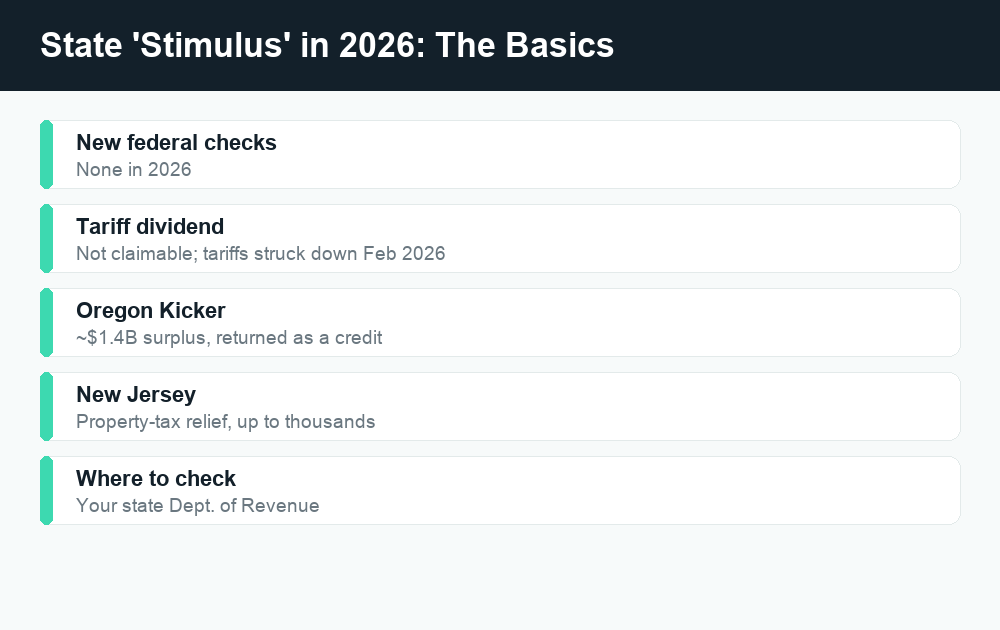
There are no new federal stimulus checks in 2026, and there is no “tariff dividend” payment either. What is real is a patchwork of state-level relief: Oregon’s roughly $1.4 billion “Kicker” tax-surplus credit, New Jersey property-tax relief programs, and assorted rebates in other states. Whether you get anything depends entirely on where you live and your tax situation.
Quick answer: Congress has not passed a new round of federal stimulus checks for 2026, and the “tariff dividend” idea is not a thing you can claim, especially after the Supreme Court struck down many of the tariffs behind it in February 2026. Real money in 2026 comes from individual states: Oregon is returning a large surplus through its Kicker credit, and New Jersey offers sizable property-tax relief. Check your own state’s Department of Revenue to see if you qualify, and never pay a fee or hand over your login to “release” a rebate.
First, the part everyone gets wrong: there are no new federal checks
Every few months a wave of posts, videos, and forwarded text messages claims a new $1,200, $2,000, or “fourth stimulus” check is on the way. In 2026, that is not true at the federal level. Congress has not authorized a new round of Economic Impact Payments, and the IRS is not mailing out broad stimulus checks to everyone with a Social Security number.
The most recent twist in the rumor mill is the so-called “tariff dividend,” the idea that money collected from tariffs would be handed back to taxpayers as a check. There is no such program you can sign up for or claim. And the legal ground under it got shakier in February 2026, when the Supreme Court struck down many of the tariffs that were supposed to fund it. In short: if you see an ad or message promising a federal “tariff rebate” or “tariff dividend check,” treat it as a red flag, not a payday.
That does not mean no money is moving in 2026. It means the action has shifted to the states. Several states are returning budget surpluses or expanding property-tax relief, and those are real, official programs. The catch is that they vary enormously, and most require you to live in a specific state, meet income or age rules, and sometimes file a form. Below are the two headline examples, followed by how to check your own state.
Oregon’s “Kicker”: returning a roughly $1.4 billion surplus
Oregon has an unusual law nicknamed the “Kicker.” When the state collects significantly more in personal income tax than its official forecast predicted, it is required to return the excess to taxpayers rather than keep it. For 2026, that surplus is large, in the neighborhood of $1.4 billion, which is why you may be hearing about it.
A few things are worth understanding about how the Kicker actually works, because it is not a check in the mail for most people:
- It usually comes as a tax credit, not a paper check. In most years the Kicker is applied as a credit on your Oregon state income tax return, which can lower what you owe or increase your refund. It is tied to filing your Oregon return.
- The amount is roughly proportional to your tax. The Kicker is generally calculated as a percentage of the state income tax you paid. People who paid more state tax tend to receive a larger Kicker; people who paid little or none receive little or none.
- You generally have to file an Oregon return to get it. If you skip filing, you typically miss the credit.
Because the exact percentage and the filing details can change from year to year, the right move is to confirm the current figures on the Oregon Department of Revenue website rather than trusting a number from a social-media post. Oregon also publishes a “What’s My Kicker?” style lookup in many years that lets you estimate your amount once the numbers are finalized.
New Jersey: property-tax relief that can reach into the thousands
New Jersey takes a different approach. Instead of a surplus rebate, the state runs ongoing property-tax relief programs aimed at homeowners and, in some cases, renters and seniors. These are the programs people often lump in with “stimulus,” even though they are really targeted property-tax assistance.
Two well-known examples illustrate the model:
- ANCHOR-style relief. New Jersey’s ANCHOR program provides property-tax relief to eligible homeowners and renters, with the benefit amount depending on factors like income and whether you own or rent. Benefits have historically ranged from a few hundred dollars up to roughly $1,500 for many homeowners, though exact amounts and brackets are set each cycle.
- Senior Freeze (Property Tax Reimbursement). This program helps eligible older and disabled residents by reimbursing the increase in their property taxes over a base year, effectively “freezing” their bill. For long-time qualifying homeowners, the reimbursement can add up to several thousand dollars over time.
New Jersey has also been working to combine and simplify some of these programs so residents can apply in one place. Because eligibility rules (income limits, age, residency, and how long you have owned your home) change and because application windows open and close, you should confirm the current rules and deadlines on the official New Jersey Division of Taxation site before assuming you qualify.
Other states: rebates and property-tax relief vary widely
Oregon and New Jersey are just two examples. Many other states run their own rebates, surplus refunds, or property-tax and rent relief programs. The details differ so much that there is no single national answer, but the common categories look like this:
| Type of relief | How it usually works | Who tends to qualify |
|---|---|---|
| Surplus / “kicker” refund | State returns excess tax revenue, often as a credit on your state return | Residents who filed a state income tax return |
| Property-tax relief (homeowner) | Rebate, credit, or reimbursement tied to property taxes paid | Homeowners, often with income and residency limits |
| Renter relief | Credit or rebate based on rent paid (rent is treated as indirect property tax) | Renters meeting income limits in some states |
| Senior / disability freeze | Reimburses increases in property tax above a base year | Older or disabled long-term homeowners |
| Targeted one-time rebate | Flat payment passed by the legislature for a specific year | Varies; often tied to filing a return by a deadline |
The takeaway: do not assume that because a friend in another state got a check, you will too. Relief is set state by state, and even within a state the amount can swing based on your income, age, and whether you rent or own.
How to check what your state actually offers
You can usually find the truth in a few minutes by going straight to official sources instead of relying on viral posts. Here is a simple, repeatable process.
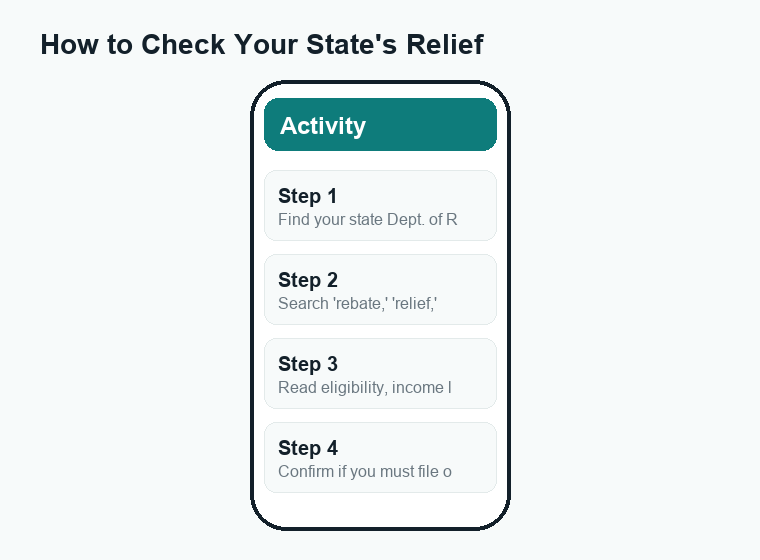
- Search for your state’s Department of Revenue or Division of Taxation. These are the official agencies that administer rebates and credits. Look for a web address ending in
.gov. - Look for pages labeled “rebate,” “relief,” “credit,” or “refund.” Many state revenue sites have a dedicated section for current-year relief programs and deadlines.
- Check eligibility and deadlines carefully. Note income limits, age requirements, residency rules, and the application or filing deadline. Missing a deadline is the most common reason people lose out.
- Confirm whether you need to file or apply. Some relief is automatic if you file your state return; some requires a separate application.
- For federal questions, use IRS.gov. If you are wondering about a federal payment, the IRS website is the authority. If a “federal stimulus” is not listed there, it is not real.
If you cannot find a program on your state’s official site, that is your answer: it probably does not exist, regardless of what an ad or text message claims.
Scam warning: how fake “stimulus” and “rebate” schemes work
Rumors about checks are catnip for scammers, because people want the money to be real. In 2026, expect a steady stream of fake “stimulus,” “tariff dividend,” and “rebate” pitches by text, email, social media, and phone. They tend to follow the same playbook, and once you know it, they are easy to spot.
Watch for these red flags:
- They ask for a fee to “release,” “process,” or “unlock” your payment. No legitimate government rebate requires you to pay money up front to receive money. If there is a fee, it is a scam.
- They want your login, full Social Security number, or banking password. Real agencies do not ask you to “verify” by handing over your online banking or tax-account password through a link in a message.
- They create urgency. “Claim within 24 hours or lose your check” is a pressure tactic, not how government programs communicate.
- They use look-alike links. Scam sites mimic official names but use odd web addresses. Official tax and benefit sites end in
.gov. When in doubt, type the address yourself instead of clicking. - They contact you out of the blue by text or DM. The IRS and most state agencies do not start the conversation about a rebate via random text messages or social-media accounts.
A good rule: any message that combines “free government money” with a request for a fee or your login is almost certainly a scam. When you are unsure, stop, do not click, and navigate to the official site on your own.
Frequently asked questions
Is there a fourth federal stimulus check in 2026?
No. As of early July 2026, Congress has not passed a new round of federal Economic Impact Payments, and the IRS is not sending broad stimulus checks. If you see a claim about a new federal check, verify it directly on IRS.gov before believing it.
What is the “tariff dividend,” and can I claim one?
The “tariff dividend” was an idea to return tariff revenue to taxpayers as a payment, but there is no program you can sign up for or claim. The legal basis weakened further when the Supreme Court struck down many of the underlying tariffs in February 2026. Treat any “tariff rebate” offer as a likely scam.
How do I get the Oregon Kicker?
For most Oregon taxpayers, the Kicker arrives as a credit when you file your Oregon state income tax return, not as a separate paper check. The amount is generally tied to the state income tax you paid. Confirm the current percentage and details on the Oregon Department of Revenue website.
Who qualifies for New Jersey property-tax relief?
It depends on the specific program. ANCHOR-style relief is aimed at eligible homeowners and renters, with amounts tied to income and housing status, while the Senior Freeze helps qualifying older or disabled long-term homeowners. Income limits, age, and residency rules vary, so check the New Jersey Division of Taxation site for current eligibility and deadlines.
How can I tell if a rebate offer is a scam?
The biggest tells are a request for an up-front fee, a demand for your login or banking password, false urgency, look-alike links, and unsolicited texts or DMs. No legitimate government rebate makes you pay to receive money. When in doubt, go directly to the official .gov site instead of clicking a link.
Conclusion
The headline for 2026 is simple: there are no new federal stimulus checks and no claimable “tariff dividend,” but real, state-level relief does exist. Oregon is returning a large surplus through its Kicker credit, New Jersey offers property-tax relief that can reach into the thousands, and other states run their own rebates and freezes. The only reliable way to know what you qualify for is to check your own state’s Department of Revenue, watch the deadlines, and stay alert to scams that ask for fees or logins. For more plain-English breakdowns of tax credits, rebates, and money apps, explore our related WalletWisp guides.