
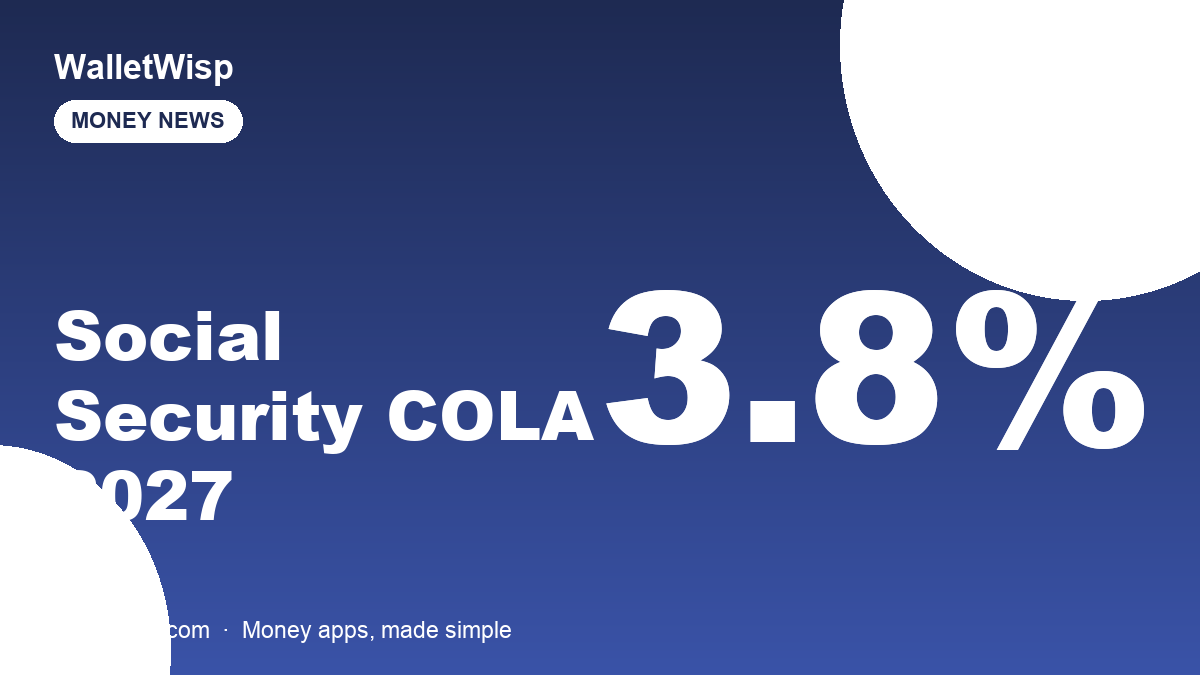
The 2027 Social Security cost-of-living adjustment (COLA) is not final yet, but early forecasts put next year’s raise somewhere between roughly 3.8% and 4.7%. The official figure will not be locked in until the Social Security Administration (SSA) announces it in mid-October 2026, after the summer inflation data is complete.
Quick answer: Early 2027 COLA estimates range from about 3.8% (The Senior Citizens League) to as high as roughly 4.7% based on hotter recent inflation. These are projections, not the final number. SSA calculates the real COLA from third-quarter (July, August, September) CPI-W data and will announce it in mid-October 2026. Any raise takes effect with your January 2027 benefit. Always confirm the official figure at SSA.gov.
What is the Social Security COLA?
The cost-of-living adjustment, or COLA, is the annual increase applied to Social Security and Supplemental Security Income (SSI) payments to help benefits keep pace with rising prices. The idea is simple: if a gallon of milk, a doctor’s copay, and your electric bill all cost more this year than last, your benefit should rise too so it does not quietly lose value over time.
Congress made the COLA automatic starting in the 1970s. Before that, any increase to benefits required a separate act of Congress, which meant retirees could go years without a raise even as prices climbed. Today the adjustment happens every year on a set schedule, tied to a specific inflation measure rather than to politics. Some years the raise is large; some years it is modest; and in rare years with essentially no inflation, there is no COLA at all.
It is worth being clear about what the COLA is not. It is not a bonus, a stimulus, or a reward. It is an inflation catch-up. In a good year it roughly keeps your buying power flat; it does not make you wealthier in real terms. Understanding that framing helps set realistic expectations before the 2027 number lands.
How the COLA is calculated
The COLA is not set by a committee vote or a guess. It is a formula tied to a government inflation index called the CPI-W — the Consumer Price Index for Urban Wage Earners and Clerical Workers, published by the Bureau of Labor Statistics.
Here is the mechanism in plain terms. SSA looks at the average CPI-W for the third quarter of the current year, meaning the months of July, August, and September. It compares that average to the third-quarter average from the last year a COLA was determined. The percentage increase between those two figures becomes the COLA for the following year.
Because only July, August, and September count, inflation earlier in the year does not directly decide the final number — it only shapes the forecasts. That is a big reason projections made in the spring and summer can shift as the actual summer data rolls in. A hot June headline does not lock anything in; the third-quarter readings are what matter.
| Element | How it works |
|---|---|
| Index used | CPI-W (urban wage earners and clerical workers) |
| Months that count | July, August, September (third quarter) |
| Comparison | This year’s Q3 average vs. prior COLA year’s Q3 average |
| Announced | Mid-October 2026 by SSA |
| Takes effect | January 2027 benefit payments |
One recurring criticism from retiree advocacy groups is that CPI-W tracks the spending of working-age wage earners, not retirees. Older Americans tend to spend a larger share of their income on health care and housing, which often rise faster than the average basket of goods. A separate index, the CPI-E (“E” for the elderly), has been proposed as a more accurate gauge, but it is not the one the law currently uses. Unless Congress changes the statute, CPI-W remains the yardstick.
The 2027 COLA forecasts and why they vary
Because the official number depends on data that will not be complete until the end of September 2026, everything circulating now is a projection. As of mid-2026, published estimates for the 2027 COLA sit in a fairly wide band:
| Source / scenario | Projected 2027 COLA |
|---|---|
| The Senior Citizens League (advocacy estimate) | ~3.8% |
| Higher-inflation scenario | up to ~4.7% |
| Official SSA figure | Announced mid-October 2026 |
Why such a range? A few reasons:
- Different inflation assumptions. A forecast is only as good as its guess about how prices behave over the summer. Analysts who assume inflation cools quickly land near the lower end; those who expect it to stay elevated land higher.
- The data is not in yet. The July–September readings are the deciding inputs, and in mid-2026 those months have not happened. Every month of new CPI-W data nudges the estimates.
- Methodology and timing. Groups update their projections at different points and weight recent trends differently, so two credible forecasts can disagree by a full percentage point or more.
The practical takeaway: treat any 2027 COLA figure you see before October as a well-informed estimate, not a promise. It is useful for rough planning, but do not build a budget around a specific percentage until SSA makes it official.
When the official 2027 number arrives
Mark your calendar for mid-October 2026. That is when SSA typically releases the confirmed COLA, right after the September CPI-W data is published. The announcement usually gets heavy news coverage, and SSA posts the details directly on SSA.gov.
The increase then applies to January 2027 benefit payments. For most retired workers, that means the first check reflecting the new amount lands in January. (SSI recipients often see the adjustment slightly earlier, at the very end of December, because of how those payment dates fall.) SSA also mails and posts personalized COLA notices, and you can view your specific new benefit amount in your my Social Security account online.
What a COLA does — and doesn’t — do for your buying power
A COLA is designed to protect purchasing power, not grow it. Even a healthy-looking percentage can feel underwhelming once real life is factored in. Here is why the number on paper and the number in your wallet can diverge.
Medicare premiums can eat into it. For many retirees, the standard Medicare Part B premium is deducted directly from the Social Security payment. If that premium rises at the same time as the COLA, part of your raise is absorbed before you ever see it. In some years the premium increase has canceled out a large share of the COLA for affected beneficiaries.
Retiree costs may outrun the index. Because the COLA is tied to CPI-W rather than an elderly-specific index, it may not fully capture the health care and housing inflation that hits older households hardest. A 3.8% raise does not help much if your prescription costs and rent jumped by more.
Taxes can follow the raise. A larger benefit can, for some households, push more of their Social Security income into the taxable range or nudge them across other income thresholds. The COLA itself is not a tax, but a bigger benefit can have downstream tax effects worth checking with a tax professional or the IRS.
None of this means the COLA is worthless — far from it. Without it, inflation would erode fixed benefits year after year with no relief. The point is to set expectations honestly: in a typical year the adjustment roughly holds you even, and that is exactly what it is built to do.
How to plan around the 2027 COLA
You cannot control the final percentage, but you can prepare sensibly:
- Use forecasts as a range, not a target. If you want to sketch a 2027 budget, model both a lower (around 3.8%) and higher (around 4.7%) scenario so you are ready either way.
- Wait for October before finalizing. The official number is the only one that will actually hit your check. Hold off on locking in new commitments based on a projection.
- Check your Medicare Part B premium too. Your net raise depends on both the COLA and any premium change, so look at them together.
- Log in to verify your own figure. Your personalized new benefit amount will appear in your my Social Security account at SSA.gov — that beats relying on a national average.
Watch out for COLA scams
Every year around COLA season, scammers use the news to trick beneficiaries. Be skeptical of anyone who contacts you out of the blue about your Social Security “raise.” A few rules that never change:
- SSA will not call, text, or email you demanding personal information, a fee, or gift cards to “activate,” “unlock,” or “release” your COLA. There is nothing to activate — the increase is automatic.
- Your COLA does not require an application, a confirmation payment, or a special form.
- Do not click links in unsolicited messages claiming to show your new benefit. Type SSA.gov yourself and log in to your own account.
- If someone pressures you to act immediately or threatens to suspend your benefits, it is a scam. Hang up and, if you want, contact SSA through the official number listed on SSA.gov.
Frequently asked questions
What will the 2027 Social Security COLA be?
No one knows the exact figure yet. Early forecasts as of mid-2026 range from about 3.8% (The Senior Citizens League) up to roughly 4.7% under higher-inflation scenarios. The official 2027 COLA will be announced by SSA in mid-October 2026. Check SSA.gov for the confirmed number.
When is the 2027 COLA announced and when does it start?
SSA typically announces the COLA in mid-October, right after the September inflation data is released — so mid-October 2026 for the 2027 figure. The increase then applies to January 2027 benefit payments (SSI recipients may see it at the end of December 2026).
How is the Social Security COLA calculated?
It is based on the CPI-W inflation index. SSA compares the average CPI-W for July, August, and September of the current year to the same third-quarter average from the last year a COLA was set. The percentage increase becomes the next year’s COLA. Because only the third quarter counts, forecasts can shift as summer data arrives.
Why do the 2027 COLA forecasts disagree with each other?
The final number depends on inflation data that is not complete until the end of September 2026. Forecasters make different assumptions about how prices will move over the summer, and they update their estimates at different times, so credible projections can differ by a full percentage point or more.
Will a bigger COLA actually improve my buying power?
Not necessarily. A COLA is meant to keep benefits even with inflation, not to make you wealthier. Rising Medicare Part B premiums, retiree-specific costs like health care and housing, and possible tax effects can offset part of the raise. In a typical year it roughly holds your purchasing power steady.
The bottom line
The 2027 Social Security COLA is shaping up to land somewhere between roughly 3.8% and 4.7%, but the only figure that counts is the one SSA announces in mid-October 2026, effective with January 2027 checks. Use the current forecasts to plan a range, watch your Medicare premium alongside the raise, verify your personal amount at SSA.gov, and stay alert for scams that spike around COLA season. For more on making the most of your benefits, see our related WalletWisp guides on Social Security timing, Medicare costs, and budgeting on a fixed income.