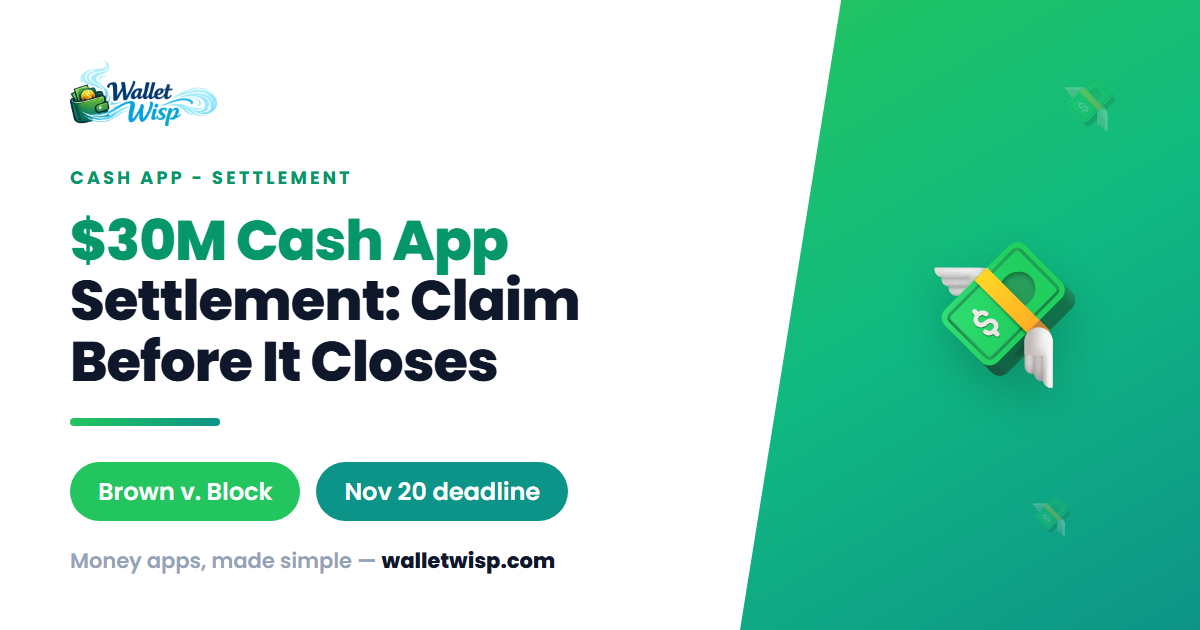
If you ever reported an unauthorized charge or transfer on Cash App and got stuck with no refund — or only part of your money back — there’s a $30 million settlement with your name potentially on it. The case is Brown v. Block, Inc., filed in the U.S. District Court for the Northern District of California, and the window to file a claim closes on November 20, 2026.
Here’s the catch: millions of eligible users will never claim a cent simply because they don’t know the settlement exists, or they confuse it with one of the other Cash App settlements floating around. This guide breaks down exactly who qualifies, how much you could get, and the steps to file before the deadline.
What the Brown v. Block settlement is about
Block, Inc. is the parent company of Cash App. The lawsuit alleges that when customers reported unauthorized transfers — money moving out of their accounts that they didn’t approve — Block didn’t always handle those disputes the way federal law requires.
That law is the Electronic Fund Transfer Act (EFTA) and its implementing rule, Regulation E. Together they require a payment app like Cash App to promptly investigate unauthorized-transfer reports, issue provisional credit while investigating in many cases, and refund your loss unless it can prove you actually authorized the transaction. The complaint argued that too many users were denied full refunds or left waiting. Block agreed to a $30 million fund to resolve the claims without admitting wrongdoing.
Who qualifies
You’re likely a class member if all three of these are true:
- You had a Cash App account (including a linked Cash App Card or bank account).
- You reported an unauthorized transfer to Cash App between January 1, 2019 and February 28, 2026.
- You received no refund, or only a partial refund, for that transfer.
“Unauthorized transfer” means money that left your account without your permission — account takeovers, fraudulent withdrawals, stolen-card charges, or transfers pushed through after someone gained access to your login. It generally does not cover transactions you authorized but later regretted, such as paying a scammer who tricked you into sending money yourself (those “authorized push payment” scams are often treated differently and may be part of other cases).
How much money you could get
Your payout depends on whether you can document your loss and how many people file. Based on the settlement terms reported to date, compensation is structured like this:
| Type of payment | What you may receive | What’s required |
|---|---|---|
| Documented out-of-pocket loss | Up to 100% reimbursed, capped at $2,500 | Proof: bank records, screenshots, transaction history |
| Undocumented claim | Flat $25–$75 (varies with claim volume) | Signed attestation under penalty of perjury |
| Lost-time compensation | $25/hour, up to 4 hours ($100 max) | Describe time spent resolving the dispute |
These amounts are the figures reported from the settlement documents and can be adjusted — if a large number of people file, per-person payouts may shrink pro rata; if few file, documented claims may be paid closer to the cap. Always confirm the current numbers on the official settlement website before relying on them.
A worked example
Say a scammer took over Maria’s account in 2023 and pushed out $1,800. She reported it to Cash App and received only a $600 provisional credit that was later reversed, leaving her $1,800 out of pocket. Maria kept her bank statement and in-app dispute screenshots, and she spent about three hours on calls and messages.
- Documented loss reimbursement: up to $1,800 (under the $2,500 cap)
- Lost time: 3 hours × $25 = $75
- Potential total: ~$1,875
Now compare that to Devon, who remembers a roughly $40 unauthorized charge but tossed the records. Without proof, Devon files the undocumented path and signs the attestation, likely landing in the $25–$75 range plus any lost-time credit. The lesson: documentation is the single biggest lever on your payout.
How to file your claim before Nov 20, 2026
- Find the official settlement website. Class settlements are administered through a dedicated site with a Notice ID and claim portal. Verify the exact URL through the Northern District of California’s court notices or a reputable source before entering any personal details — scam “settlement” look-alikes are common.
- Gather your proof. Pull your Cash App transaction history (Activity tab), any dispute confirmation emails or in-app messages, and the linked bank/card statement showing the loss.
- Complete the claim form. Enter your identity details, your Notice ID or confirmation code if you received one, a description of the unauthorized transfer, and upload your documentation.
- Choose how you want to be paid. Most administrators offer options like a mailed check, Cash App deposit, or other electronic payment.
- Submit before the deadline and save your confirmation. File on or before November 20, 2026. Screenshot or print the confirmation page.
Key dates at a glance
| Milestone | Date |
|---|---|
| Class period covered | Jan 1, 2019 – Feb 28, 2026 |
| Opt-out / objection deadline | Reported as Aug 10, 2026 (passed) |
| Final approval hearing | Reported as Sept 15, 2026 |
| Claim filing deadline | Nov 20, 2026 |
Don’t confuse this with the other Cash App settlements
There are several Cash App matters in the news, and mixing them up can cost you a claim:
- The $15M data-breach settlement (over 2021–2023 security incidents) had a claim deadline back in November 2024 and is now paying out — you cannot file a new claim there.
- A $45M+ multistate attorney-general settlement and the CFPB order against Block are enforcement actions; those don’t require you to file an individual claim the same way.
- Brown v. Block — the $30M unauthorized-transfer settlement in this guide — is the one still open for claims through November 20, 2026.
Frequently Asked Questions
I don’t have screenshots or records anymore. Can I still file?
Yes. You can file an undocumented claim by signing an attestation under penalty of perjury that you experienced an unauthorized transfer that wasn’t fully refunded. You’ll typically receive a smaller flat amount (reported at $25–$75) rather than full reimbursement, so it’s worth checking your old emails, bank statements, and Cash App activity for any proof first.
Do I have to pay taxes on the settlement money?
Reimbursement of an actual financial loss is generally not taxable income, but lost-time or interest portions can be. Amounts and your personal situation vary, so if you receive a sizable payment, confirm with a tax professional. WalletWisp can’t give tax advice.
Will filing a claim close my Cash App account or hurt my credit?
No. Filing a class action claim doesn’t affect your account standing or your credit. You’re simply asking the settlement administrator to review your eligibility for a payment from the fund.
How long until I get paid?
Class settlement payments usually arrive weeks to several months after the claim deadline and final court approval, once claims are validated. Keep your mailing address and payment details current with the administrator, and watch for official emails rather than unexpected texts asking for fees — legitimate settlements never charge you to claim.
The bottom line
If an unauthorized transfer ever drained your Cash App balance and you weren’t made whole, the Brown v. Block settlement is a genuine chance to recover up to $2,500 of documented losses plus lost-time compensation — but only if you file by November 20, 2026. Dig up your records today, confirm the official claim site, and submit before the window shuts. Five minutes now could put real money back in your pocket.
WalletWisp is an independent informational resource and is not affiliated with Cash App, Block, Inc., or the settlement administrator. This article is for general information only and is not financial or legal advice. Always verify details and deadlines on the official settlement website before filing.