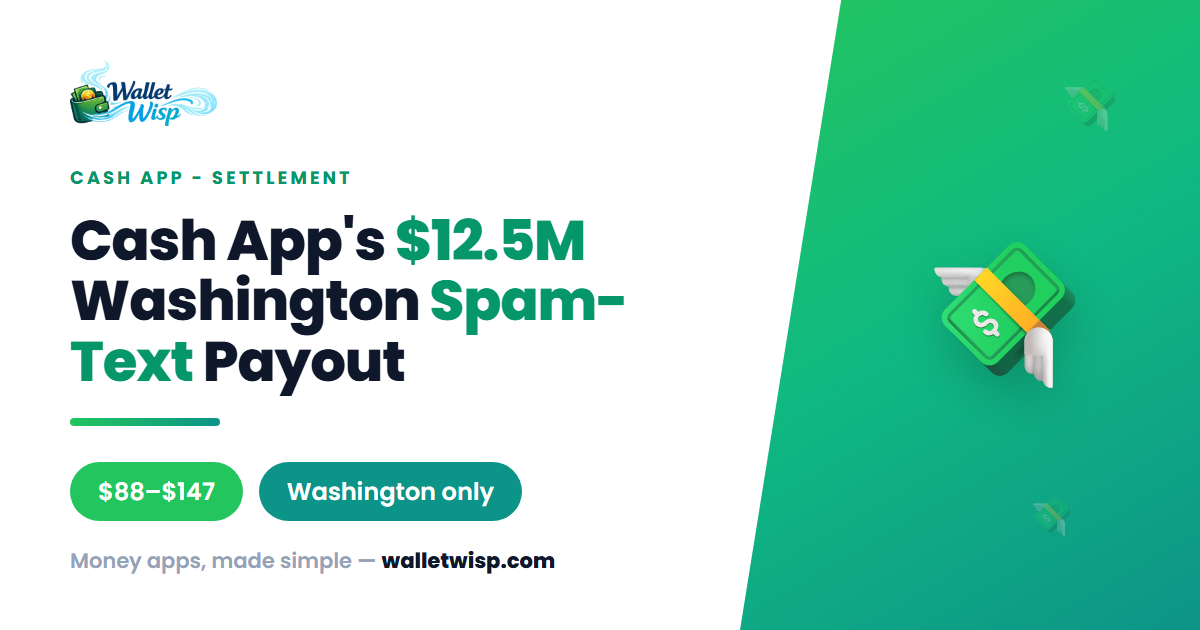
If you live in Washington state and once got a surprise “Join me on Cash App” text, you may be one of nearly two million people tied to a $12.5 million class action settlement against Block, Inc. — Cash App’s parent company. A federal judge gave the deal final approval in December 2025, and payments have been working their way to claimants since early 2026. Here’s exactly who qualifies, how the money is calculated, and when it lands.
What the settlement is about
The case is Bottoms v. Block, Inc. (No. 2:23-cv-01969), filed in the U.S. District Court for the Western District of Washington in Seattle. Lead plaintiff Kimberly Bottoms sued in late 2023, arguing that Cash App’s “Invite Friends” referral feature — which let users send pre-filled texts offering a $5 bonus for signing up — sent unsolicited messages in violation of Washington’s Commercial Electronic Mail Act (CEMA, RCW 19.190). That state law bans sending commercial texts to Washington numbers without clear consent.
Block denied any wrongdoing and did not admit fault. As is common in class actions, the company agreed to pay a lump sum to resolve the matter rather than continue litigating. U.S. District Judge John Chun called the deal “fair, reasonable, and adequate” and granted final approval on or about December 2, 2025, after Judge Marsha Pechman had granted preliminary approval on July 29, 2025.
Who qualifies
You’re a class member if all of the following apply:
- You had a Washington state telephone number (a Washington area code) — or were a Washington resident at the time.
- You received an unsolicited Cash App referral/”Invite Friends” text message.
- The text arrived between November 14, 2019 and August 7, 2025.
- You did not clearly consent in advance to receiving it.
Plaintiffs’ attorneys estimated there were about 1,975,187 Washington class members. Importantly, qualifying for the class and getting paid are two different things: you had to file a valid claim by the deadline. If you did not submit a claim by October 27, 2025, you are not eligible for a payment, and that window cannot be reopened.
How much money — the $88–$147 range (and why checks came in higher)
The widely reported estimate was $88 to $147 per person. That figure came from the attorneys’ September 2025 projection, which assumed no more than 5% of the nearly two million class members would file valid claims. Here’s how the pot breaks down:
| Item | Amount |
|---|---|
| Total settlement fund | $12.5 million |
| Attorneys’ fees | ~$3.1 million |
| Class representative award (Kimberly Bottoms) | $10,000 |
| Approximate amount shared among claimants | ~$8.7 million |
| Estimated payment per valid claim | $88–$147 |
| Class period | Nov 14, 2019 – Aug 7, 2025 |
| Claims deadline | Oct 27, 2025 (closed) |
| Final approval | ~Dec 2, 2025 |
Because class-action payouts divide a fixed pot among everyone who actually files, the fewer people who claim, the bigger each check. The $88–$147 estimate assumed a 5% claim rate. In practice, far fewer than two million people submitted claims, so some secondary reports put the actual per-claim payout notably higher — figures around $394 per accepted claim have circulated. Treat those higher numbers as unofficial until the settlement administrator confirms them; the $88–$147 range remains the only figure that came straight from the court filings.
A worked example
Say the roughly $8.7 million claimant pool is split among 60,000 valid claims. That’s about $145 each — right at the top of the official estimate. If only 25,000 valid claims were accepted, the same $8.7 million divides into roughly $348 each. That’s the mechanism behind reports of larger-than-expected checks: a low claim rate, not a bigger settlement.
When the money arrives
The settlement agreement set a “Distribution Date” 30 calendar days after final approval. With final approval around December 2, 2025, that pointed to distribution beginning in early 2026. Payments then rolled out in the method each claimant chose on the claim form:
| Payment method | What to expect |
|---|---|
| Digital payment (e.g., PayPal, Venmo, direct deposit, prepaid card) | Typically the fastest — sent to the account/email you provided on the claim. |
| Paper check | Mailed to the address on your claim; watch for an envelope from the settlement administrator. Checks carry an expiration date. |
| Reissued check | If a first-round digital payment failed or a check went stale, a replacement may be mailed. Reissued checks also expire. |
By late 2026, distribution is in its final stages. If you filed a valid claim and have not received anything, act promptly — checks and reissues have deadlines, and uncashed funds don’t wait forever.
What to do if your payment hasn’t shown up
- Locate your claim ID / confirmation from when you filed in 2025.
- Confirm the email, payment account, or mailing address you submitted is still active.
- Contact the official settlement administrator directly (use the contact info from the official claims website or your filing confirmation — not a number from a random web page).
- Ask specifically about a reissue if your check expired or a digital payment bounced.
- Check your spam folder and any prepaid-card or payment-app notifications you may have missed.
Frequently Asked Questions
Can I still file a claim?
No. The claims deadline was October 27, 2025, and it has passed. Courts do not reopen class-action claim windows after final approval, so if you didn’t submit a claim, you can’t be paid from this settlement. Beware of any site or message claiming it can file a late claim for you — that’s a red flag for a scam.
Is this the same as the $45 million multistate Cash App settlement?
No — those are separate matters. A different, much larger multistate settlement involving dozens of state regulators sends money to the states themselves, not to individual users, so there’s no consumer claim form for it. The Washington Bottoms v. Block case is the one paying individual claimants the $88–$147-range checks.
Will accepting this payment cost me anything or affect my Cash App account?
No. Claimants don’t pay a fee to receive a settlement payment, and accepting it doesn’t change or close your Cash App account. The only effect is that, by being part of the class and not opting out, you released your related legal claims against Block over these texts. The administrator never asks for your Social Security number, full bank login, or a “processing fee” to release a payment — those are scam signals.
Why did I only get an estimate instead of an exact amount?
Class-action payouts are “pro rata,” meaning the available pool is divided among everyone who files a valid claim. Until all claims are reviewed and approved, the exact per-person figure isn’t final. That’s why the court filings gave a $88–$147 range rather than a single number — and why the actual check could land higher if fewer people claimed.
The bottom line
If you had a Washington phone number and got unwanted Cash App referral texts between November 2019 and August 2025 — and you filed a claim by October 27, 2025 — your payment of roughly $88–$147 (potentially more, given a low claim rate) should be arriving by check or digital transfer through 2026. If you filed and haven’t been paid, contact the official settlement administrator with your claim ID and confirm your contact details before any reissue deadline passes. If you never filed, unfortunately this one has closed, but it’s a good reminder to keep an eye on legitimate class-action notices in the future.
WalletWisp is an independent, informational resource and does not provide financial, legal, or tax advice. For official details, payment status, or to verify any figure, contact the court-appointed settlement administrator or consult the official settlement website.