
If your tax refund still hasn’t arrived in late June or early July 2026, you’re not alone — the IRS is still issuing refunds well past the April deadline, and several common situations (filing late, filing on paper, errors, identity checks, or certain tax credits) can push your payment back by weeks or even months. A standard e-filed return with direct deposit usually lands in about 21 days, but anything outside that simple path takes longer.
Quick answer: The IRS keeps sending refunds for weeks and months after filing season, so payments are still going out into early July 2026. Most e-filed returns with direct deposit are paid in about 21 days; paper returns, amended returns, math errors, identity verification, and credit-related reviews take longer. Track your money with the “Where’s My Refund?” tool or the IRS2Go app, and always verify time-sensitive details at IRS.gov.
The 2026 filing season by the numbers
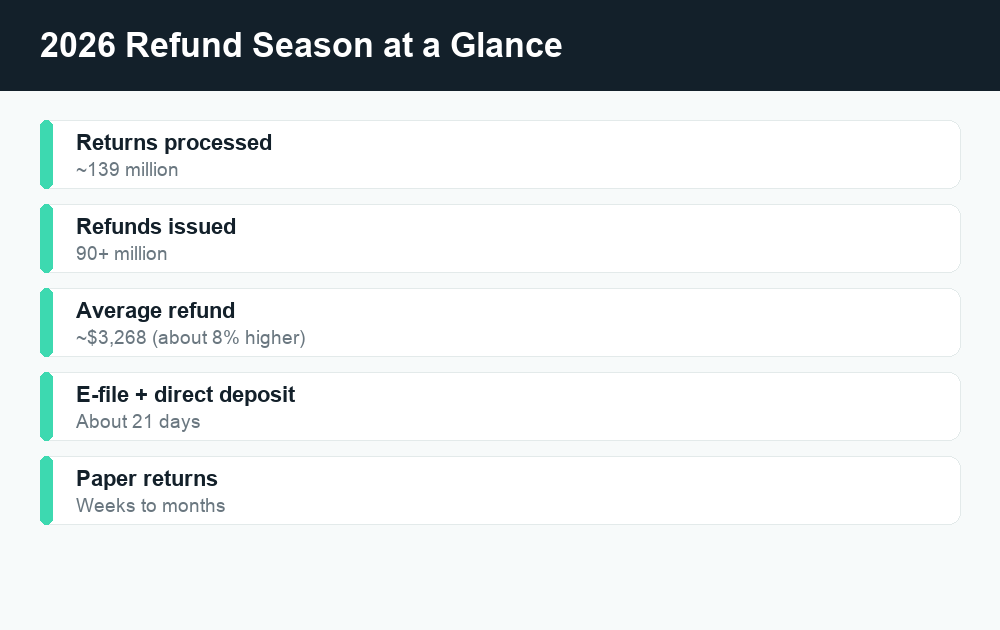
As of the 2026 filing season, the IRS processed roughly 139 million returns and issued more than 90 million refunds. The average federal refund came in at about $3,268 — roughly 8% higher than the prior year. For most households, that refund is one of the biggest single payments they’ll see all year, so it’s no surprise that a delay can feel stressful.
Here’s the part people miss: “filing season” closing in April doesn’t mean refunds stop. The IRS continues processing returns and sending money throughout the summer. Returns filed close to the deadline, returns that needed a closer look, and paper returns are still working their way through the system in June and into early July 2026. A delayed refund usually doesn’t mean something is wrong — it often just means your return fell into a category that takes more time.
Typical IRS refund timelines: e-file vs. paper
The single biggest factor in how fast you get paid is how you filed. Electronic filing with direct deposit is by far the fastest route. Paper returns and paper checks are the slowest. The table below shows typical ranges — these are general estimates, not guarantees, and your situation can vary.
| How you filed | How you’re paid | Typical timeline |
|---|---|---|
| E-file | Direct deposit | About 21 days (most returns) |
| E-file | Paper check | Longer — add mailing time |
| Paper return (mailed) | Direct deposit | Several weeks to months |
| Paper return (mailed) | Paper check | Longest — weeks to months plus mail |
| Amended return (Form 1040-X) | Any method | Often many weeks to several months |
The roughly 21-day estimate applies to a clean, error-free e-filed return with direct deposit. If you mailed a paper return, the IRS has to manually open, sort, and key in your information, which adds significant time. If you requested a paper check instead of direct deposit, add postal delivery on top of processing. And if you filed an amended or corrected return, expect a substantially longer wait — amended returns are processed separately and on their own slower track.
Why your refund is still delayed in June or July 2026
If you’re past the typical window, one of the reasons below is usually behind it. Most are routine and don’t require you to do anything.
You filed near the April deadline
The IRS receives a massive surge of returns in the final days before the deadline. Returns filed in that crunch sit in a much larger queue, so even a straightforward return can take longer than 21 days simply because of volume. If you filed in April, a June or early-July refund is well within normal range.
You filed on paper
Paper returns are the most common cause of long waits. They can’t be processed automatically — a person has to handle them — so they routinely take weeks to months. If you mailed your return, patience is the main remedy.
Your return had errors or didn’t match IRS records
Math mistakes, a misspelled name, a wrong Social Security number, a bank account typo, or income that doesn’t match what employers and payers reported can all trigger a manual review. The IRS may correct some issues automatically, but others require it to pause and sometimes send you a letter. Double-check every number before you file to avoid this.
Your return needs identity verification
To fight refund fraud, the IRS may flag a return for identity verification. If that happens, you’ll typically receive a letter asking you to confirm your identity online or by phone. Your refund is held until you complete that step, so respond promptly if you get one of these notices — and only follow instructions from the official letter and IRS.gov, never from a text or random email.
You claimed the EITC or Additional Child Tax Credit
By law, the IRS applies extra scrutiny to returns claiming the Earned Income Tax Credit (EITC) or the Additional Child Tax Credit (ACTC). Refunds tied to these credits are held longer for verification before being released. This is built into the system to reduce fraud and improper payments, and it affects millions of filers each year.
You filed an amended or corrected return
Amended returns (Form 1040-X) are handled on a separate, slower track and commonly take many weeks to several months. If you amended your return, the standard refund timelines simply don’t apply.
You owe a debt that triggered an offset
If you owe certain past-due debts — such as back taxes, defaulted federal student loans, unpaid child support, or other federal or state obligations — part or all of your refund can be applied to that debt through the Treasury Offset Program. When that happens, you’ll generally receive a notice explaining how much was taken and where it went. Your refund isn’t “lost”; it was redirected to cover what you owed.
How to track your refund: Where’s My Refund? and IRS2Go
The IRS gives you two free, official ways to check your status — and they pull from the same system, so you don’t need both.
- Where’s My Refund? — the online tool on IRS.gov, accessible from a computer or phone browser.
- IRS2Go — the official IRS mobile app, available for download on iPhone and Android, with the same refund-tracking feature.
To check your status, you’ll need three pieces of information from your return: your Social Security number (or ITIN), your filing status (single, married filing jointly, and so on), and the exact whole-dollar refund amount you’re expecting. If any of these don’t match, the tool won’t show your status.
Status typically updates once per day, usually overnight, so checking repeatedly throughout the day won’t show new information. For e-filed returns, your status generally appears within about 24 hours after the IRS accepts your return. For mailed paper returns, it can take around four weeks before any status shows up at all — that’s normal, not a sign of a problem.
What the status bars mean
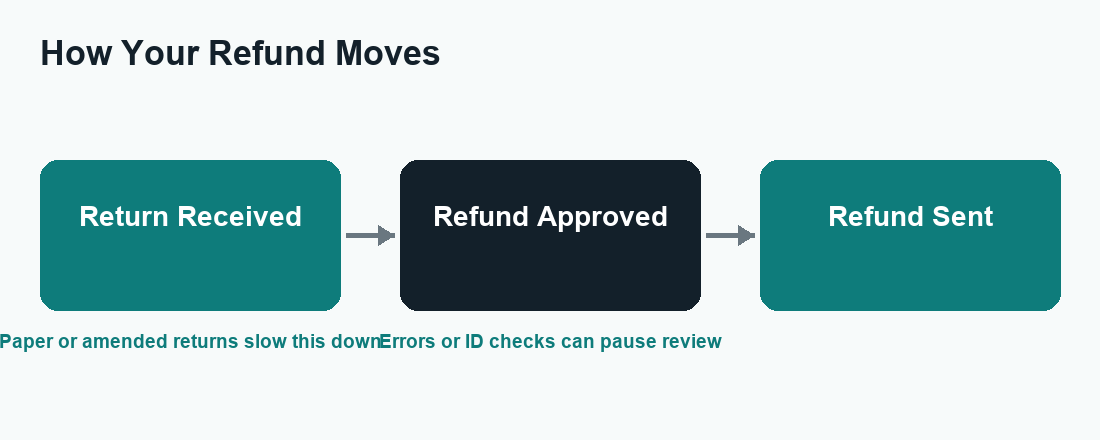
“Where’s My Refund?” walks your return through three simple stages. Knowing what each one means saves a lot of worry.
| Status | What it means | What to do |
|---|---|---|
| Return Received | The IRS has your return and is processing it. | Wait — this is the normal first stage. |
| Refund Approved | Processing is done and your refund is scheduled. | A payment date is usually provided. |
| Refund Sent | Your money is on its way to your bank or mailbox. | Allow a few days for the bank or mail. |
Once you hit “Refund Sent,” give your bank a few business days to post a direct deposit, or allow extra time if you’re waiting on a mailed paper check. If the tool ever shows a message asking you to take action or to call, follow the on-screen instructions — and only those from the official IRS channels.
When should you actually call the IRS?
Calling the IRS rarely speeds anything up, and phone representatives generally can’t give you information beyond what “Where’s My Refund?” already shows. The IRS itself asks people not to call unless a real amount of time has passed or the tool specifically tells you to.
As a general rule, consider reaching out only if: it has been well beyond the typical timeline for how you filed (much longer than 21 days for an e-filed return, or beyond the IRS’s stated paper-return window), the “Where’s My Refund?” tool explicitly directs you to contact the IRS, or you received a letter asking you to take a specific action. Before you call, have your return in front of you. For exact current wait-time guidance and the right phone number, check IRS.gov rather than relying on numbers you find elsewhere — scammers set up fake “IRS” hotlines.
Watch out for refund scams
Refund season is prime time for fraud. The IRS does not initiate contact by text message, email, or social media to ask for personal or financial information, and it won’t demand instant payment or threaten you over the phone. Treat any “click here to claim your refund” text, any email asking for your bank login, or any caller pressuring you for gift cards as a scam. When in doubt, don’t click — go directly to IRS.gov and use the official tools. The only legitimate ways to check your refund are “Where’s My Refund?” and the IRS2Go app.
Frequently asked questions
How long does an IRS refund take in 2026?
Most e-filed returns with direct deposit are issued in about 21 days. Paper returns, amended returns, and returns that need review take longer — sometimes weeks to months. The 21-day figure is a typical estimate, not a guarantee.
Why is my refund taking longer than 21 days?
Common reasons include filing on paper, filing close to the April deadline, errors or mismatched information, identity verification, claiming the EITC or Additional Child Tax Credit, filing an amended return, or having a debt offset applied. Most of these are routine and don’t require action on your part.
Are refunds still being issued in July 2026?
Yes. The IRS continues processing returns and sending refunds well after the April deadline, so payments are still going out in June and into early July 2026. A late refund usually reflects when or how you filed, not a problem with your return.
What’s the fastest way to check my refund status?
Use “Where’s My Refund?” on IRS.gov or the official IRS2Go mobile app. You’ll need your Social Security number or ITIN, your filing status, and your exact expected refund amount. The status updates about once a day, usually overnight.
Should I call the IRS if my refund is late?
Usually no — phone agents typically can’t tell you more than the online tool. Call only if it’s been well beyond the normal timeline, the tool tells you to, or you got a letter asking you to act. Always get the official phone number from IRS.gov.
The bottom line
A refund that’s still pending in June or early July 2026 is almost always normal. The IRS keeps paying refunds long after the filing deadline, and the wait usually comes down to how you filed and whether your return needed extra review. Check your status with “Where’s My Refund?” or IRS2Go, watch for legitimate IRS letters, ignore refund-themed texts and emails, and verify any time-sensitive details directly at IRS.gov. For more on managing your money while you wait, see our related WalletWisp guides on budgeting, banking apps, and avoiding payment scams.