You sold a $60 pair of sneakers, the buyer hit “pay,” and $58.76 landed in your Venmo balance. Where did the other $1.24 go? That’s Venmo’s goods & services (G&S) fee at work — and it’s one of the most misunderstood charges in the peer-to-peer payment world. This guide breaks down exactly how much Venmo takes from sellers, what the tap-to-pay and international add-ons cost, and — crucially — who actually foots the bill.
The core seller fee: 1.9% + $0.10
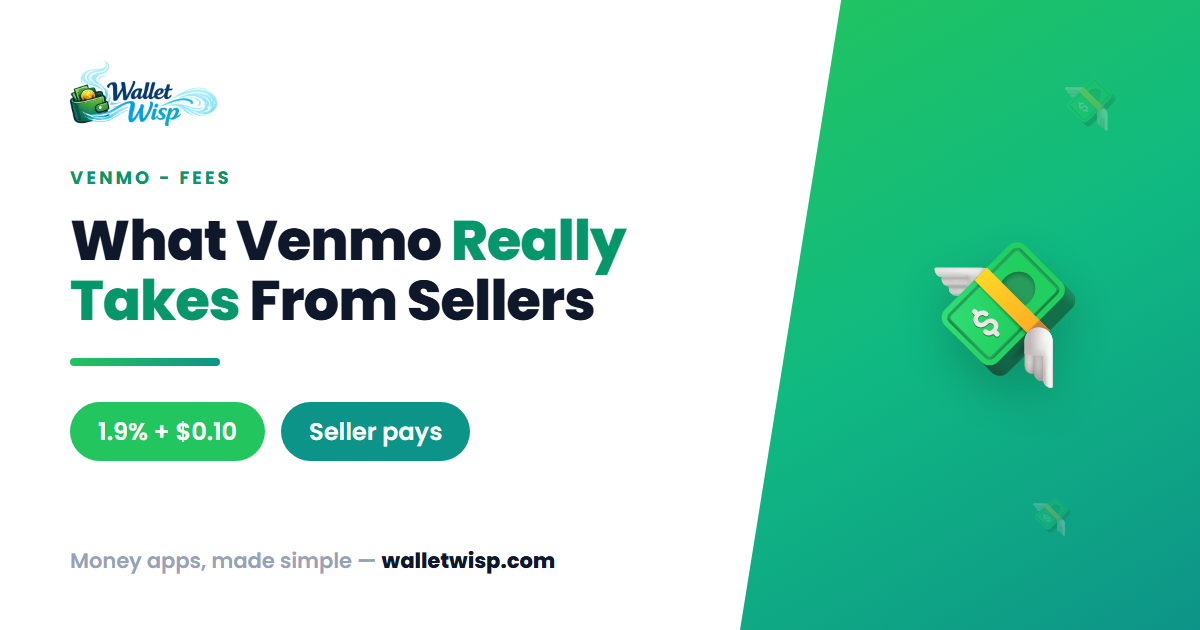
When a payment is marked as a purchase (a goods & services transaction), Venmo charges the seller a fee of 1.9% of the payment amount plus a flat $0.10. This is deducted automatically before the money reaches your balance — you never get an invoice, and the buyer never sees a surcharge on their end.
This applies whether you have a Venmo business profile or you receive a G&S payment on a personal account (which happens when a buyer toggles on “turn on for purchases” or sends to a business profile). The buyer pays the sticker price; you absorb the fee.
A worked example
Say a customer pays you $100 for a goods & services transaction:
- Percentage fee: 1.9% × $100 = $1.90
- Fixed fee: $0.10
- Total Venmo fee: $2.00
- You receive: $98.00
The flat $0.10 matters most on small payments. On a $5 sale, you pay $0.10 + $0.095 ≈ $0.20 — effectively about 4% — while on a $500 sale the dime barely registers and your effective rate drops toward 1.9%.
The add-ons: tap-to-pay and international
The 1.9% + $0.10 rate is the baseline for standard online/in-app purchases. Two situations carry a higher cost:
- In-person tap-to-pay: If you accept a contactless card or phone tap using Venmo’s in-person acceptance, the rate rises to 2.29% + $0.10 per transaction.
- International commercial transactions: When the payment crosses a border, Venmo adds a 1.50% surcharge on top of the applicable rate.
Fee comparison at a glance
| Transaction type | Fee (seller pays) | On a $100 sale |
|---|---|---|
| Standard goods & services | 1.9% + $0.10 | $2.00 |
| In-person tap-to-pay | 2.29% + $0.10 | $2.39 |
| International (standard + surcharge) | 1.9% + 1.50% + $0.10 | $3.50 |
| Personal payment (friends & family) | $0.00* | $0.00 |
*Personal payments funded by a bank account, debit card, or Venmo balance are free. If a buyer sends a personal payment using a credit card, a 3% fee applies — but that’s charged to the sender, not you.
Who actually pays the fee?
This is the part people get wrong. For goods & services payments, the seller (recipient) always pays the fee — it’s netted out of the amount you receive. Buyers pay exactly what they agreed to and, in exchange, get Venmo’s Purchase Protection if the item never arrives or isn’t as described.
You cannot legitimately pass the G&S fee to the buyer inside Venmo — there’s no built-in surcharge button. Some sellers ask buyers to “add a little to cover fees,” but that’s an informal arrangement, not a Venmo feature. And you should never ask a buyer to send a purchase as a friends & family payment to dodge the fee: doing so strips away Purchase Protection for the buyer and violates Venmo’s terms for commercial activity.
The other costs that quietly stack up
The G&S fee isn’t the only place Venmo can take a cut. Two more to keep on your radar:
- Instant transfers to your bank: Moving your balance out instantly costs 1.75% of the transfer (minimum $0.25, maximum $25). A standard bank transfer takes 1–3 business days but is free.
- No monthly or setup fees: Venmo business profiles have no subscription cost and no account-opening fee, so your only unavoidable expense is the per-transaction G&S fee.
Watch the stacking effect: if you take a $100 G&S payment and then instant-transfer the proceeds, you pay $2.00 up front, then 1.75% of $98 (about $1.72) to cash out fast — roughly $3.72 total. Using the free standard transfer instead saves that second charge entirely.
How to keep more of each sale
- Batch your payouts and use the free 1–3 day bank transfer instead of instant transfers whenever you can wait.
- Price the fee in. If you sell a lot, build roughly 2% into your list prices so the fee comes out of margin you planned for, not profit you counted on.
- Reserve tap-to-pay for when you need it. The 2.29% rate is convenient in person, but a standard in-app charge is cheaper if the customer can pay online.
- Keep transactions domestic where possible to avoid the 1.50% international surcharge.
Frequently Asked Questions
Does the buyer or the seller pay Venmo’s goods & services fee?
The seller pays. The 1.9% + $0.10 fee is deducted from the payment before it reaches your balance. The buyer pays only the agreed price and receives Purchase Protection in return.
Can I avoid the Venmo seller fee?
Not on legitimate goods & services payments — the fee is automatic. Asking a buyer to send a purchase as a “friends & family” personal payment does avoid the fee but removes buyer protection and breaks Venmo’s rules for commercial transactions, which can put your account at risk.
Why is Venmo’s tap-to-pay fee higher than the standard rate?
In-person contactless payments run at 2.29% + $0.10 rather than 1.9% + $0.10 because card-present processing carries higher network and interchange costs. The extra roughly 0.39% covers accepting a physical tapped card or phone.
How much does Venmo take on a $1,000 sale?
On a standard $1,000 goods & services payment, Venmo takes 1.9% ($19.00) plus $0.10, for a total of $19.10, leaving you with $980.90. A tap-to-pay version would cost $23.00, and an international one about $34.10.
The bottom line
For most sellers, Venmo’s cut is simple: 1.9% + $0.10 per goods & services sale, paid by you, the seller. Add 0.39% for in-person tap-to-pay, 1.50% for international, and remember that instant transfers layer on another 1.75%. Plan your pricing around the baseline, cash out on the free standard transfer, and Venmo stays a low-cost way to get paid.
WalletWisp is an informational resource, not financial advice. Fees and terms can change — always confirm current rates in the Venmo app or at venmo.com before relying on them.