You covered your roommate’s half of the electric bill on the 3rd. Rent hits on the 5th. Two days ago that was just a problem. Now Cash App will let you undo the damage — for a price.
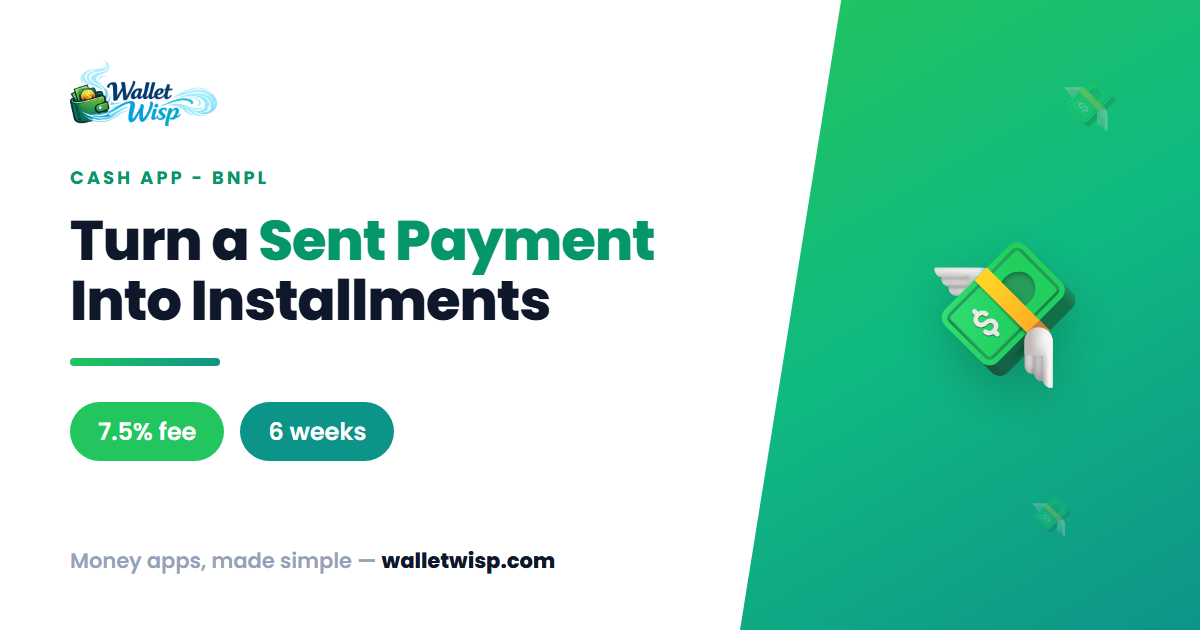
In April 2026, Cash App became the first major U.S. payments app to let customers convert a peer-to-peer payment they’ve already sent into an installment plan. You pick an eligible payment from your Activity feed, agree to an upfront fee, and the full amount lands back in your Cash App balance almost immediately. You then repay it over about six weeks. The person you paid is never involved and never notified — as far as they’re concerned, the money arrived and the story ended.
The feature runs on Afterpay, which Block (Cash App’s parent company) owns. The loans themselves are originated by First Electronic Bank, a Utah-chartered industrial bank and FDIC member. That matters more than it sounds: this is a real credit product with a real Truth in Lending disclosure, not a courtesy feature.
The $25 and 30-day eligibility rules
Not every payment you’ve sent can be converted. Cash App applies a specific filter, and a payment has to clear all of it:
- At least $25. Send someone $20 for lunch and it’s simply not convertible. There’s no way to bundle two small payments to clear the threshold.
- Sent within the last 30 days. This is a rolling window, and it’s the part people miss. A payment from 31 days ago is gone. The option quietly disappears from your Activity feed with no warning.
- Fully processed. A pending or still-settling transfer isn’t eligible yet.
- No cash back or overdraft coverage involved. Transactions that used Overdraft Coverage are excluded, and Round Ups aren’t supported by Afterpay on Cash App.
- You have to be approved. Cash App states plainly that eligibility depends on multiple factors and isn’t guaranteed. Availability also varies by state, and specific rates and terms can differ by state.
Even when you’re eligible, the amount you can convert isn’t unlimited. Cash App’s own disclosures describe loan amounts ranging from $1 to $1,000, and your personal ceiling depends on the original transaction size plus an individual assessment. Sending someone $2,000 doesn’t guarantee you can convert all of it.
To find it: open the Money tab and look for the Afterpay section, or scan your Activity tab for transactions labeled “Pay over time available.” Only eligible items carry that label.
What the upfront fee actually costs
The pricing is a flat 7.5% setup fee on the amount you convert. There’s no compounding interest, no revolving balance, and no down payment. You know your total repayment before you agree to anything.
Cash App’s disclosure spells out what 7.5% means in credit terms: a 7.5% setup fee on a 42-day term works out to a fixed APR of about 65.15%. That’s the honest number to keep in your head. It’s not a scam and it’s not hidden — but it’s not cheap money either.
| Payment you sent | 7.5% upfront fee | Total you repay | Six weekly payments |
|---|---|---|---|
| $25 | $1.88 | $26.88 | about $4.48 |
| $50 | $3.75 | $53.75 | about $8.96 |
| $100 | $7.50 | $107.50 | about $17.92 |
| $250 | $18.75 | $268.75 | about $44.79 |
| $500 | $37.50 | $537.50 | about $89.58 |
| $1,000 | $75.00 | $1,075.00 | about $179.17 |
A worked example
Say you sent your landlord $600 on the 1st and payday moved. You convert it on the 4th. The fee is $45, your total is $645, and $600 hits your balance right away. You then owe roughly $107.50 a week for six weeks. Six weeks later you’ve paid $45 for the breathing room — about the cost of one and a half overdraft fees at a typical bank, for far more usable cash.
Now flip it. You convert $75 you sent for concert tickets. The fee is $5.63 and your weekly payment is about $13.44. Renting $75 for six weeks costs you less than a sandwich. Whether that’s smart depends entirely on whether the $13.44 is genuinely available every week for the next six weeks — because if it isn’t, you’ve turned one squeeze into six.
How repayment works
You get two structures, and you choose at signup:
- Six equal weekly payments over the 42-day term. Predictable, spread out.
- One payment on the final due date. Nothing due until the end, then the full amount at once.
Payments are set up to run automatically, though the current loan agreement allows you to opt out of autopay through the Cash App Afterpay applet or by contacting Support. There’s no penalty for paying early — pay it off the next day if your check clears, and you won’t be charged extra. Check your Truth in Lending disclosure for whether any portion of the setup fee is refunded on early payoff, since that piece varies.
Miss the final due date and the consequences depend on your state’s version of the agreement. Some versions impose a late fee of up to about $5; the current agreement instead assesses non-compounding overdue interest starting on the 7th calendar day after the final due date, accruing weekly. Either way, defaulting can suspend Cash App features and block you from future loans — the product is deliberately non-revolving, so an unpaid plan means no new plan.
Does it affect your credit?
Cash App’s position is direct: using Cash App Afterpay doesn’t impact your credit score, and its press materials for the pay-over-time products state there’s no impact to a customer’s credit score. Afterpay’s short-term installment plans don’t report your on-time payments to Equifax, Experian, or TransUnion. Any eligibility assessment is done without a hard inquiry.
Three honest caveats:
- It won’t build credit either. Paying six weeks of installments perfectly does nothing for your score. If credit-building is your goal, this is not the tool.
- Serious delinquency can still surface. If a balance goes badly unpaid and lands with a collection agency, that collection account can be reported. The Utah disclosure in the loan agreement warns that a negative credit report may be submitted if you fail to fulfill your credit obligations.
- Lenders may see it anyway. BNPL reporting standards are actively changing across the industry. What isn’t reported today isn’t guaranteed to stay invisible — and if you’re applying for a mortgage, an underwriter reviewing your bank statements will see the payments regardless of any credit file.
When this is worth it — and when to skip it
It’s a reasonable trade when you’re avoiding something more expensive: a $35 overdraft fee, a late rent penalty, or a payday loan at triple this cost. Converting $200 for $15 to protect a $50 late fee is straightforward math in your favor.
Skip it when the payment was discretionary and the plan just moves the problem forward. Six weeks of $18 withdrawals is easy to underestimate, and 65% APR is genuinely expensive credit even in short bursts. Also worth knowing: Cash App’s own Borrow product and a credit card cash advance are different tools with different pricing — compare before you convert a large amount.
Frequently Asked Questions
Does the person I paid know I converted the payment?
No. The recipient already received the money and their side is finished. The installment plan is entirely between you, Cash App, and the lender.
Can I convert a payment I sent two months ago?
No. The window is a strict rolling 30 days from the transaction date. Once it passes, the “Pay over time available” label disappears and the payment can’t be converted.
Can I convert two $15 payments to reach the $25 minimum?
No. The $25 threshold applies to each individual transaction. Small payments simply aren’t eligible on their own or combined.
What if I get denied even though my payment meets all the rules?
Eligibility depends on factors beyond the transaction itself, including your Cash App history and your state — the feature isn’t available everywhere. Meeting the $25 and 30-day rules makes a payment eligible for consideration, not automatically approved.
The short version
Cash App will convert a processed P2P payment of $25 or more from the last 30 days into a six-week plan for a flat 7.5% upfront fee — roughly 65% APR — with the cash back in your balance right away, no compounding interest, and no hit to your credit score. Set a calendar reminder for your final due date, pay it off early if you can, and treat the 30-day window as the deadline it is. Used once to dodge an overdraft, it’s a genuinely useful safety valve. Used routinely, it’s an expensive habit dressed up as convenience.
WalletWisp is informational only and not financial advice — verify current fees and terms in your Cash App account before you convert anything.