
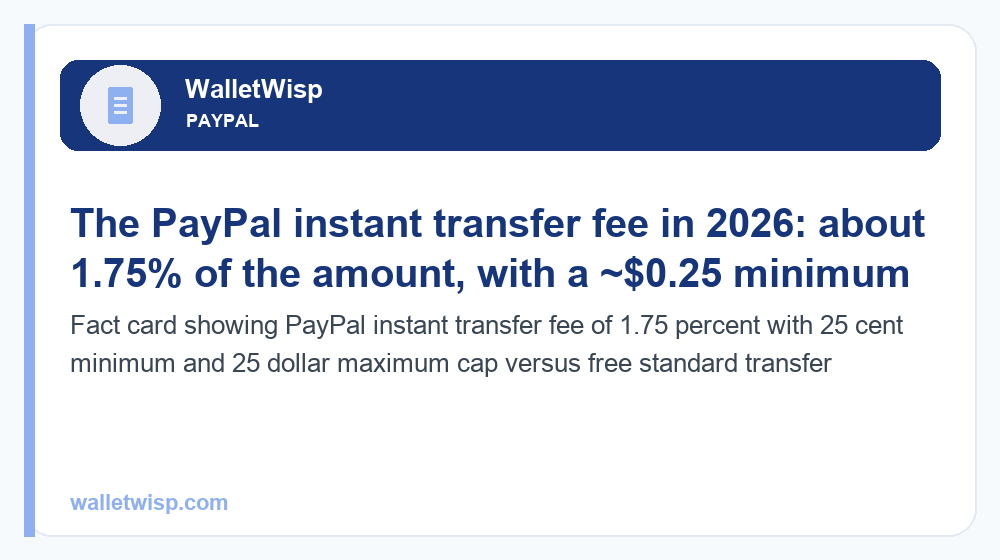
The PayPal instant transfer fee in 2026 is approximately 1.75% of the amount you move, with a minimum charge of around $0.25 and a maximum cap of about $25 per transfer. This fee applies when you move money from your PayPal balance to an eligible linked debit card or bank account and want it to arrive within minutes rather than days. If you can wait 1 to 3 business days, the standard bank transfer is completely free — which is the single easiest way to avoid the PayPal instant transfer fee entirely.
Below, we break down exactly how the fee is calculated, when the $25 cap kicks in, how “instant” actually performs in real life, who is eligible, how business and personal accounts compare, and the specific steps to sidestep the charge.
How the PayPal instant transfer fee works in 2026
PayPal charges a percentage-based fee for the convenience of moving your money out of PayPal immediately. The core structure is straightforward, but the minimum and maximum boundaries are where people get tripped up. Here is the typical 2026 structure for US personal accounts:
- Fee rate: approximately 1.75% of the transfer amount.
- Minimum fee: about $0.25 per transfer, even on very small amounts.
- Maximum fee (cap): about $25 per transfer, no matter how large the transfer is.
- Standard transfer: $0 (free), arriving in roughly 1 to 3 business days.
These figures are typical and can vary slightly by account type, region, and any promotional pricing PayPal is running. Always confirm the exact fee on the confirmation screen before you tap “Transfer,” because PayPal displays the precise charge for your specific amount at that moment.
The minimum fee: why small transfers feel expensive
Because there is a floor of roughly $0.25, tiny instant transfers carry a disproportionately high effective rate. Move $5 instantly and 1.75% would only be about $0.09 — but the $0.25 minimum overrides it, so you pay $0.25. That works out to an effective rate of 5% on that $5. The lesson: instant transfers make the least sense on small amounts.
The $25 cap: why large transfers are where instant pays off
On the other end, the roughly $25 maximum protects large transfers from runaway percentage fees. Without a cap, a $5,000 instant transfer at 1.75% would cost $87.50. Instead, the fee stops climbing once 1.75% of your transfer reaches about $25 — which happens at roughly $1,428. Any transfer above that amount costs a flat ~$25, so the effective percentage keeps shrinking the more you move.
PayPal instant transfer fee examples by amount
The table below shows how the fee behaves across a range of transfer sizes. It illustrates the minimum floor at the low end, the standard 1.75% in the middle, and the $25 cap taking over at the high end.
| Transfer amount | 1.75% raw fee | Fee actually charged | Effective rate |
|---|---|---|---|
| $5 | $0.09 | $0.25 (minimum) | 5.00% |
| $25 | $0.44 | $0.44 | 1.75% |
| $100 | $1.75 | $1.75 | 1.75% |
| $500 | $8.75 | $8.75 | 1.75% |
| $1,000 | $17.50 | $17.50 | 1.75% |
| $1,428 | $25.00 | $25.00 (cap reached) | 1.75% |
| $3,000 | $52.50 | $25.00 (capped) | 0.83% |
| $5,000 | $87.50 | $25.00 (capped) | 0.50% |
All amounts are approximate 2026 figures for US personal accounts and are rounded for illustration. Your actual quoted fee may differ by a few cents.
Instant to debit card vs. instant to bank account
PayPal offers instant transfers to two destinations, and both carry the same headline fee structure in 2026 — roughly 1.75% with the ~$0.25 minimum and ~$25 cap. The practical differences come down to eligibility and network:
- Instant transfer to a debit card: Moves money over the card networks (Visa/Mastercard fast-funds rails). Your debit card must be eligible for instant deposits — most major US debit cards are, but some prepaid or older cards are not.
- Instant transfer to a bank account: Uses the RTP/real-time payment rails through your linked bank. Your bank must support instant receipt of these transfers. Many large US banks do; some smaller institutions and credit unions still route these as slower transfers.
If PayPal doesn’t show an instant option for a particular card or bank, it usually means that destination isn’t enrolled in the fast-payment network — in which case your only choice there is the free standard transfer.
How long does “instant” really take?
In most cases, an instant transfer lands in your debit card or bank account within a few minutes. PayPal’s own guidance says funds typically arrive within 30 minutes, though the vast majority complete in under 5 minutes. A few real-world caveats:
- Delays happen: Bank processing, fraud reviews, or network congestion can occasionally push an “instant” transfer to 30 minutes or longer.
- Weekends and holidays: Unlike standard bank transfers, instant transfers do run on weekends and holidays — that’s a genuine advantage when you need cash on a Saturday.
- First-time transfers: New accounts or newly linked cards may face additional verification that slows the first transfer.
If speed on weekends or same-hour access is the whole point, the fee may be worth it. If not, the free standard route almost always makes more financial sense.
Standard vs. instant: the full comparison
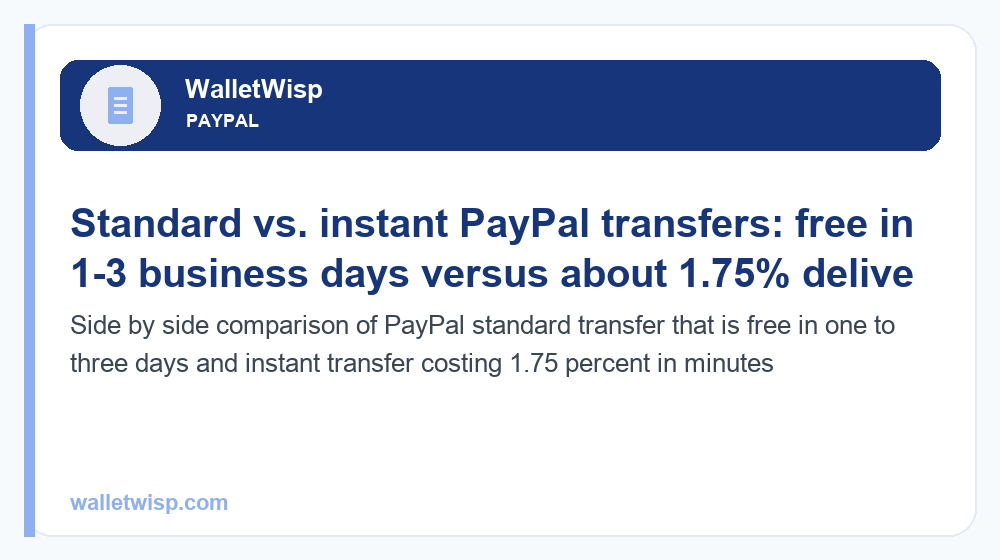
This is the comparison most people actually need. The standard transfer is free but slower; the instant transfer is fast but costs a percentage. Here’s how they stack up in 2026:
| Feature | Standard transfer | Instant transfer |
|---|---|---|
| Fee | $0 (free) | ~1.75% (min ~$0.25, max ~$25) |
| Speed | ~1–3 business days | Usually within minutes (up to ~30 min) |
| Destination | Linked bank account | Eligible debit card or bank account |
| Weekends/holidays | Does not process | Processes any day |
| Best for | Non-urgent cash-out, saving on fees | Urgent needs, larger amounts (cap helps) |
| Effective cost on $200 | $0 | ~$3.50 |
For a deeper look at how these charges fit into PayPal’s broader pricing, see our full guide to PayPal fees explained.
Eligibility: who can use instant transfer
Instant transfer isn’t guaranteed for every account. To use it in 2026 you generally need:
- A verified PayPal account in good standing.
- A linked debit card or bank account that is enrolled in the instant-payment networks (PayPal will only show the instant option if the destination qualifies).
- A transfer amount within PayPal’s per-transaction and daily limits, which vary by account.
If you only see the “1–3 business days” option and no instant choice, your linked card or bank isn’t eligible for instant deposits. Adding an eligible debit card is often the quickest fix.
Business vs. personal accounts
Personal and business PayPal accounts both offer instant transfers, and the headline instant-transfer fee (approximately 1.75%, ~$25 cap) is broadly similar for standard cash-outs in 2026. The bigger difference for businesses is elsewhere in the fee stack: businesses also pay per-transaction processing fees when they receive money, which is a separate charge from the instant transfer fee.
In other words, a business owner might pay a goods-and-services fee to accept a payment, and then — separately — an instant transfer fee to move that money to their bank quickly. These are two distinct costs. To understand the receiving side, read our breakdown of the PayPal goods and services fee in 2026.
How to avoid the PayPal instant transfer fee
The good news: avoiding the fee is simple and completely legitimate. Here’s how:
- Choose the standard transfer. When you tap “Transfer” from your PayPal balance, select the free “1–3 business days” option instead of instant. This is the number-one way to pay $0.
- Plan ahead. If you know you’ll need the money, start the standard transfer a few business days early so it arrives when you need it.
- Batch your cash-outs. If you must use instant, do it on a larger lump sum rather than many small transfers — the ~$25 cap means big transfers get a lower effective rate, and you avoid paying the ~$0.25 minimum repeatedly.
- Spend directly from your PayPal balance. Using a PayPal debit card or paying merchants directly from your balance sidesteps the need to cash out at all.
- Time it around the weekend. Standard transfers don’t process on weekends, so start yours early in the week to avoid the temptation of paying for instant.
The math is clear: on a $200 transfer, waiting a couple of business days saves you about $3.50. Over a year of regular cash-outs, that adds up fast. If you also use Venmo, note that its instant transfer pricing is structured almost identically — compare the details in our guide to the Venmo instant transfer fee in 2026.
When paying the instant transfer fee is actually worth it
The fee isn’t always a bad deal. It makes sense when:
- You genuinely need the cash within minutes — an emergency bill, an overdraft you’re racing to cover, or a weekend expense.
- You’re moving a large amount where the ~$25 cap makes the effective rate small (0.5% on $5,000 is cheap for guaranteed same-hour funds).
- Your bank’s standard transfer would otherwise leave you short over a holiday weekend.
Outside of those situations, the free standard transfer is almost always the smarter financial choice.
Frequently Asked Questions
How much is the PayPal instant transfer fee in 2026?
It’s approximately 1.75% of the transfer amount, with a minimum of about $0.25 and a maximum cap of around $25 per transfer. So a $100 transfer costs about $1.75, while a $5,000 transfer is capped at roughly $25.
Is there a way to transfer PayPal money to my bank for free?
Yes. Choose the standard bank transfer, which is free and typically arrives in 1 to 3 business days. Only the instant option (arriving in minutes) carries the ~1.75% fee.
What is the maximum PayPal instant transfer fee?
The fee is capped at approximately $25 per transfer in 2026. Because the cap kicks in once 1.75% reaches $25 (around $1,428), any transfer larger than that costs a flat ~$25 no matter how big it is.
Does instant transfer to a debit card cost more than to a bank?
No. Both destinations use the same ~1.75% fee structure with the same ~$0.25 minimum and ~$25 cap. The main difference is eligibility — your specific card or bank must be enrolled in the instant-payment networks.
How long does a PayPal instant transfer really take?
Most complete within a few minutes, and PayPal says funds typically arrive within 30 minutes. Unlike standard transfers, instant transfers process on weekends and holidays, though occasional delays from bank or fraud checks can happen.
Why did PayPal charge me $0.25 on a tiny transfer?
Because the fee has a minimum of about $0.25. On small amounts, 1.75% would be less than that floor, so the minimum applies instead — which is why small instant transfers have a high effective rate.
Do business accounts pay a different instant transfer fee?
The instant transfer fee itself is broadly similar (~1.75%, ~$25 cap). However, businesses also pay separate per-transaction fees to receive payments, which are distinct from the cost of moving money to a bank instantly.
Can I get the instant transfer fee refunded if the transfer is delayed?
PayPal generally doesn’t refund the fee for typical delays within its stated window. If a transfer fails and the money is returned to your PayPal balance, the fee is usually reversed. For anything unusual, contact PayPal support directly.