
Wise vs PayPal comes down to one thing: the exchange rate. For most international money transfers in 2026, Wise is meaningfully cheaper because it uses the real mid-market exchange rate and charges a small, transparent upfront fee, while PayPal folds a currency-conversion margin of roughly 3%–4% into a weaker rate on top of its transaction fee. PayPal wins only on speed and reach into a recipient’s existing PayPal balance. Below we break down fees, the rate markup, speed, limits, supported currencies and which service is cheaper at $200, $1,000 and $5,000.
This comparison assumes you are sending money to someone abroad who needs it in their local currency. If you only ever move funds between two PayPal accounts in the same currency, the calculus changes, and we cover that case too.
How Wise and PayPal actually charge you
The critical difference in any Wise vs PayPal comparison is where the cost hides. Wise splits its price into two visible parts: a variable percentage fee plus a tiny fixed fee, both shown before you confirm. Crucially, Wise then converts your money at the mid-market rate — the same rate you see on Google or Reuters, with no markup added.
PayPal works differently. Its headline transaction fee can look competitive, but PayPal adds a separate currency-conversion spread on top of a base exchange rate. That spread is typically around 3%–4% for personal cross-border payments and is where most of the real cost lives. Because it is baked into the rate rather than shown as a line-item fee, many senders underestimate what PayPal actually costs. For the full breakdown of every charge PayPal applies, see our guide to PayPal’s full fee schedule.
Funding method matters
With both services, how you pay changes the total. Funding a Wise transfer by bank debit (ACH) or a Wise balance is cheapest; a credit or debit card adds a card-network surcharge. PayPal is similar — paying with a linked bank account or PayPal balance avoids the card-funding surcharge, while a credit card can add roughly 2%–3% more. Always check the funding option before you confirm.
Exchange-rate markup: the real difference
Here is the part that decides the whole contest. Suppose the true mid-market rate is 1 USD = 0.92 EUR.
- Wise converts at exactly 0.92 and charges its fee separately. You see the rate, the fee and the recipient amount before you send.
- PayPal might convert at around 0.885–0.89 — a 3%–4% haircut versus mid-market — and then apply its transaction fee. That built-in spread is effectively an invisible fee.
On a $1,000 transfer, a 3.5% rate markup alone is about $35 before PayPal’s stated fee is even counted. Wise’s equivalent markup is $0 because it never marks up the rate. This single factor is why Wise is usually cheaper for anything above pocket money, and why savvy senders treat the advertised transaction fee as only half the story.
Fee and feature comparison
The table below summarizes how the two services stack up on the dimensions that matter most in 2026. Figures are typical ranges and should be treated as estimates — your exact price depends on the currency pair, amount and funding method.
| Factor | Wise | PayPal |
|---|---|---|
| Exchange rate used | Mid-market (no markup) | Base rate + ~3%–4% margin |
| Upfront transfer fee | ~0.4%–1%+ variable + small fixed fee | Personal cross-border fee (est. ~5%, often capped ~$4.99) |
| Card-funding surcharge | Extra ~1%–2% (est.) | Extra ~2%–3% (est.) |
| Fee transparency | Fully itemized before sending | Rate margin hidden in exchange rate |
| Typical speed | Minutes to ~2 business days | Minutes (PayPal-to-PayPal) |
| Delivery method | Recipient bank account, Wise balance, some cards | Recipient PayPal account/balance |
| Best for | Cost, bank payouts, larger amounts | Speed to existing PayPal users |
Transfer speed compared
Speed is PayPal’s strongest card. A PayPal-to-PayPal transfer between two accounts is usually near-instant, which is convenient when both people already use the platform. Wise is not instant in every case, but it is faster than most people expect: a large share of Wise transfers now arrive within seconds to a few hours, and the slower currency routes still typically complete within one to two business days.
The nuance is delivery. PayPal delivers into a PayPal balance; getting that money into a bank account is a second step that can add a day and, for instant bank withdrawals, an extra fee (commonly around 1.5%). Wise typically deposits straight into the recipient’s local bank account, so there is no second hop. If your recipient needs cash in the bank, Wise’s end-to-end time is often comparable or better despite PayPal’s instant in-app credit.
Sending limits
Limits depend heavily on currency, funding method and verification status, so treat the following as general 2026 guidance rather than hard caps.
Wise supports large transfers — for many currencies you can send up to roughly $1 million per transfer via bank funding, though card-funded transfers are capped much lower (often in the low thousands per transaction). USD ACH transfers historically top out near the $1 million mark for personal accounts.
PayPal generally allows verified accounts to send large totals, but individual transactions are often capped in the range of $10,000–$60,000 depending on account history and region. Unverified accounts face tighter ceilings until identity and funding sources are confirmed.
Supported countries and currencies
PayPal has the wider raw footprint, available in 200+ countries and regions, but it holds and converts a comparatively short list of around 20+ currencies. Wise supports fewer countries on paper — you can send to 140+ countries — yet it holds and converts 40+ currencies and can pay out directly to local bank accounts in most of them, which is the practical measure that matters for delivering usable local money.
In short: PayPal is easier to find in more places, but Wise’s bank-payout coverage and larger active currency set usually make it the more useful tool for turning your dollars into a foreign currency in someone’s local account.
Receiving money
On the receiving side, Wise gives users free local account details in several major currencies (USD, EUR, GBP, AUD and more), so a recipient can be paid as if they held a local bank account. Receiving into Wise is generally free; converting later uses the same mid-market-plus-small-fee model.
PayPal charges the recipient a fee on cross-border commercial payments, and a currency conversion applies if the money lands in a different currency than the account holds. For casual personal receipts within the same currency PayPal can be free, but international and goods-and-services receipts carry percentage fees. If you receive on PayPal and want the funds elsewhere, options like moving a balance out matter — see how to move a PayPal balance to Cash App for a common workaround.
Which is cheaper for various amounts?
The table below estimates the total real cost — transaction fee plus rate markup — of sending USD and converting to EUR, funded from a bank account or balance. These are illustrative 2026 estimates; run a live quote before sending.
| Amount sent (USD → EUR) | Wise est. total cost | PayPal est. total cost | Cheaper option |
|---|---|---|---|
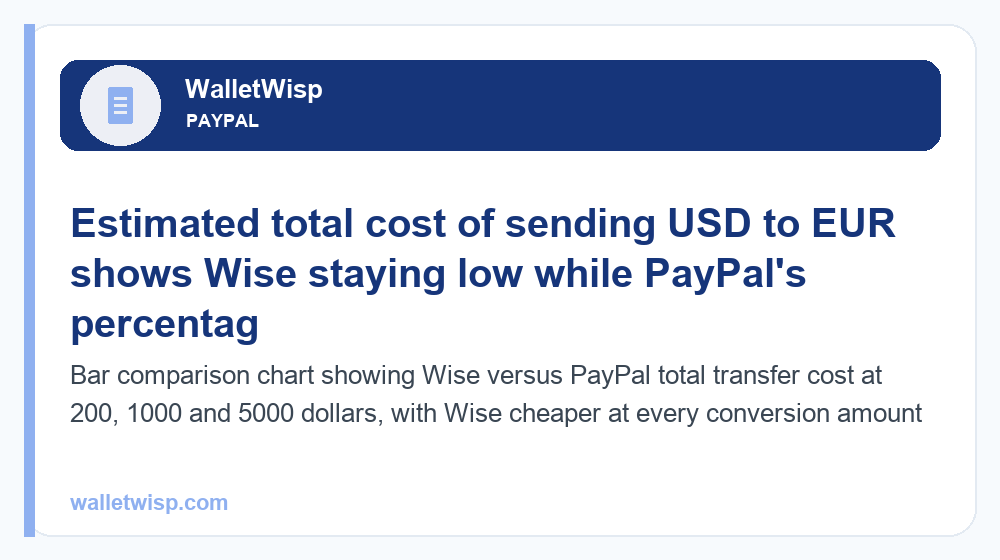
| $200 | ~$2–$4 | ~$11–$15 (fee + ~3.5% margin) | Wise |
| $1,000 | ~$7–$11 | ~$40–$45 (fee + ~3.5% margin) | Wise |
| $5,000 | ~$30–$45 | ~$180–$200 (mostly rate margin) | Wise |
| Same-currency PayPal-to-PayPal | N/A (bank payout model) | Often free (personal) or small % | PayPal |
The pattern is consistent: as the amount grows, PayPal’s percentage-based rate margin scales up while Wise’s cost stays proportionally small. For a $5,000 transfer the gap can exceed $150 — real money. The one scenario where PayPal is cheaper is a same-currency personal transfer between two existing PayPal users, where no conversion happens at all.
When to choose each service
Choose Wise when
- You are converting between currencies and want the lowest total cost.
- The recipient needs money in their local bank account, not a wallet.
- You are sending a larger amount where the rate markup dominates.
- You want fully transparent, itemized pricing.
Choose PayPal when
- Both people already use PayPal and speed is the priority.
- The payment is same-currency, avoiding conversion entirely.
- You value buyer/seller protection on goods-and-services payments.
- You are a merchant already invoicing through a PayPal business account and want everything in one place.
Frequently Asked Questions
Is Wise always cheaper than PayPal for international transfers?
For currency conversions, Wise is cheaper the vast majority of the time because it uses the mid-market rate with no markup, while PayPal adds a roughly 3%–4% conversion margin plus its fee. The main exception is a same-currency PayPal-to-PayPal transfer, where no conversion happens and PayPal can be free.
What is the mid-market exchange rate?
The mid-market rate is the midpoint between the buy and sell prices of a currency on the global market — the “real” rate you see on Google, Reuters or XE. Wise uses this rate directly; PayPal and most banks add a hidden margin on top of it, which quietly raises your cost.
How long does a Wise transfer take versus PayPal?
PayPal-to-PayPal transfers are usually near-instant. Wise ranges from seconds to about two business days depending on the currency route and funding method, but it typically pays straight into a bank account, so its end-to-end time to usable funds is often competitive.
Does PayPal charge a fee to receive international money?
Yes for commercial (goods-and-services) payments and often for cross-border personal payments, plus a conversion charge if the currency differs from the account balance. Same-currency personal receipts can be free. Wise, by contrast, is generally free to receive.
Can I send large amounts with Wise or PayPal?
Wise supports large transfers — up to roughly $1 million per transfer for many currencies via bank funding, though card funding is capped far lower. PayPal typically caps individual transactions in the $10,000–$60,000 range depending on verification and region. Verify your account first to unlock higher limits.
Which supports more countries and currencies?
PayPal is available in more countries (200+) but holds around 20+ currencies. Wise reaches 140+ countries and holds 40+ currencies with direct local bank payouts, which is usually more useful when the goal is delivering money in someone’s local currency.
Is Wise safe and regulated?
Wise is a licensed, regulated money-services business in the US, UK, EU, Australia and other markets, and it safeguards customer funds separately from company money. PayPal is likewise regulated and long-established. Both are considered safe for personal transfers; choose based on cost and delivery method.
Can I use PayPal or Wise for business payments?
Both offer business features. PayPal is strong for invoicing, checkout and buyer protection through a business account, while Wise Business is popular for low-cost international payouts, multi-currency accounts and batch payments. Many businesses use both — PayPal for receiving customer payments and Wise for paying overseas suppliers cheaply.