

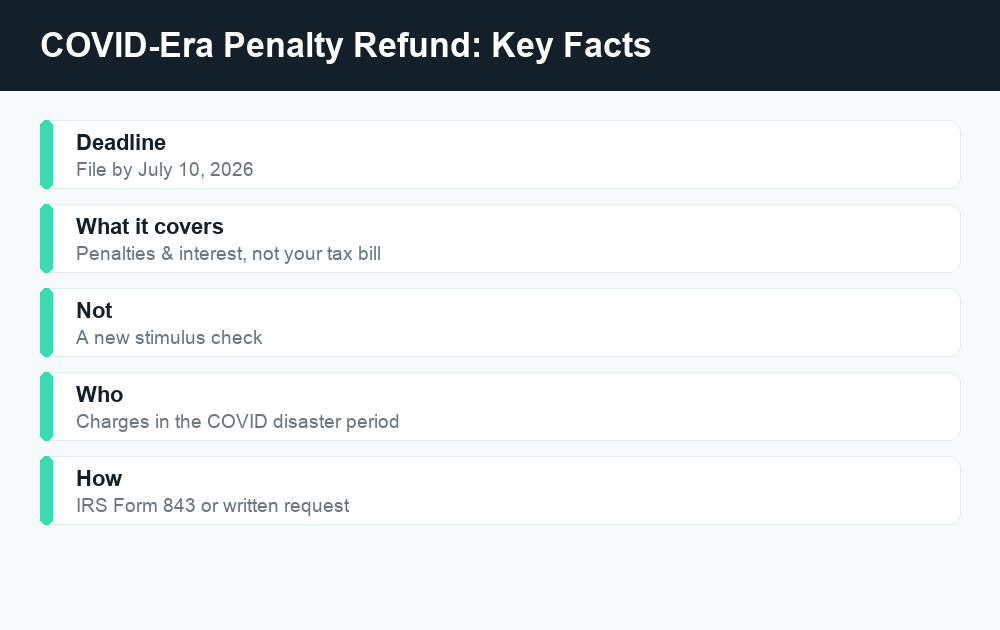
If you paid certain IRS penalties or interest that were assessed during the COVID-19 federal disaster period, you may be able to claim a refund of those amounts, but only if you file a claim with the IRS on or before July 10, 2026. The National Taxpayer Advocate has flagged that tens of millions of taxpayers may be eligible, so it is worth checking before this hard deadline passes.
Quick answer: This is not a new stimulus check. It is a chance to get back specific penalties and interest the IRS charged during the COVID-19 disaster period, if those amounts should have been reduced or paused. To claim, you generally file IRS Form 843 or send a written refund request, and it must reach the IRS by July 10, 2026. Amounts vary widely and many people will not qualify, so confirm your eligibility on IRS.gov or with a tax professional before you count on any money.
What this COVID-era penalty relief actually is
During the COVID-19 pandemic, the federal government declared a nationwide disaster. When a federal disaster is declared, certain tax deadlines can be postponed, and penalties or interest that were charged during the affected window can sometimes be reduced, removed, or refunded.
The National Taxpayer Advocate, an independent watchdog inside the IRS that looks out for taxpayers, raised a concern: a large number of people may have been charged penalties and interest during the COVID-19 disaster period that they should not have owed, or that should have been recalculated. Where that happened, those taxpayers may be entitled to a refund of the affected penalty and interest amounts.
Two important points to keep front and center:
- This is about penalties and interest, not your underlying tax bill. It targets the extra charges layered on top of what you owed, not the core tax itself.
- This is not a new stimulus or relief payment. Nobody is mailing out fresh checks. This is a refund of money you may have already paid in penalties and interest.
Because the relief is tied to a specific disaster period and specific types of charges, it is narrow by design. The headline “tens of millions may be eligible” describes the size of the pool the watchdog is worried about, not a guarantee that any one person will get a payout.
Who may qualify for a COVID-era IRS penalty refund
There is no single, simple checklist that applies to everyone, and eligibility depends on your specific account history with the IRS. That said, you are more likely to want to look into this if several of the following describe you:
- You filed or paid a federal tax during the COVID-19 disaster period and were charged a penalty, interest, or both.
- Those penalties or interest were assessed during a window when deadlines may have been postponed because of the federal disaster declaration.
- You actually paid the penalty or interest (you generally need to have paid an amount to get a refund of it).
- You have not already received relief, an abatement, or a refund for those same charges.
Common situations where penalties and interest pile up include filing a return late, paying a balance late, or underpaying estimated taxes. If any of those happened to you in the relevant period, it is worth pulling your records and checking whether the charges should be revisited.
On the other hand, you most likely will not benefit if you never paid a penalty or interest, if the charges fell outside the disaster period, or if the IRS already corrected your account. When in doubt, the safest move is to look at your own IRS account transcript rather than guess.
Reality check: Eligibility and any refund amount depend entirely on your specific IRS account. Do not assume you qualify just because you owed taxes during the pandemic. Verify before you spend any time or money chasing a claim.
How to file a claim before July 10, 2026
To request a refund of penalties and interest, you generally have two routes: file IRS Form 843, Claim for Refund and Request for Abatement, or submit a clear written request to the IRS. Form 843 is the standard tool for asking the IRS to refund or abate penalties, interest, and certain other charges.
At a high level, the process looks like this:
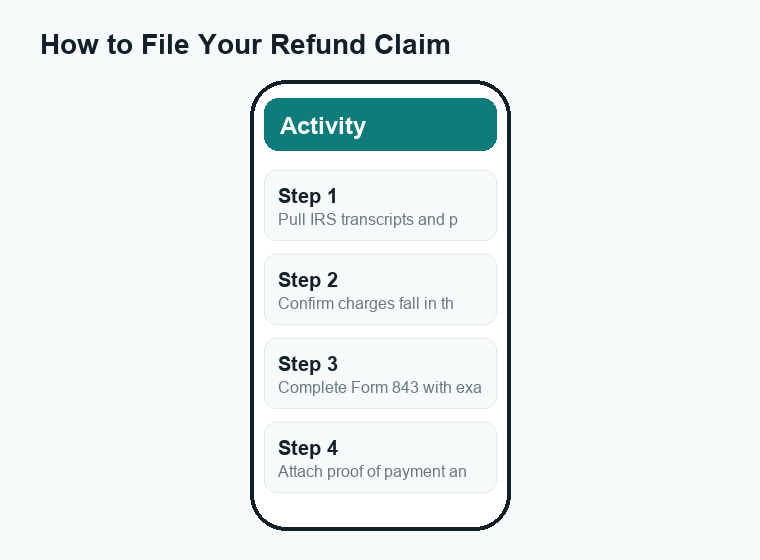
- Pull your records. Get your IRS account transcript and any notices showing the penalty and interest amounts and the dates they were assessed.
- Confirm the charges fall in the disaster window. Match the assessment dates against the COVID-19 disaster period the relief covers.
- Complete Form 843 (or write a clear refund request) identifying the tax type, the period, the exact amounts, and why you believe the penalties or interest should be refunded.
- Attach supporting documents such as copies of notices, proof of payment, and a short explanation tied to the disaster relief.
- Send it so it reaches the IRS on or before July 10, 2026. Use a method that gives you proof of mailing or submission, and keep a full copy of everything.
Always download the current version of Form 843 and its instructions from IRS.gov, since the form, mailing addresses, and any electronic options can change. The instructions tell you where to send the claim based on your situation.
Documents that strengthen your claim
A refund claim is much stronger when it is specific and backed by paper. Gather these before you file:
| Document | Why it helps |
|---|---|
| IRS notices showing penalties/interest | Pinpoints the exact charges and assessment dates |
| IRS account transcript | Confirms what was charged and what you paid |
| Proof of payment (bank or IRS records) | Shows you actually paid the amount you want refunded |
| Copy of the relevant tax return | Ties the claim to the correct tax year and type |
| Short written explanation | Connects your charges to the COVID-19 disaster relief |
You do not need a thick binder. You need the right few pages that clearly show what was charged, when, that you paid it, and why it should be refunded. Keep copies of everything you send.
Why the July 10, 2026 deadline matters so much
Refund claims are governed by strict time limits. The reason July 10, 2026 is being treated as a hard deadline is that, after it passes, the window to claim a refund of these specific COVID-era penalties and interest may close, and a claim filed even one day late can be denied purely on timing, no matter how valid it would have been.
That makes this a “use it or lose it” situation for anyone who qualifies. If you think there is any chance the relief applies to you, the smart play is to start now rather than wait until early July. Pulling transcripts, confirming amounts, and preparing Form 843 takes time, and you want your claim to physically reach the IRS by the deadline, not just be mailed at the last minute.
If the deadline is close when you read this, prioritize getting a complete, on-time claim filed. You can keep copies and follow up later, but you cannot rescue a claim that missed the cutoff.
Watch out for scams
Any time the IRS, a deadline, and the word “refund” appear together, scammers show up. Protect yourself:
- The IRS does not text, email, or DM you out of the blue demanding personal information or offering to “process your COVID penalty refund” for a fee. Treat unsolicited messages like that as scams.
- Be wary of anyone who guarantees a refund or a specific dollar amount before reviewing your actual records. No one can promise that.
- Never pay an upfront fee to a stranger who contacted you first, and never hand over your Social Security number, bank login, or IRS account credentials to an unverified caller or site.
- Go straight to IRS.gov to download forms and check status, and use a tax professional you chose and vetted, not one that found you.
A legitimate claim costs you the effort of paperwork and, if you hire help, a reasonable fee you agreed to in advance. It never requires gift cards, crypto, or an urgent payment to “unlock” your money.
Frequently asked questions
Is this a new stimulus check?
No. This is not a new stimulus or relief payment. It is a possible refund of certain penalties and interest the IRS assessed during the COVID-19 federal disaster period. You are potentially getting back money you already paid, not receiving a brand-new benefit.
How much money could I get back?
It varies widely and depends entirely on your specific IRS account, how much in penalties and interest you were charged, and whether those charges qualify. Be skeptical of anyone who promises a specific amount. Many taxpayers will not qualify at all, so do not count on a payout until you confirm eligibility.
What form do I use to claim it?
The standard tool is IRS Form 843, Claim for Refund and Request for Abatement, though a clear written refund request can also be used. Download the current form and instructions from IRS.gov so you have the latest version and the correct mailing address for your situation.
What happens if I miss the July 10, 2026 deadline?
If your claim does not reach the IRS by July 10, 2026, you may lose the ability to claim a refund of these particular COVID-era penalties and interest. A late claim can be denied on timing alone, so it is best to file well before the deadline with proof of submission.
Do I need a tax professional to do this?
Not necessarily, but it can help, especially if your situation is complicated or you are unsure whether the charges qualify. At minimum, confirm the details on IRS.gov. If you hire someone, choose a reputable professional yourself rather than responding to anyone who contacts you first.
The bottom line
This is a narrow but potentially valuable opportunity: a chance to recover certain penalties and interest charged during the COVID-19 disaster period, but only if your claim reaches the IRS by July 10, 2026. It is not a stimulus, amounts vary, and many people will not qualify, so verify your eligibility on IRS.gov or with a trusted tax professional before you act, and do it soon rather than at the last minute. For more plain-English help with taxes, refunds, and avoiding money scams, explore our related WalletWisp guides.