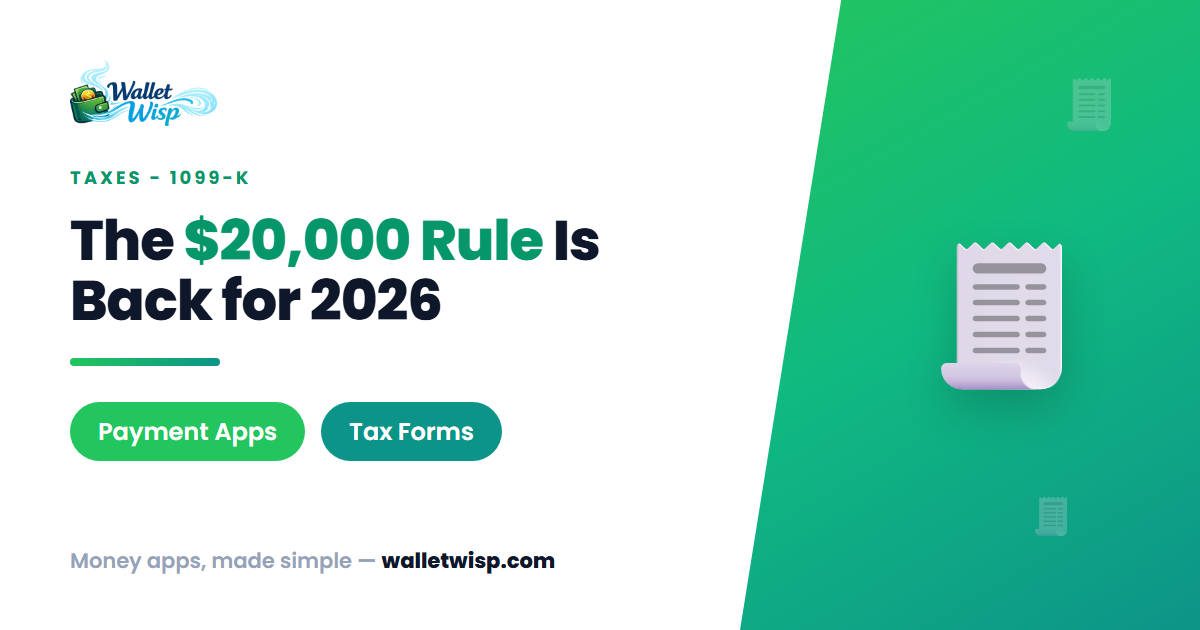
If you sell on Venmo, PayPal, or Cash App, the rules for getting a Form 1099-K changed again — and for the 2026 tax year, they changed in your favor. The One Big Beautiful Bill Act (OBBBA), signed into law on July 4, 2025, permanently restored the old federal reporting threshold of more than $20,000 in payments AND more than 200 transactions. The feared $600 rule that had been looming since 2021 is gone at the federal level.
But “gone at the federal level” is not the whole story. Some states still send forms at $600, and — this is the part people miss — the tax you owe hasn’t changed at all. Here’s exactly who gets a 1099-K for 2026, what the form actually means, and the simple steps to take before December 31.
What Is a Form 1099-K, Really?
A 1099-K is an information return that payment apps and online marketplaces (the IRS calls them “third-party settlement organizations”) send to you and the IRS. It reports the gross dollars you received for goods and services through that platform during the year. It is a paperwork trigger, not a tax bill.
Crucial point: receiving income is taxable whether or not you get a 1099-K. The form just determines whether the IRS automatically gets a copy. If you earn money selling things or doing work, that income belongs on your return even if no form ever arrives.
The 2026 Federal Threshold: $20,000 and 200 Transactions
For calendar year 2026, a platform must issue a 1099-K only when both of these are true for your goods-and-services payments on that specific app:
- You received more than $20,000 in gross payments, and
- You had more than 200 separate transactions.
Both conditions must be met. Hit one but not the other, and no federal form is required. The thresholds also apply per platform — $12,000 on PayPal and $12,000 on Venmo are counted separately, not combined.
How the threshold has whipsawed
| Period | Federal 1099-K threshold |
|---|---|
| 2011–2023 | > $20,000 AND > 200 transactions |
| 2024 (transition) | > $5,000 (phase-in relief) |
| 2025 (as originally planned) | > $2,500 (before OBBBA) |
| 2025 & 2026 onward (after OBBBA) | > $20,000 AND > 200 transactions |
OBBBA reinstated the higher threshold retroactively, so it applies to 2025 returns as well as 2026. Platforms that already issued forms under the lower transitional numbers aren’t required to go back and amend them.
Goods-and-Services vs. Friends-and-Family
This distinction is the single most important thing for app users to understand. Only goods-and-services payments count toward a 1099-K. Genuine personal transfers do not.
- Counts (reportable): a customer pays you through PayPal “Goods & Services,” a buyer checks out for an item you listed, or a client taps the business/seller option in Venmo or Cash App.
- Does not count: a roommate Venmoing their half of rent, friends splitting a dinner tab, or a relative sending a birthday gift — as long as these are correctly sent as personal “friends and family” payments.
The risk: if personal money gets miscoded as a business payment, it can land on a 1099-K and look like taxable income. Always use the correct payment type, and keep the two from mixing.
State Rules: The $600 Trap Still Exists
A handful of states set their own, lower 1099-K thresholds and did not follow the federal rollback. If you live or sell in one of them, you can receive a 1099-K far below $20,000. Commonly cited lower-threshold states include:
- Maryland, Massachusetts, Vermont, Virginia, and Washington, D.C. — $600, with no transaction minimum.
- Illinois — more than $1,000 and at least 4 transactions.
State rules change frequently and some are still catching up to OBBBA, so confirm your own state’s current threshold with its department of revenue before assuming you’re clear. The federal $20,000 floor protects you from the IRS copy; it does not override a stricter state requirement.
Two Worked Examples
Example 1 — The casual reseller. Dana sells concert tickets and old sneakers, taking about $9,500 across 60 Cash App “for business” transactions in 2026. No federal 1099-K (under both limits). But Dana lives in Virginia, so Cash App issues a state 1099-K because she cleared $600. Dana still owes tax on any profit either way — and now the state has a copy.
Example 2 — The full-time seller. Marcus runs an Etsy-style shop through PayPal Goods & Services, collecting $41,000 over roughly 900 orders. He clears both federal thresholds, so he gets a 1099-K reporting the full $41,000 gross. That figure is before refunds, shipping, and PayPal fees — he’ll deduct legitimate business expenses so he’s taxed on profit, not gross receipts.
What Sellers Should Do Before December 31
- Separate business and personal. Use a dedicated account or clearly tag business payments so personal transfers never get counted as sales.
- Confirm your name, address, and TIN on each app. A mismatch can trigger backup withholding or a corrected form later.
- Download your transaction history now. Pull 2026 reports from each platform while access is easy; reconcile gross payments against your own records.
- Track expenses year-round. Fees, shipping, supplies, and the cost of items you resold reduce taxable profit — but only if you can document them.
- Know your state’s number. If you’re in a $600 state, expect a form and plan for it.
- Remember the golden rule: report income whether or not a form shows up. The absence of a 1099-K is never permission to skip reporting.
Frequently Asked Questions
If I don’t get a 1099-K, do I still owe tax?
Yes. The 1099-K only controls whether the IRS automatically receives a copy. All income from selling goods or providing services is taxable and must be reported, regardless of whether any form is issued.
Will splitting rent or sending gifts on Venmo get reported?
No — as long as they’re sent as personal “friends and family” payments. Only goods-and-services payments count toward a 1099-K. Use the correct payment type so personal money isn’t misclassified as a sale.
Does selling my own used stuff at a loss create taxable income?
Generally no. Selling personal items for less than you paid is a nondeductible personal loss, not income. But the gross amount can still appear on a 1099-K, so keep records showing the original cost to explain it on your return.
Do PayPal, Venmo, and Cash App combine toward the $20,000 limit?
No. Each platform tracks its own totals. You could receive $15,000 on two different apps and get no federal form from either, because neither one crossed $20,000 on its own.
The Bottom Line
For 2026, the federal 1099-K threshold is firmly back at more than $20,000 and more than 200 transactions, so most casual users won’t receive a form from the IRS’s copy. Watch two things: your state may still send one at $600, and your tax obligation exists with or without any form. Keep business and personal payments apart, save your records, and report what you earn. A little organization before December 31 turns tax season from a scramble into a formality.
WalletWisp is informational and does not provide financial, tax, or legal advice. Rules change and state requirements vary — verify details with the IRS or a qualified tax professional for your situation.
Sources: Avalara — OBBBA 1099 thresholds, Kiplinger — IRS 1099-K threshold, OnPay — 2026 1099 reporting changes, Gig Tax Guide — 1099-K thresholds by state.