
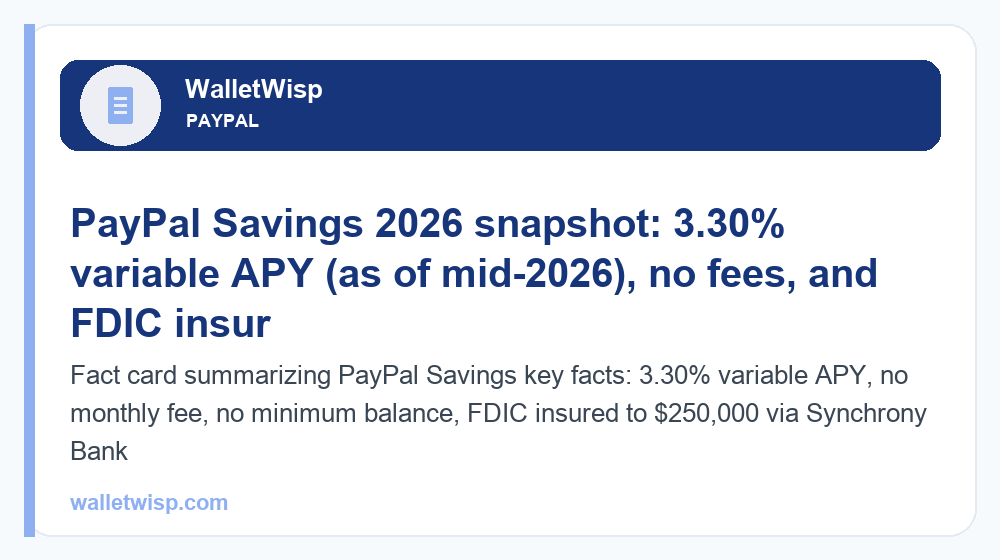
PayPal Savings is a high-yield savings account offered inside your PayPal account and held at Synchrony Bank, Member FDIC. As of mid-2026 it pays a variable 3.30% APY (rate as of June 16, 2026 and subject to change), with no monthly fees, no minimum balance, and FDIC insurance up to $250,000. It is genuinely worth it if you already live inside PayPal and want a simple, fee-free place to earn interest on idle cash, but a standalone high-yield savings account (HYSA) often pays a comparable or slightly higher rate with more flexibility.
Below we break down the current rate, how to open an account, withdrawal and deposit limits, FDIC coverage, fees, and an honest pros-and-cons comparison against a dedicated HYSA so you can decide whether keeping your emergency fund at PayPal makes sense in 2026.
What is PayPal Savings and who runs it?
PayPal Savings is not a bank account operated by PayPal itself. PayPal is a technology and payments company, so it partners with a chartered bank to hold customer deposits. That partner is Synchrony Bank, a well-known online bank that also powers many retail store cards and its own direct high-yield savings products.
When you open PayPal Savings, your deposits are swept to Synchrony Bank, where they sit in an FDIC-insured account. PayPal provides the app, the interface, and the instant transfer plumbing between your everyday PayPal balance and the savings account, while Synchrony provides the banking charter and the deposit insurance. This is a common “banking-as-a-service” structure used by many fintech apps in 2026.
The practical benefit is that money moves between your spendable PayPal balance and your savings almost instantly and for free. The trade-off is that PayPal Savings is a single-purpose product: you cannot write checks against it, there is no debit card tied directly to the savings balance, and you cannot open multiple savings “buckets” the way some standalone banks allow.
PayPal Savings APY in 2026
The headline number is the APY. As of June 16, 2026, PayPal Savings advertised a 3.30% APY. This is a variable rate, meaning PayPal and Synchrony can raise or lower it at any time, including after you open the account, in response to Federal Reserve policy and market conditions. Interest is calculated daily and typically credited to your account monthly, so your balance compounds over time.
A 3.30% APY is roughly 30 to 60 times higher than the national average for traditional brick-and-mortar savings accounts, which have hovered near 0.40% in recent years. That said, the most aggressive online banks and money-market accounts sometimes advertise higher promotional rates. If you are chasing the absolute top yield, compare PayPal against the current leaders in our roundup of the best high-yield savings rates for July 2026 before you commit.
How much you could earn
The table below shows estimated annual interest at a 3.30% APY. These figures assume the rate stays constant for a full year, which is not guaranteed with a variable-rate account, so treat them as illustrative estimates rather than promises.
| Balance | Est. interest at 3.30% APY (1 year) | Est. monthly interest |
|---|---|---|
| $1,000 | ~$33 | ~$2.75 |
| $5,000 | ~$165 | ~$13.75 |
| $10,000 | ~$330 | ~$27.50 |
| $25,000 | ~$825 | ~$68.75 |
| $50,000 | ~$1,650 | ~$137.50 |
Remember that interest earned is taxable. If you earn $10 or more in a year, Synchrony Bank will issue a Form 1099-INT, and you must report the interest as ordinary income on your federal return.
PayPal Savings at a glance
Here is a quick reference of the account’s core features and limits as of 2026.
| Feature | Detail |
|---|---|
| Partner bank | Synchrony Bank, Member FDIC |
| APY (variable) | 3.30% (as of June 16, 2026; subject to change) |
| Minimum to open | $0 |
| Minimum ongoing balance | $0 |
| Monthly maintenance fee | $0 |
| FDIC insurance | Up to $250,000 per depositor |
| Interest compounding | Daily; credited monthly |
| Maximum deposit balance | $250,000 (aligns with FDIC limit) |
| Transfers to/from PayPal balance | Instant and free |
| Access | PayPal website and mobile app |
How to open PayPal Savings
Opening the account takes just a few minutes if you already have a verified personal PayPal account. A PayPal Balance account is required, because savings withdrawals move to and from that balance. Here is the step-by-step process.
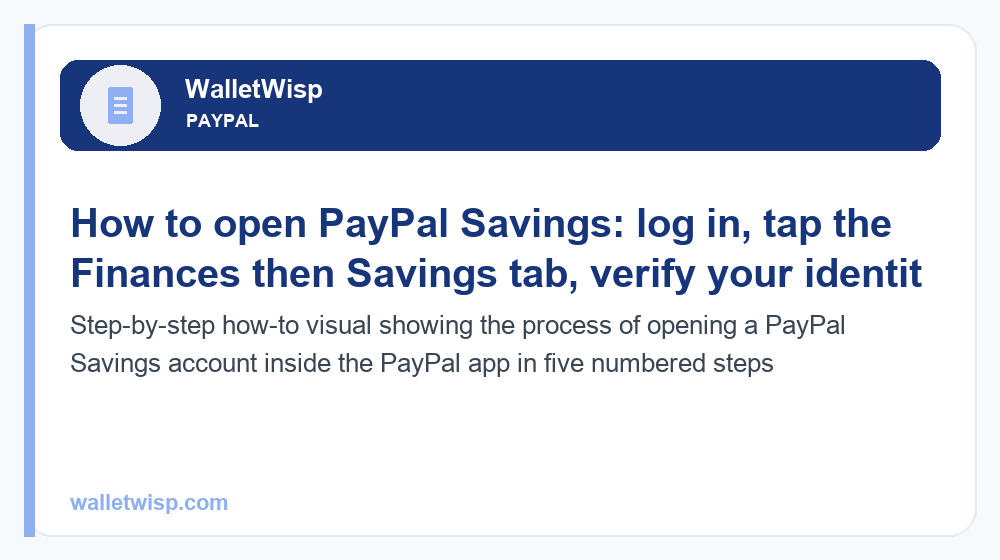
- Log in to PayPal. Use the mobile app or paypal.com with your existing personal account. Business-only users should note that this is a personal-account feature; if you run a company profile, see our guide to the PayPal business account in 2026 for what applies to you.
- Open the Savings section. On the website, click the Finances tab, then the Savings tab. In the app, tap the Accounts (or Wallet/Finances) tab, then Savings.
- Start the application. Select the option to open a savings account. You will be asked to confirm personal details.
- Verify your identity. Because this opens a real bank account at Synchrony, federal law requires identity verification. You will typically confirm your name, address, date of birth, and Social Security number.
- Review and accept the terms. Read the Synchrony Bank deposit account agreement and the rate disclosure, then agree.
- Fund the account. Move money in from your PayPal balance, a linked bank account, or a linked debit card. There is no minimum, so you can start with any amount.
Once open, you will see your savings balance and accrued interest alongside your regular PayPal wallet. You must be at least 18 and a U.S. resident with a valid SSN or ITIN to qualify.
Deposits, withdrawals, and transfer limits
PayPal Savings is designed around instant internal transfers. The key rules to understand are how money gets in, how it gets out, and the caps involved.
Getting money in
You can fund savings from your PayPal balance, a linked bank account, or a linked debit card. Transfers from your PayPal balance are instant. Bank transfers may take one to a few business days to clear, similar to a standard ACH transfer.
Getting money out
Withdrawals from PayPal Savings work in one direction: you move funds back to your PayPal balance, and from there you can spend the money, send it to friends, or transfer it out to a linked bank account. There is no debit card or ATM access attached directly to the savings balance, and you cannot write checks against it. The upside is that internal transfers to your spendable balance are instant and free, so your cash is never truly locked away.
Limits to know
- $250,000 balance cap: PayPal generally limits the savings balance to $250,000, which mirrors the FDIC insurance ceiling for a single depositor.
- Withdrawal frequency: Since the federal Regulation D six-per-month withdrawal cap was relaxed in 2020, PayPal Savings does not impose the old strict limit, but the bank reserves the right to set reasonable limits. In practice, everyday users rarely hit them.
- Standard PayPal sending/transfer limits still apply to money once it lands in your spendable balance and you push it out to a bank.
FDIC insurance and safety
This is where PayPal Savings has a clear advantage over simply leaving cash in your regular PayPal balance. Your everyday PayPal balance is generally not FDIC-insured on its own, but funds in PayPal Savings are deposited at Synchrony Bank and are eligible for FDIC insurance up to $250,000 per depositor, per ownership category.
That means if Synchrony Bank were to fail, your insured savings would be protected by the U.S. government up to the coverage limit. This “pass-through” insurance is why moving idle cash from your spendable balance into PayPal Savings is a smart safety upgrade, not just a way to earn interest. If you hold more than $250,000, spread the excess across separate insured institutions to stay fully covered.
Fees
PayPal Savings itself is refreshingly clean on fees: there is no monthly maintenance fee, no minimum balance fee, and no fee to open or close the account. Moving money between your PayPal balance and savings is free.
The fees to watch are not on the savings account but elsewhere in the PayPal ecosystem. For example, instant transfers of your spendable balance to a debit card or bank account carry a percentage-based fee, while standard bank transfers are free but slower. To avoid surprises when you eventually move money out, review our full breakdown of PayPal fees explained. As long as you use standard (free) ACH transfers to your bank, you can operate PayPal Savings at zero cost.
Pros and cons of PayPal Savings
No account is perfect. Here is an honest look at where PayPal Savings shines and where it falls short in 2026.
Pros
- Competitive variable APY that far outpaces traditional bank savings accounts.
- FDIC insured up to $250,000 through Synchrony Bank.
- No fees and no minimums to open or maintain.
- Instant, free transfers between savings and your spendable PayPal balance.
- Seamless if you already use PayPal for shopping, freelancing, or peer-to-peer payments.
- Automatic savings tools and goals to help you set money aside.
Cons
- Rate is often matched or beaten by top standalone online banks and money-market accounts.
- No debit card or ATM access directly on the savings balance.
- Only one savings account/bucket is available per user.
- Requires a PayPal Balance account, so it is not for people avoiding the PayPal ecosystem.
- Customer service is through PayPal, which some users find slower than dedicated banks.
- Variable rate can drop without much notice.
PayPal Savings vs a standalone HYSA
The central question for most people is whether to keep savings at PayPal or open a dedicated high-yield savings account at an online bank. The right answer depends on how you already manage money. The comparison below highlights the practical differences.
| Factor | PayPal Savings | Typical standalone HYSA |
|---|---|---|
| APY (2026 range) | ~3.30% variable | ~3.5%-4.5% variable (top online banks) |
| Monthly fee | $0 | $0 at most online banks |
| Minimum balance | $0 | $0 at most online banks |
| FDIC insured | Yes, via Synchrony ($250k) | Yes, direct ($250k) |
| Speed to spendable cash | Instant to PayPal balance | 1-3 days ACH to checking |
| Multiple savings buckets | No | Often yes |
| ATM/debit access | No | Sometimes (money market) |
| Best for | Heavy PayPal users | Rate maximizers |
Is PayPal Savings worth it in 2026?
PayPal Savings is worth it if you already receive money through PayPal, shop with it, or run a side hustle that pays out to your balance. In that case, moving idle cash into savings is a no-brainer: you gain FDIC insurance you would not otherwise have on your spendable balance, you earn a solid variable APY, and you pay no fees. The instant transfers make it especially handy as a place to park short-term cash you might spend online.
It is less compelling if your goal is purely to squeeze out the highest possible yield or to build a large, segmented savings system with multiple goals and a linked ATM card. In those cases a dedicated online HYSA usually edges ahead on rate and flexibility. Many savvy savers use both: PayPal Savings for the cash they actively cycle through PayPal, and a separate HYSA for their core emergency fund. Whatever you choose, keep an eye on the variable rate and compare it periodically against the market so your money is always working as hard as it can.
Frequently Asked Questions
What is the current PayPal Savings APY?
As of June 16, 2026, PayPal Savings advertised a 3.30% variable APY. Because it is variable, the rate can rise or fall at any time based on Federal Reserve policy and market conditions, so always confirm the live rate in your PayPal app before depositing.
Is PayPal Savings FDIC insured?
Yes. Deposits in PayPal Savings are held at Synchrony Bank, Member FDIC, and are eligible for FDIC insurance up to $250,000 per depositor. Note that your regular spendable PayPal balance is generally not FDIC-insured on its own, which is one reason to move idle cash into savings.
Who is the bank behind PayPal Savings?
Synchrony Bank provides the banking services and deposit insurance for PayPal Savings. PayPal supplies the app, interface, and instant transfer features, while Synchrony holds the actual deposits under its bank charter.
Are there any fees for PayPal Savings?
No. There is no monthly maintenance fee, no minimum balance requirement, and no fee to open or close the account. Transfers between savings and your PayPal balance are free. Fees may apply elsewhere in PayPal, such as instant transfers to a debit card, so review PayPal’s broader fee schedule if you plan to move money out quickly.
How do I withdraw money from PayPal Savings?
You withdraw by transferring funds from savings back to your spendable PayPal balance, which is instant and free. From there you can spend the money, send it to others, or transfer it out to a linked bank account. There is no debit card or ATM tied directly to the savings balance.
Is there a limit on how much I can keep in PayPal Savings?
PayPal generally caps the savings balance at $250,000, which matches the FDIC insurance limit for a single depositor. If you need to save more than that while staying fully insured, hold the excess at a separate FDIC-insured institution.
Do I need a PayPal account to open PayPal Savings?
Yes. You need a personal PayPal Balance account, because savings deposits and withdrawals move to and from that balance. You must also be at least 18, a U.S. resident, and able to verify your identity with a valid SSN or ITIN.
Is PayPal Savings better than a standalone high-yield savings account?
It depends on your priorities. PayPal Savings is more convenient if you already use PayPal heavily and value instant transfers. A standalone HYSA often offers a slightly higher rate and features like multiple savings buckets or ATM access. Many people use both, keeping PayPal cash in PayPal Savings and their core emergency fund in a dedicated HYSA.