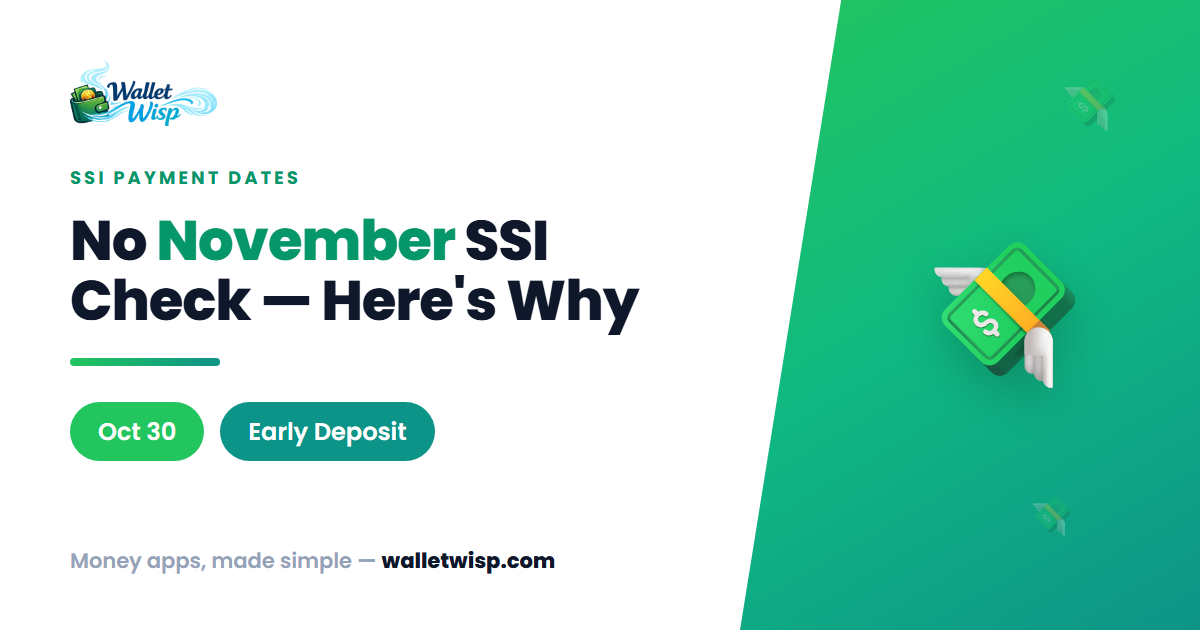
If you receive Supplemental Security Income (SSI), your calendar is about to look strange: you’ll get two SSI deposits in October 2026 and none in November. This isn’t a cut, a delay, or a glitch. Your “November” payment simply arrives early — on Friday, October 30, 2026 — and then the next deposit doesn’t come until December. Here’s exactly why that happens and when the money is likely to show up if you bank with Cash App or Chime.
Why There’s No November SSI Check
The Social Security Administration (SSA) pays SSI on the first of each month. But there’s a long-standing rule: when the 1st lands on a weekend or federal holiday, SSA moves the payment to the business day before.
November 1, 2026 falls on a Sunday. So the payment that would normally arrive November 1 is pushed back to the last business day in October — Friday, October 30. Because that money is dated for November but paid in October, there is no separate deposit during the month of November itself.
That’s why October 2026 has two SSI payments:
- October 1, 2026 — your regular October SSI.
- October 30, 2026 — your November SSI, paid early.
After October 30, your next SSI deposit is Tuesday, December 1, 2026 (December 1 is a weekday, so it pays on its normal date). Nothing is missing — it’s a timing quirk, not a lost check.
SSI Payment Schedule: October 2026 – December 2026
| Benefit month | Deposit date | Why |
|---|---|---|
| October 2026 | Thursday, Oct. 1, 2026 | Normal 1st-of-month date |
| November 2026 | Friday, Oct. 30, 2026 | Nov. 1 is a Sunday → paid prior business day |
| December 2026 | Tuesday, Dec. 1, 2026 | Dec. 1 is a weekday → normal date |
The Budgeting Trap to Watch
The gap between the October 30 deposit and the December 1 deposit is roughly five weeks — longer than a typical month. It’s easy to see the second October deposit as “extra” money, but it isn’t: it’s November’s benefit arriving a day or two ahead of the calendar flip.
Worked example: Say you receive the 2026 federal maximum of $994 as an individual. On October 30 you’ll see $994 land. If you treat it as a bonus and spend it in early November, you’ll have nothing new coming in until December 1 — a 32-day stretch. The safer move is to earmark the October 30 deposit as your November money and spread it across the whole month.
For reference, after the 2.8% cost-of-living adjustment (COLA) for 2026, the federal SSI maximums are:
- Individual: $994 per month (up from $967)
- Couple: $1,491 per month (up from $1,450)
Your actual amount may be lower depending on other income, resources, or state supplements.
When the Early Payment Hits Cash App and Chime
Here’s where people get confused. Apps like Cash App and Chime advertise government benefits “up to two days early.” So does that mean your October 30 payment could land even earlier?
Possibly — but understand how it actually works. SSA sets the official payment date (October 30). The U.S. Treasury sends an electronic payment file to your bank or app ahead of that date. Cash App and Chime can post the money as soon as they receive that file, which is often up to two business days before the official date. They are not giving you an extra benefit; they’re simply crediting an eligible deposit as soon as they’re allowed to.
Because October 30 is itself already an early (pulled-forward) date, an early-pay app may surface the deposit a day or two sooner — potentially Wednesday, October 28 or Thursday, October 29. But this is never guaranteed, and there is no promised posting hour. It depends entirely on when Treasury transmits the file.
Cash App vs. Chime: Early Benefit Deposits at a Glance
| Feature | Cash App | Chime |
|---|---|---|
| Early benefits claim | Up to 2 days early* | Up to 2 days early* |
| Bank partner / routing | Sutton Bank (073923033) | The Bancorp Bank / Stride Bank |
| Deposit notification | In-app alert when funds post | In-app alert when funds post |
| Guaranteed hour? | No | No |
| Guaranteed every month? | No — depends on the Treasury file | No — depends on the Treasury file |
*”Up to two days early” is a ceiling, not a promise. Neither app can force the Treasury to send the file sooner, and neither guarantees it will beat the other in any given month.
How to Set Up Direct Deposit for SSI
If you want your federal benefits routed to Cash App or Chime, use the government’s official channels rather than typing numbers into a random form:
- Find your app’s account number and routing number (in Cash App: tap the Money tab → direct deposit; in Chime: Move Money → direct deposit).
- Update your deposit destination at GoDirect.gov or by calling the Treasury’s Go Direct line at 1-800-333-1795, or through your my Social Security account.
- Confirm the change took effect before a payment date so your money isn’t sent to an old account.
Choosing an early-pay app does not change the official SSA date — it only affects when your bank chooses to release the funds it receives.
Frequently Asked Questions
Did my November SSI payment get canceled?
No. It was paid early on Friday, October 30, 2026, because November 1 is a Sunday. You received November’s benefit — it just arrived before the month began, so nothing posts during November.
Will I get my October 30 deposit even earlier on Cash App or Chime?
Maybe. Both apps can release government deposits up to two business days early, so the funds could appear around October 28–29. But it isn’t guaranteed, and there’s no set time of day. Turn on app notifications so you’re alerted the moment it posts.
When is my next SSI payment after October 30?
Your next deposit is Tuesday, December 1, 2026. That’s a roughly five-week gap, so plan the October 30 money to cover all of November.
Does getting paid early mean I’m getting extra money?
No. Early access only moves when you can see and spend the same payment — it doesn’t add to your benefit. The October 30 deposit is your November check, not a bonus.
The Bottom Line
There’s no November SSI check because November’s payment lands early on Friday, October 30, 2026 — a routine weekend-adjustment, not a problem. If you use Cash App or Chime, the deposit may surface a day or two sooner thanks to early-pay features, but the safest plan is to treat that money as November’s budget and stretch it to December 1. Set up a notification, mark your calendar, and you’ll never be caught off guard by the “missing” November deposit again.
WalletWisp is an informational resource and does not provide financial advice. Payment dates and amounts follow official Social Security Administration rules; verify specifics with SSA or your financial app.