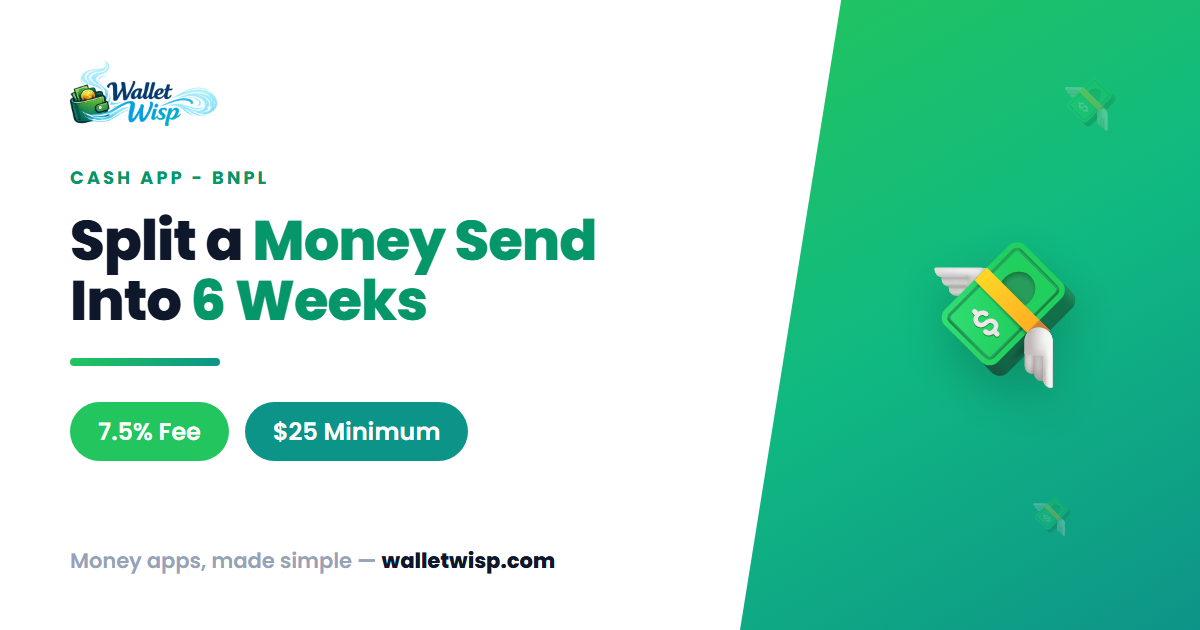
Cash App just did something no major U.S. payments app had done before: it let you borrow against money you’ve already sent to another person. The new feature, called Pay-Over-Time for P2P, launched on April 2, 2026, and turns an ordinary peer-to-peer send — splitting rent with a roommate, paying back a friend, tipping a gig worker — into a short-term installment plan with a flat 7.5% fee and a six-week repayment window.
It’s effectively “buy now, pay later” for sending money to humans instead of merchants. Below, we break down exactly how it works, what it costs in real dollars, and whether it’s a smart move or an expensive habit.
What Cash App Pay-Over-Time for P2P Actually Is
Normally, when you send money on Cash App, it leaves your balance immediately. Pay-Over-Time changes that. Instead of the full amount coming out at once, Cash App fronts the money to your recipient (or back to your own balance) and you repay it in weekly installments over up to six weeks, plus a one-time 7.5% fee.
There are two ways to use it:
- Prospective (before you send): When composing a new P2P payment of $25 or more, you can choose to split it into installments rather than paying all at once.
- Retroactive (after you send): If you already sent an eligible payment of $25+ within the last 30 days, you can convert it after the fact — Cash App instantly returns the amount to your balance, and you repay it over time.
Behind the scenes, this runs on Cash App’s existing Afterpay infrastructure. The loans are issued by First Electronic Bank and serviced by Square Capital, LLC — the same lending engine Cash App already uses for installment purchases on debit cards. Availability varies by state, and your personal limit depends on the original transaction size and an individual eligibility assessment.
The Rules at a Glance
| Feature | Detail |
|---|---|
| Fee | Flat 7.5% of the amount (one time, upfront) |
| Minimum send | $25 |
| Maximum | Varies by user / eligibility assessment |
| Term | Up to six weeks |
| Repayment | Weekly installments, or pay in full by the due date |
| Interest | None — no compounding, no revolving balance |
| Eligibility window | Sends of $25+ made within the last 30 days |
| Lender | Afterpay (First Electronic Bank, serviced by Square Capital) |
| Launched | April 2, 2026 |
The key selling point is predictability: there’s no compounding interest and no revolving balance. You know the total cost the moment you opt in — the 7.5% is the whole fee, not an ongoing rate.
What It Costs: Worked Examples
The 7.5% is a flat fee on the amount you’re splitting. Here’s what that looks like in practice across a six-week plan:
| Amount sent | 7.5% fee | Total repaid | Roughly per week (6 wks) |
|---|---|---|---|
| $25 | $1.88 | $26.88 | ~$4.48 |
| $100 | $7.50 | $107.50 | ~$17.92 |
| $300 | $22.50 | $322.50 | ~$53.75 |
| $500 | $37.50 | $537.50 | ~$89.58 |
Example: You split $300 rent with a roommate but your paycheck is a week out. You send the full $300 now using Pay-Over-Time. Your roommate gets paid immediately. You repay about $53.75 a week for six weeks, for a total of $322.50 — $22.50 more than if you’d paid cash.
How the 7.5% compares to a real interest rate
7.5% sounds small next to a credit card’s 20%+ APR — but that card rate is annual, and this fee covers only about six weeks. If you annualize the cost of a six-week plan, 7.5% works out to an effective rate north of 60% APR. For a one-off cash-flow gap it can be worth it; as a recurring habit, it’s expensive money.
How to Use It, Step by Step
- Open Cash App and start a payment to a person, or open a recent eligible send from the last 30 days.
- Look for the Pay Over Time option (shown only if you and the transaction are eligible).
- Review the plan: the 7.5% fee, your weekly amount, and the payment dates.
- Confirm. The recipient keeps their money (or it returns to your balance on a retroactive conversion).
- Repay weekly from your linked funding source, or pay the balance off early at no extra cost.
Is It Worth It?
Pay-Over-Time makes the most sense for a genuine, short-term timing gap — your money is coming in a week or two, but a bill or shared expense can’t wait. In that case, 7.5% to avoid a late fee, an overdraft charge, or an awkward “I’ll get you next week” can be a reasonable trade.
It’s probably worth it when:
- You have variable income (gig work, multiple jobs) and need to smooth one bill.
- The alternative is a $35 overdraft fee or a missed payment on something that reports to credit.
- You can realistically clear it within the six weeks.
Think twice when:
- You’d be using it just to send money you don’t actually have.
- You’re stacking multiple plans at once — the weekly payments add up fast.
- The purchase is a want, not a need. A 7.5% surcharge on everyday sends erodes your budget quickly.
The honest read: this is a convenience product that monetizes short-term cash crunches. Used once in a while for a real emergency, it’s fine. Used routinely to live beyond your balance, it quietly turns friend-to-friend payments into a chain of small loans.
Frequently Asked Questions
Does Cash App Pay-Over-Time charge interest or just the 7.5% fee?
There’s no compounding interest and no revolving balance. The cost is the single flat 7.5% fee charged upfront. For a $100 send, that’s $7.50 — your total repayment is $107.50 regardless of whether you pay weekly or in one lump sum by the due date.
What’s the minimum amount I can split?
The transfer must be at least $25. There’s an upper limit too, but it varies by user based on Cash App’s eligibility assessment and the size of the original transaction. The feature only appears if both you and the transaction qualify, and availability depends on your state.
Can I convert a payment I already sent?
Yes. Eligible sends of $25 or more made within the last 30 days can be converted retroactively. Cash App returns that amount to your balance and you repay it over the six-week term — handy if you sent money and your cash flow tightened afterward.
Does using it affect my credit score?
Cash App markets the product around predictable, no-interest installments rather than credit building, and it runs on the Afterpay lending system. Cash App hasn’t published full details on credit reporting or late fees for this specific feature, so check the plan terms shown in-app before you confirm, and don’t assume missed payments are consequence-free.
The Bottom Line
Cash App’s Pay-Over-Time for P2P is a first-of-its-kind way to split a money send into six weekly payments for a flat 7.5% fee, with a $25 minimum and no compounding interest. For a real, short-lived cash gap it can beat an overdraft or a late fee. But that 7.5% annualizes into a steep effective rate, so treat it as an occasional bridge — not a way to spend money you don’t have yet. Always review the exact fee, weekly amount, and dates in the app before you tap confirm.
WalletWisp is informational and not financial advice. Verify current fees and terms directly in the Cash App before making a decision.