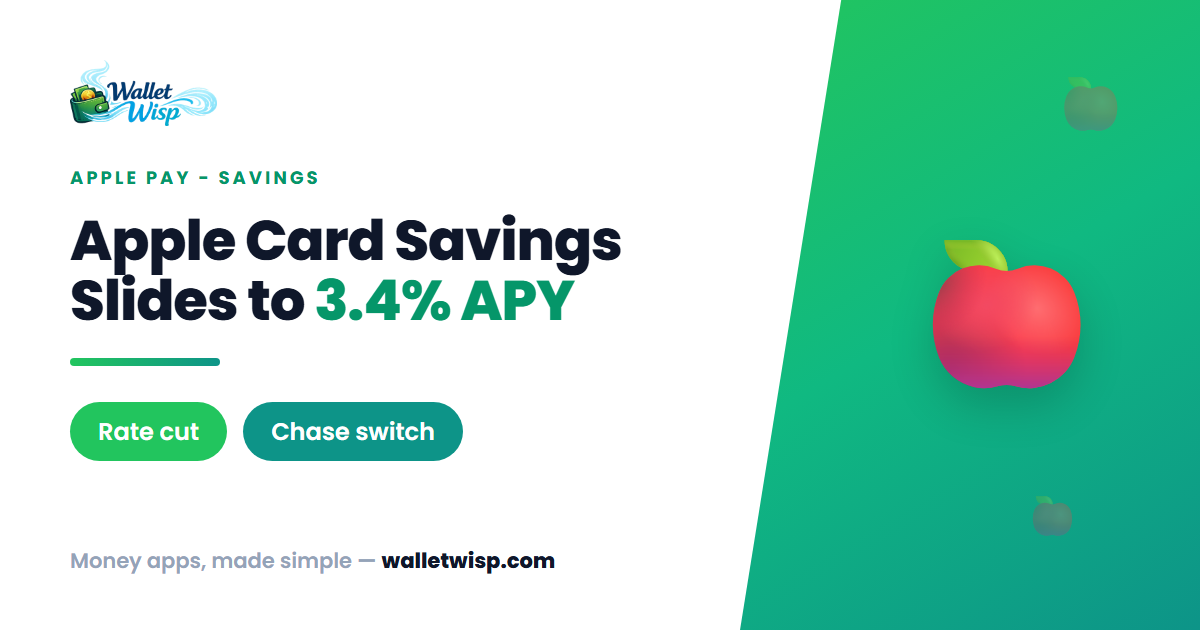
If you opened your Apple Card Savings account expecting a set-it-and-forget-it 4%-plus return, the last two years have probably felt like a slow leak. As of June 4, 2026, the annual percentage yield (APY) sits at 3.40% — a new all-time low for the account and the second cut of 2026. On top of that, the account is changing hands: JPMorgan Chase is taking over the entire Apple Card program from Goldman Sachs. Here’s a plain-English breakdown of why your yield keeps shrinking and what the issuer switch actually means for your balance.
The short answer: rates fall, and Apple’s partner is heading for the exit
Two things are happening at once. First, high-yield savings rates across the industry have drifted down from their 2023–2024 peaks. Second, Goldman Sachs — the bank that has issued Apple Card and run Apple Card Savings since launch — is winding down its consumer-banking business and handing the program to JPMorgan Chase. A partner that’s on its way out has little incentive to compete aggressively for new deposits, which helps explain why Apple’s cuts have outpaced what the broader market would predict.
The APY timeline: from 4.15% to 3.40%
Apple Card Savings launched in April 2023 with a headline-grabbing 4.15% APY and climbed higher through 2024 as interest rates peaked. Since then it’s been a steady march downward:
| Date | APY | Notes |
|---|---|---|
| April 2023 | 4.15% | Launch rate |
| 2024 peak | ~4.40% | Rate raised as Fed held high |
| May 2025 | 3.65% | One of several 2025 cuts |
| April 23, 2026 | 3.50% | First 2026 cut, then a record low |
| June 4, 2026 | 3.40% | Current rate — newest record low |
Here’s the detail that frustrates a lot of account holders: the June 2026 cut to 3.40% came even though the Federal Reserve had not cut its benchmark rate at any point in 2026. Normally, savings yields drop because the Fed lowered rates. This one didn’t have that cover — a strong hint that the Goldman-to-Chase transition, not monetary policy, is shaping how hard Goldman is willing to fight for your deposits.
What the JPMorgan Chase takeover means for you
On January 7, 2026, JPMorgan Chase confirmed a deal to become the Apple Card issuer, ending Goldman’s roughly six-year run. A few numbers frame the scale: Goldman is offloading about $20 billion in outstanding Apple Card balances at a discount of more than $1 billion, and Chase booked a $2.2 billion provision for potential credit losses as part of the handoff. The deal is expected to take roughly 24 months to fully close and is subject to regulatory approval.
The good news for everyday users is that this is a back-office change, not a rip-and-replace. Here’s what Apple and Chase have signaled:
- Your card keeps working. Apple Card continues to run on the Mastercard network, and existing perks (Daily Cash, no annual fee) are expected to carry over.
- Your Savings balance stays put during the transition. You don’t need to move money or reopen anything today. Balances migrate to Chase’s platform gradually over the two-year window.
- Terms and the APY can still change. The rate has always been variable, and a new issuer sets its own deposit strategy. Chase runs its own savings products, so the eventual rate structure could look different once the migration completes.
- Watch for official notifications. Any real account change will come through the Wallet app and formal disclosures — not a text or email with a login link. Treat unexpected “verify your Apple Card” messages as likely phishing.
A worked example: what 3.40% actually earns you
Rate cuts sound alarming, but it helps to see the real dollars. Say you keep $10,000 in Apple Card Savings for a full year:
- At 4.40% (2024 peak): roughly $440 in interest.
- At 3.65% (May 2025): roughly $365.
- At 3.40% (today): roughly $340.
So the drop from peak to now costs about $100 a year on a $10,000 balance — meaningful, but not catastrophic. On a $2,000 balance, the same slide is closer to $20 a year. Whether that’s worth chasing a higher-paying account depends on how much you keep parked there.
Should you move your money?
At 3.40%, Apple Card Savings is no longer a market leader, but it isn’t a bad account either — it still charges no fees, requires no minimum balance, and pays interest daily. The convenience of Daily Cash flowing straight in remains a genuine perk. That said, several online banks were advertising higher APYs in the 3.7%–4.2% range in 2026. If you’re optimizing for yield and have a large balance, comparison-shopping makes sense. If you value the tight Apple Wallet integration and keep a modest balance, staying put through the Chase transition is perfectly reasonable.
One practical note: Apple Card Savings deposits are FDIC-insured up to the standard $250,000 limit through the issuing bank, so your principal is protected regardless of which bank ultimately runs the program.
Frequently Asked Questions
Why did my Apple Card Savings APY drop if the Fed didn’t cut rates?
The June 2026 cut to 3.40% happened without a Fed rate cut behind it. Analysts point to the Goldman-to-Chase transition: with Goldman exiting consumer banking, it has less reason to offer a top-tier rate to attract new deposits. Broader industry softening plays a role too, but the timing suggests the issuer switch is a major factor.
Do I need to do anything because of the JPMorgan Chase takeover?
Not right now. The migration unfolds over about two years and is designed to be seamless. Keep using your card normally, and watch for official notifications inside the Wallet app or formal mailed disclosures. Don’t act on unsolicited texts or emails asking you to “confirm” your account.
Is my money still safe during the transition?
Yes. Apple Card Savings balances are FDIC-insured up to $250,000 per depositor, and the transfer of balances to Chase happens under regulatory oversight. Your principal isn’t at risk because of the issuer change.
Will the APY go back up after Chase takes over?
No one can promise that. The rate is variable and set by the issuer’s deposit strategy plus the broader rate environment. Chase could reprice the account higher or lower once the migration completes. Treat any future rate as subject to change and re-check it periodically in the Wallet app.
The bottom line
The 3.40% APY is the newest low in a long, steady decline, and the unusual part — a cut with no Fed move behind it — points squarely at Goldman’s exit and the handoff to JPMorgan Chase. For most users, there’s nothing urgent to do: your card works, your balance is insured, and the transition is meant to be invisible. If you’re sitting on a large balance and want maximum yield, it’s worth comparing rates elsewhere. Otherwise, keep an eye on official Wallet notifications as Chase phases in over the next couple of years.
WalletWisp is informational only and not financial advice. Verify current rates and terms in the Apple Wallet app before making decisions.