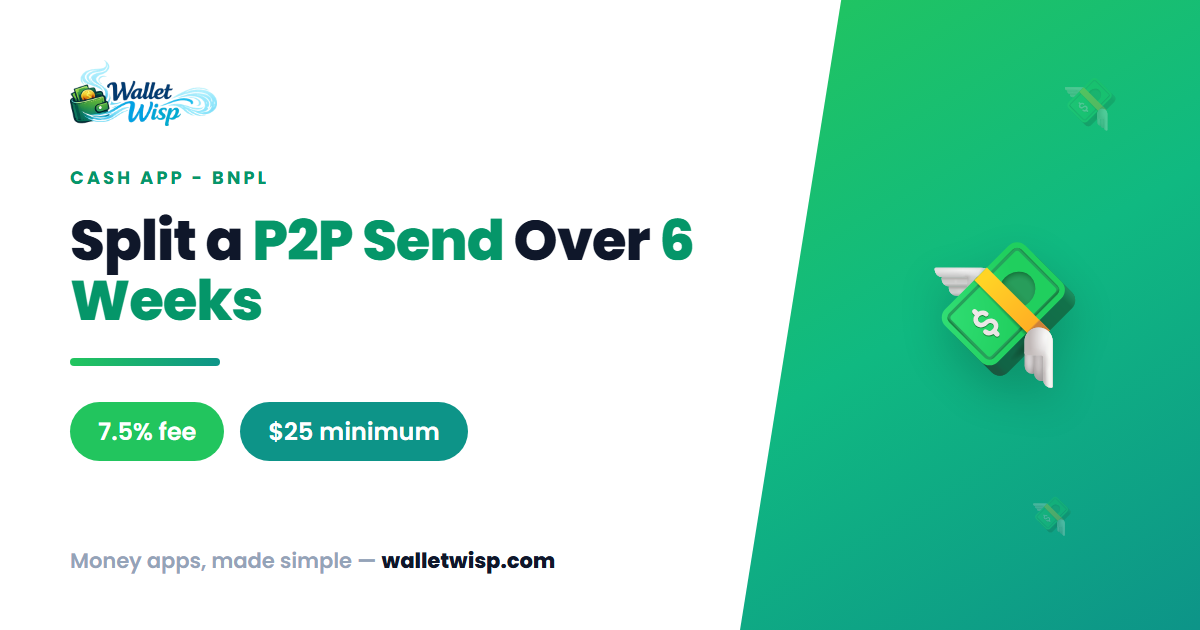
On April 2, 2026, Cash App did something no major U.S. payments app had done before: it let people pay over time on ordinary peer-to-peer (P2P) sends — the everyday money you send friends, roommates, and family. Instead of only splitting a store purchase, you can now take a send you already made and stretch the cost across up to six weeks for a flat upfront fee.
If you’ve ever sent someone $200 for rent and then watched your balance get uncomfortably thin before payday, this feature is aimed squarely at you. Below is a plain-English breakdown of how it works, what it actually costs, and when it does — and doesn’t — make sense.
What Cash App’s Pay Over Time Actually Is
Cash App’s pay-over-time for P2P is a short-term installment plan built on the company’s existing lending products (the same family that powers Afterpay). The twist is that it applies retroactively to a person-to-person payment you’ve already sent.
Here’s the key idea: your recipient always gets the full amount immediately, exactly like a normal send. The “pay over time” part only affects you, the sender. Cash App effectively fronts you the money you already spent, drops it back into your balance, and you repay it — plus a flat 7.5% fee — over the next few weeks.
Owen Jennings, Head of Business at Block (Cash App’s parent company), framed it as “delivering flexibility at every touchpoint where customers are sending and spending their money.” The company is pitching it at people with uneven cash flow — gig workers, freelancers, and anyone whose bills don’t line up neatly with payday.
The Rules at a Glance
| Detail | How it works |
|---|---|
| Minimum send | $25 or more |
| Time window | The send must have happened within the last 30 days |
| Fee | Flat 7.5% upfront (no compounding interest) |
| Repayment term | Weekly installments over up to 6 weeks, or one lump sum at the due date |
| Recipient | Gets the full amount instantly — unaffected |
| Credit check | No traditional credit pull; eligibility is assessed per transaction |
| Availability | Varies by state and by individual account |
| Structure | Non-revolving — default on one and you can’t open another |
How the 7.5% Fee Works — With Real Numbers
The pricing is refreshingly simple compared to credit-card APRs. It’s a single, flat 7.5% of the amount you convert, charged upfront. There’s no interest that compounds over time, and Cash App has not advertised a separate late fee in its announcement.
Borrow $100 and you repay $107.50, full stop. Here’s how that scales:
| Amount converted | 7.5% fee | Total you repay | Rough weekly payment (6 weeks) |
|---|---|---|---|
| $25 | $1.88 | $26.88 | ~$4.48 |
| $100 | $7.50 | $107.50 | ~$17.92 |
| $250 | $18.75 | $268.75 | ~$44.79 |
| $500 | $37.50 | $537.50 | ~$89.58 |
Worked example: Say you send your roommate $300 for utilities on the 3rd of the month, but rent also hit and you’re short. Within 30 days you convert that $300 send into a pay-over-time plan. The fee is $22.50, so you owe $322.50. Choose weekly installments and you’ll pay roughly $53.75 a week for six weeks. Your roommate never knows the difference — they got their $300 the moment you sent it.
Is 7.5% a good deal?
It depends entirely on the term. A flat 7.5% over six weeks is not the same as a 7.5% annual rate. Because you’re only borrowing for about six weeks, the annualized cost is far higher — mathematically closer to a mid-double-digit APR. That’s still typically cheaper and more predictable than a payday loan or carrying a maxed-out credit card, but it is more expensive than it looks at a glance. Treat the 7.5% as the price of a one-time bridge, not a bargain to lean on repeatedly.
How to Use It, Step by Step
- Make (or locate) a P2P send of $25 or more from the last 30 days.
- Open the payment in your Cash App activity and look for a pay-over-time or installment option (shown only if you and the transaction are eligible).
- Review the amount you can convert, the flat 7.5% fee, and the total repayment.
- Pick your schedule: weekly payments across up to six weeks, or a single lump sum on the due date.
- Confirm. The converted amount lands back in your Cash App balance, and your repayment schedule begins.
Note: Not every send qualifies. Cash App evaluates each transaction against its “responsible lending criteria,” and how much you can convert depends on the original amount and your account history. Eligibility and the exact conversion limit can differ from one payment to the next.
The Safeguards — and the Risks
Cash App built in a notable guardrail: the product is non-revolving. In Block’s words, “if you don’t pay back a loan, then you can’t take out another loan.” That design is meant to stop the debt spirals that critics associate with buy-now-pay-later (BNPL) products.
Still, applying BNPL to casual money sends is new territory, and consumer advocates have flagged general concerns: normalizing borrowing for everyday transfers, the risk of stacking multiple plans, and reliance that can signal deeper financial strain. The healthiest way to use it is as an occasional cash-flow bridge — not a default setting for money you send friends.
Frequently Asked Questions
Does the person I sent money to pay anything or wait for their funds?
No. Your recipient receives the full amount instantly, just like any normal Cash App send. The fee and the repayment schedule apply only to you, the sender.
Can I convert any payment I’ve already sent?
Only sends of $25 or more made within the last 30 days are potentially eligible, and only if Cash App’s per-transaction assessment approves it in your state. You’ll see the option on the payment itself if it qualifies; if you don’t see it, that send isn’t eligible.
Will using this hurt my credit score?
Cash App has not described a traditional hard credit check for the feature — eligibility is based on its own responsible-lending criteria rather than a standard credit limit. As with any BNPL product, though, reporting practices can evolve, so read the plan terms shown before you confirm, and understand that missing payments can carry consequences.
What happens if I don’t repay on time?
The plan is non-revolving, so a default blocks you from taking out another one. Cash App’s launch materials emphasize no compounding interest and don’t advertise a late fee, but you should always review the exact terms presented at confirmation, since specifics can vary by state and account.
The Bottom Line
Cash App’s pay-over-time for P2P is a genuinely new tool: a way to retroactively spread the cost of a send you’ve already made, for a clear, flat 7.5% fee and up to six weeks to repay — with your recipient never affected. Used once in a while to smooth a rough week, it’s a transparent and predictable bridge. Used habitually, that flat fee adds up fast on an annualized basis. Know the number ($107.50 back for every $100), keep it occasional, and you’ll get the flexibility without the trap.
WalletWisp is an informational resource, not financial advice. Verify current terms, fees, and eligibility directly with Cash App before making decisions.